







How to Summit a Mountain
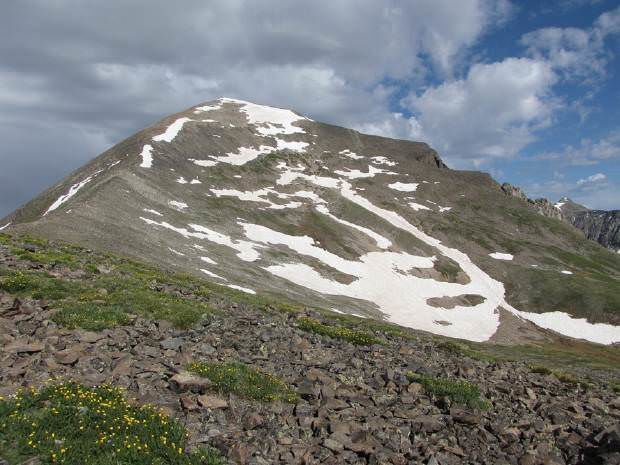
During one visit with avid runner and hiker Sam Bremner, he was two peaks short of climbing all 54 of Colorado’s 14,000-foot mountains. He chickened out on the airy “catwalk” ridge to 14,083-foot Mount Eolus and couldn’t handle the ropes on the aptly named “knife-edge” ridge on 14,130-foot Capitol Peak.
Of course, ropes can be tricky when you have no thumbs, and Sam Bremner, better known as Sam the Wolfdog, is a husky mix.
“He’s a pretty good climber though,” said his owner, Steve Bremner, who has climbed all of the state’s fourteeners. “When we get to a tough section I just say ‘up’ and he finds a way.”
Fortunately, for dogs and humans, most of Colorado’s fourteeners don’t require tail-tucking technical moves. The summit routes are long, hard and rocky — and the altitude can feel like a jackhammer on your head — but with the right preparation, most hikers can complete them. And every year hundreds of thousands do.
Coloradans and visitors love to trudge up to the stoney crests to drink in the endless views and thin, alpine air. It’s a Colorado thing.
Where else can you wake up in your own city/suburban bed, hop in the car at dawn and still get to your choice of 14,000-foot peaks by noon? Here, on summer weekends, the most accessible summits bristle with crowds of hikers. The scene is less “remote summit” and more “street fair,” with kids tossing corn chips into their mouths, tourists snapping pictures, bald guys smoking cigars and yuppies pacing the talus while cradling cell phones and saying, “Guess where I’m calling from?”
Climbing a fourteener has become a right of passage of sorts for Coloradans. The Colorado Fourteeners Initiative, a nonprofit that builds sustainable trails, estimates the state’s 54 highest peaks (is it really 54?) see 600,000 visitors a year. Far fewer choose to climb them all. Every season, it seems. someone tries to set a speed record for bagging all 54. Most people take more than a decade.
Tom Beckwith, who keeps stats for the Colorado Mountain Club, says many save the most difficult peaks for last.
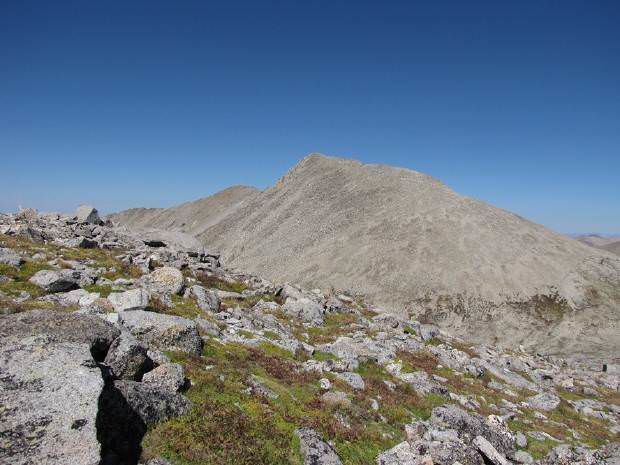
Tabeguache Peak, 14,155 feet. Courtesy of Josh Friesema

Tabeguache Peak, 14,155 feet. Courtesy of Josh Friesema
“Pyramid, El Diente, Little Bear — peaks that are a little more demanding,” he said. “But most of the peaks aren’t like that. They’re relatively easy walk-ups. Even Mount Elbert, the highest one. They’re long, but not technically difficult.”
Still he said, “Even on the easy ones, it’s not the suburbs. It’s wilderness out there and you need to be prepared.”
Prepared for what? Altitude, for one thing. A breath of air on a fourteener has only 60 percent of the oxygen of a breath at sea level. Even a slow walk can leave a hiker winded, with a pounding headache.
“I tell people who want to climb a fourteener to first hike a lower mountain and see how they feel at 11,000 or 12,000 feet, then work their way up,” said Julie Beckwith, director of member services for the Colorado Mountain Club. Other than that, she said, “buy a guide book. If you’re in shape and you have the book, you can handle it.”
Hikers also must worry about weather, said T. J. Rapoport, director of the Colorado Fourteeners Initiative. “The beauty of Colorado in the summer is that the weather is like clockwork. You know it will probably be sunny in the morning. The lightning will come by one or noon, and you want to be done by then.”
The frustrating thing, he said, is how often people ignore this simple pattern. “You get a late start . . . that can be really sketchy,” he said. “You get stuck in a storm and you have to scramble to get down.”
Several people are struck by lightning in the high country every year. Almost as bad, from Rapoport’s perspective, is that people fleeing lightning leave the sustainable trails his organization builds and traipse cross-country, damaging delicate tundra that can take decades to regenerate. “These peaks get more and more use every year. The biggest thing people can do to take care of them is stay on the trail, even if it’s really muddy,” Rapoport said.
Weather and altitude warnings usually are only the first of many warning beginning climbers receive.
Take lots of water and make sure to drink often, they’re told. Pack enough clothing to survive a freak August snowstorm. And watch for loose rock (it kills climbers in Colorado). All the warnings can be intimidating, and should be taken seriously, but most are simple and easy to follow.
Climbing the fourteeners can take hikers to remote spots in the state they might never otherwise see — past hidden alpine lakes and roaring waterfalls, and up along sculpted ridges with views stretching 100 miles. The struggle to the summit becomes addictive. Many people who complete the fourteeners move on to climb the highest thirteeners. That’s just what Bremner is doing.
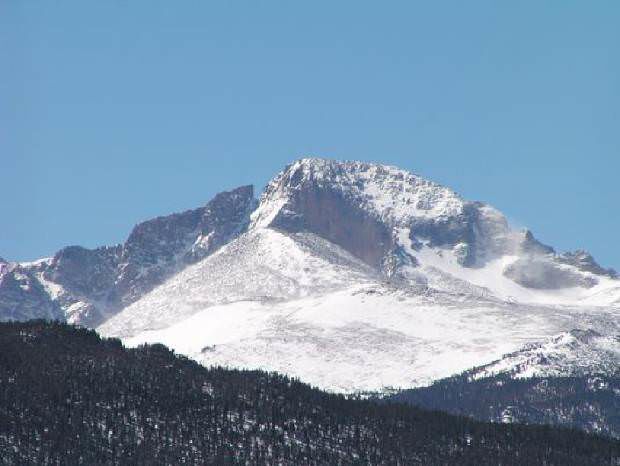
Longs Peak, 14,259 feet. Courtesy of Josh Friesema

Longs Peak, 14,259 feet. Courtesy of Josh Friesema
FOURTEENERS GEOLOGY
Why does Colorado have so many tall mountains that are relatively the same height (54 peaks over 14,000 feet) but not a single one above 15,000, or even 14,500?
“The answer is we don’t have a real good answer,” said Jack Reed, geologist emeritus for the U.S. Geological Survey. This much is clear, he said. Mountains form when the amount an area rises exceeds the amount it erodes. Most high mountains form either through movement of the Earth’s crust along plate boundaries or volcanic eruptions. The Colorado Rockies were formed by neither.
“What we seem to see instead is some sort of crustal process that has elevated the whole region the same amount,” said Reed. The area that is now Colorado was characterized by low, rolling hills 5 million years ago. Then the whole cluster of hills started to rise in unison, like people in a crowded elevator.
As the hills rose, erosion tore valleys and canyons in the rolling surface. Only the toughest and most quickly rising rocks could withstand the natural weathering forces. Today, these areas make up the state’s highest peaks. Since they were close in height when they started, and all rose about an equal distance, they are still relatively the same height. And they may still be going up, Reed said.
“They may be only rising a millimeter a year, which would be too small for us to measure,” he said. “But a millimeter a year over 1 million years would buy you a kilometer. That’s a lot of mountain.”
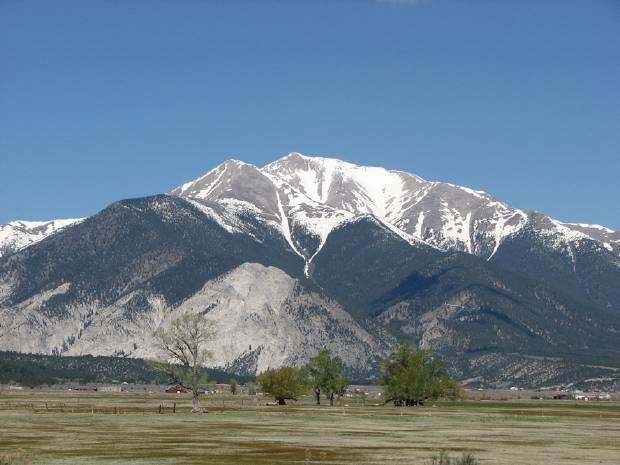
Mount Princeton, 14,196 feet. Courtesy of Josh Friesema

Mount Princeton, 14,196 feet. Courtesy of Josh Friesema
A GUIDE TO GUIDES
Colorado mountain guides are referred to by the author’s name. If someone mentions the Roach map to Pikes Peak, it’s not a map showing where the bugs are, it’s Gerry Roach’s guide to the mountain. Here’s a breakdown of the most popular. + “Colorado’s Fourteeners: From Hikes to Climbs” by Gerry Roach The most popular and up-to-date of Colorado’s fourteener guides, Roach pairs detailed maps with consistent, accurate directions, and throws in helpful weather tips and hidden philosophical nuggets, known as “Roachisms,” to break up the cut-and-dry text. + “Dawson’s Guide to Colorado’s Fourteeners,” Volumes 1 and 2, by Lou Dawson. Dawson offers complete, accurate descriptions of multiple routes on each peak, with good photos and maps. Much of the information focuses on spring skiing and snow climbing routes best enjoyed by more experienced climbers. Anyone only interested in summer climbs can stick with the cheaper, one-volume Roach guide. + “Guide to the Colorado Mountains,” by Robert Ormes The first mountain guide for the state, originally published in 1952, is kept alive by updates by the Colorado Mountain Club, but still retains Ormes’ poetically vague descriptions. Some fourteeners get no more than a sentence or two of directions, because, Ormes claimed, if you needed more, you had no business climbing the peak. It’s still a great resource for climbers who want a guide that leaves them plenty of adventure. + “A Climbing Guide to Colorado’s Fourteeners,” by Walter Borneman and Lyndon Lampert The oldest, and least-used of the fourteener guides, this book is not as reader-friendly as other guides, but has enjoyable historical information about many peaks. Available used from online book sellers.
PLAN AHEAD
The early bird gets the summit. Storms hit the Colorado Rockies almost every afternoon in summer, dishing out bone-chilling rain, hail and potentially deadly lightning. The cardinal rule of climbing in the state, therefore, is to get a pre-dawn “alpine start” and reach the summit by noon at the latest to avoid bad weather. When planning how long it will take to reach the summit of a fourteener, figure you’ll move at 1 mph – or less – above treeline.
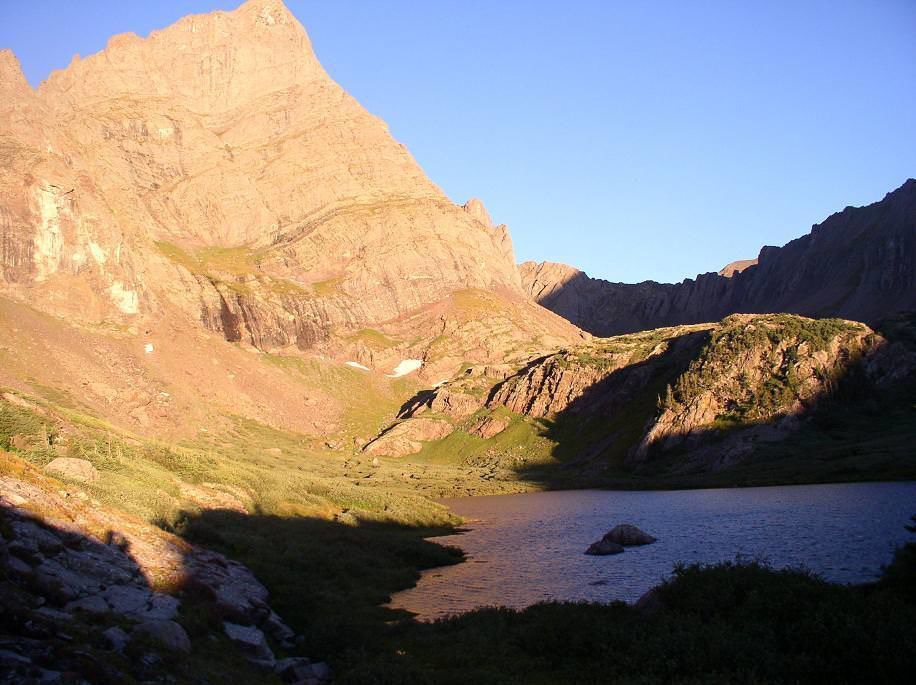
Crestone Needle (14,203 feet) towers over South Colony Basin in the Sangre de Cristo Mountains.

Crestone Needle (14,203 feet) towers over South Colony Basin in the Sangre de Cristo Mountains.
THE PEAK-BAGGERS PACKING LIST
EASY STARTS
Not all fourteeners are created equal. Many are exposed rock scrambles, but these seven peaks are just a stiff walk. Anyone willing to sweat can reach the top.
AIR UP THERE
The atmosphere at sea level is 21 percent oxygen. At 14,000 feet it still is 21 percent oxygen. So why is it so hard to breathe up there? Because the atmospheric pressure is only 60 percent of sea level, so each breath has only two-thirds as many oxygen molecules.
PEAK SEASON
What’s the climbing season for Colorado’s highest peaks? True aficionados are quick to say year-round, but for those who want snow-free hiking, the common wisdom is July through mid-September. Of course, it still snows during summer, so be prepared.
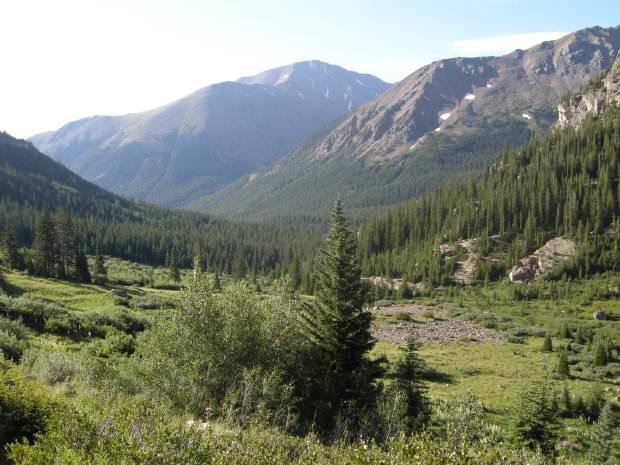
Mount Massive, 14,429 feet. Courtesy of Josh Friesema

Mount Massive, 14,429 feet. Courtesy of Josh Friesema
TOP 10 WAYS TO NAME A PEAK
What do we name our highest peaks after?
A hiker’s guide
I climbed my first fourteener at age 34. It wasn’t planned and I never expected to get to the top. At the summit I found victory — and a new passion. Since that day — and six peaks later — I am more prepared. This is what I’ve come to learn: