




As Pikes Peak’s South Slope Evolves, Caretaker’s Task Remains the Same
DOUGAL BROWNLIE
On the way to visit the man who lives on Pikes Peak’s secluded South Slope, his boss offers a warning.
“Beau is a super nice guy. A super, super nice guy. But you know, people don’t live up there because they’re extroverts. They like the peace and quiet,” says Andy Funchess, the Colorado Springs Utilities operations manager driving the bumpy dirt road through dense aspen groves.
Before Beau Brown became caretaker of the mountain’s chain of reservoirs – adjusting valves to manage flows to the city’s kitchens and bathrooms – the position was held by a “grumpy, kind of rough” man, not much of a people person, Funchess recalls.
That man left two years ago, not long after the public was allowed into the lush basin for the first time in a century. Utilities signed an agreement that made real the dreams of fishermen, hikers and mountain bikers.
They’ll apply for permits to park in the South Slope Recreation Area during summer weekends, when the fishing waters and trails are open. The city will grant spots to 20 vehicles – up from 16 first allowed in 2015. Colorado Springs Parks, Recreation and Cultural Services expects the area will be more popular than ever.
And here beneath peaks called Almagre and Rosa, on a green hillside where his little blue house sits, Beau Brown will look out at the bustle, surrounded by the songbirds that flutter around his feeders.
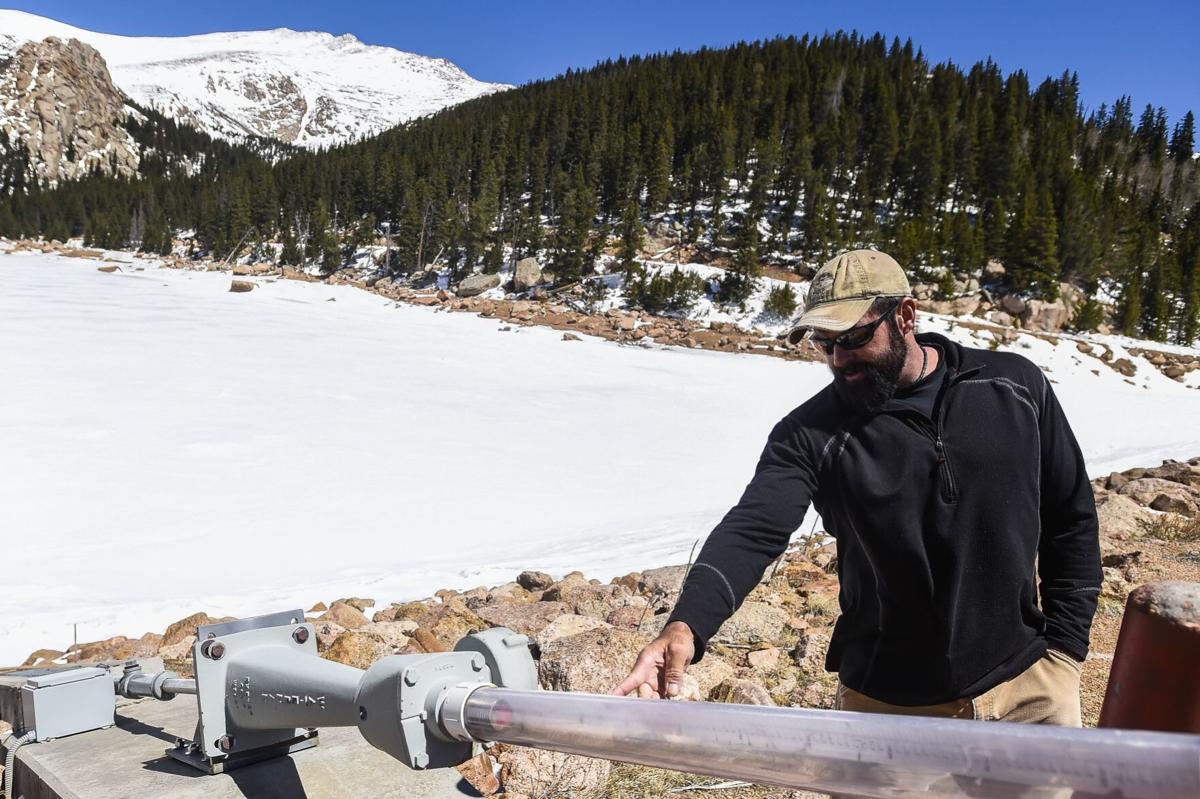
The road leads to a gate with a sign: “THIS IS YOUR DRINKING WATER” it reads, asking for respect. Brown, 44, emerges with a thin smile through a thick, black beard.
On the drive in, Funchess reflected on the difficulty Utilities has filling its four caretaker positions – especially this one, the most remote. “It takes a serious mountain man,” he said.
And Brown looks the part. He is 6 feet, 3 inches tall with a Marine’s build, fit from his former life as a personal trainer and current life as, well, a mountain man, trekking this rugged terrain above tree line to check on some of his seven reservoirs.
State the obvious – “This place is beautiful!” – and he says “thank you,” as if the land is his own. He chuckles at himself. “I’m kinda proud, you know. I’m kinda protective of it.”
Caretaker lives simply
Brown first was here in 1991, an environmental biology student working the summer for Utilities. He grew up in Cascade, the son of a U.S. Forest Service ranger exploring some of Pikes Peak’s most hidden quadrants.
“I’m not much for trails,” Brown says. “I’m more of, I guess you’d call it, bush bashing. I kinda wander, just kinda go.”
But South Slope was like nothing he’d experienced. “It’s just so pristine,” he says beside McReynolds Reservoir, named for the 50-year caretaker who started in 1909. Around the house, wooden shacks and stables from that era lean and crumble.
“If you find litter on the ground, it’s like a 100-year-old thing,” Brown says. “It’s kinda like going back in time. It’s the same as it’s been forever.”
But things are changing. Modernity has come in the shape of picnic tables and restrooms. A “NO TRESPASSING” sign sits in a shed, in the contorted, bullet-riddled state in which Brown found it.
The long argument over public access has ended, but Utilities brass still worry about potential ramifications.
“More and more people want to get farther up in the hills, into these places they’ve never been, and there’s a risk there,” says Funchess, looking at a pine-covered slope prime for a wildfire that could spread to the reservoirs. “All it takes is a couple of nutheads to mess something up for everybody.”
Enthusiasts remain split on access. Some believe the limit enhances the daily $15 experience. Says David Leinweber, owner of fishing retailer Angler’s Covey: “To plan a day and make the commitment to drive all the way over there and there’s 100 people, that wouldn’t be good.”
Others point to the fact this is public land. To develop it thus far, the city has paid nearly $750,000, says Jon Carlson, South Slope’s supervisor with city parks.
“After sinking hundreds of thousands of tax dollars into that area, is this the best way it should be managed?” asks Paul Mead, an advocate with Friends of the Peak who helped design the trails here. “I don’t know. I think that’s something worth discussion.”
Brown leaves enforcement to city rangers – he isn’t about to shoot at wrongdoers as did caretakers he’s read about in Wild West history. He understands why people want to come here, as they always have. In the mid-1880s, Seven Lakes Hotel flourished briefly as “the highest resort in the world” with the “loveliest views in Colorado.”
Things change, as Helen Hunt Jackson gathered as she observed the area. “In the days of those prehistoric poets, the pterodactyls, there must have been a mighty mountain-locked sea,” she wrote in The Atlantic in 1882, as compiled in Ivan Brunk’s book “Shattered Dreams on Pikes Peak.”
The mountain with other peaks rose, Jackson wrote, gradually overcoming that sea. “And what was left of it broke up into a chain or group of seven lakes, separated by belts and circles of grass-bearing, flower-bearing meadow.”
Now electric lines run over Brown’s house, powered by a tower on a distant mountaintop. “Weird, right?” he says looking at it. “Kinda takes away from it all.”
While the job is as complex as the West’s water rights, Brown lives simply. At night, he peers through his telescope, watching the dazzling celestial shows. By day, when he’s not checking the reservoirs or filing reports at a computer, he’s exploring with his two Labradors. A wooden shelf in his house stores some of his findings: Native American-looking tools, rusted horseshoes, antlers, intriguing rocks. He keeps his Nikon with him, capturing scenes of moose or bighorn sheep or the wilderness as it stands.
He calls himself an amateur with the camera, not one for editing.
“I don’t doctor anything up,” he says. “It’s all just time and place.”
Get OutThere
Signup today for free and be the first to get notified on new updates.
PREV
PREVIOUS
Colorado Springs Off-Highway Vehicle Enthusiasts Want Bigger Share of Public Lands
Facebook Twitter WhatsApp SMS Email Print Copy article link Save Facebook Twitter WhatsApp SMS Email Print Copy article link Save It’s a Sunday morning like any other at North Cheyenne Cañon Park’s highest lot, overflowing with hikers and mountain bikers. But the Turners are easy to find. They are the only ones with dirt bikes. […]
A Day in the Life of a Colorado Whitewater Rafting Guide
Facebook Twitter WhatsApp SMS Email Print Copy article link Save Facebook Twitter WhatsApp SMS Email Print Copy article link Save The river through Browns Canyon is high and rowdy, and Meg Bendik, Colorado whitewater rafting guide, is in her comfort zone. She raises her voice to be heard over the waves crashing against the raft. […]