




Six Colorado 13ers to Hike This Summer
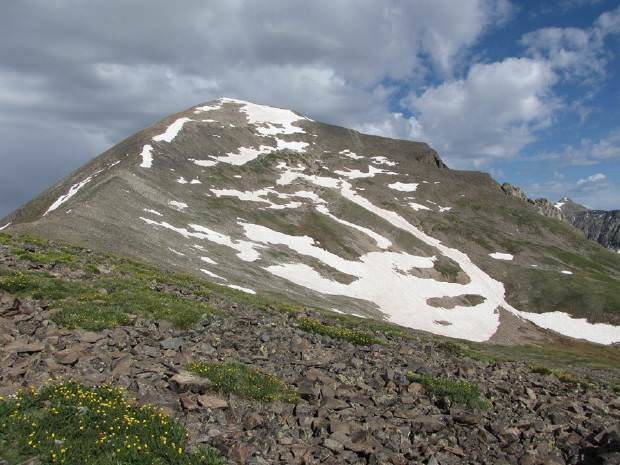
In Colorado, it is the mountains with the 14,000-foot summits that get most of the attention. There’s something about that 14,000-foot mark, an almost unfathomable height, that makes the peaks look that much more jagged and attracts those looking to push themselves in the backcountry. Meanwhile, there are nearly 600 named and unnamed peaks between 13,000 and 13,999-feet here in Colorado that are just as beautiful, with terrain just as gnarly, that see far less foot traffic. If it’s breathtaking views, a challenging ascent, and some solitude you’re after, add these six Colorado 13ers to your summer hiking bucket list.
RELATED: Colorado’s Most Daring Hikes
1. West Spanish Peak
The Spanish Peaks of southern Colorado served as a waypoint on the famed Santa Fe Trail trade route that connected Independence, Missouri with Santa Fe, New Mexico. The west peak, topping out at 13,626 feet, is the higher of the two but an easier climb, thanks to the Cordova Pass Road, which you can follow in your car up to 11,248 feet. It’s a three-hour hike to the summit, which offers long views of southern Colorado. Be sure to look for the volcanic dikes that spread like spokes on a wheel through the valley. There’s a small [campground] at the trailhead.
2. Horn Peak
The Crestone mountains of the Sangre de Cristo range attract hordes of climbers in summer. But just a few miles north is 13,450-foot Horn Peak, which from nearby Westcliffe looks like an intimidating shark’s tooth. The climb is steep—4,500 feet in 4.5 miles—but you’re likely to have the summit to yourself, with wondrous views of the narrow, jagged spine of the Sangre de Cristo Range and the San Luis Valley(the world’s largest alpine valley) to the west. Great camping can be found at the Alvarado Campground.
3. Mount Sniktau
Most 13ers – like the vast majority of the Rocky Mountains – are inaccessible in winter. Not so for 13,234-foot Mount Sniktau, which rises to the north of Loveland Pass west of Denver. Loveland Pass, the highest paved year-round pass in the nation, tops out at 11,990 feet, and from the summit it’s only a 1.75-mile ridge walk to the top. Winds keep the ridge largely snow-free in winter, so this spot is also a great place for an introduction to winter mountaineering. The 14ers Grays and Torreys dominate the view to the north, likely swarming with Denver day-trippers. Sniktau will be much quieter. Camping in the area is, however, limited.
4. Mount Ouray
This 13,971-foot behemoth is only 29 feet shy of being a fourteener, but its loss is your gain, as relatively few hikers attempt the summit. The route starts at the top of Marshall Pass, a dirt road that can be negotiated by most cars when dry. Follow the Colorado Trail/Continental Divide Trail north for a mile and then turn right and walk off-trail (there may be cairns and faint trail) up the peak’s west ridge. The summit provides an amazing view of the convergence of three mighty mountain ranges – the Sawatch, the San Juans, and the Sangre de Cristos. The beautiful O’Haver Lake Campground makes a great base camp for the climb.
RELATED: 40 Must-See Colorado Hot Spots
5. Mummy Mountain
Rocky Mountain National Park is known for its jagged, dramatic, and difficult peaks—fourteener Longs Peak has the highest failure rate of any Colorado fourteener. But this gently sloping 13,425-foot peak is actually a relatively mellow hike (no extra climbing gear needed).. The downside is the long, 16-mile round trip hike, but with an overnight backpack and a backcountry permit, you can break that up by camping at Lawn Lake, six miles up from the trailhead. From Lawn Lake, follow the trail to timberline to the saddle and intersection with the Crystal Lakes Trail. Turn right and walk up the ridge to the top, which will probably be occupied by nobody but yourself and the marmots.
6. Rio Grande Pyramid
This stunning peak is located deep in the San Juan Mountains of southern Colorado. Since the hike is 20 miles round-trip, it is best done as an overnight backpacking trip? The Weminuche Wilderness is Colorado’s largest swath of protected wilderness land and worthy of a multi-day trip. The reward is standing atop 13,281-foot Rio Grande Pyramid, a pointed, dramatic peak that fits the classic image of the Rockies. You’ll want a good map, compass, and directions, because getting lost or injured in such a remote location could be catastrophic. From the summit of Rio Grande Pyramid, the wildest corner of Colorado is spread before you in all its splendor.
Get OutThere
Signup today for free and be the first to get notified on new updates.
PREV
PREVIOUS
Getaway Guide: Spend a Weekend in Del Norte, Colorado
Facebook Twitter WhatsApp SMS Email Print Copy article link Save Facebook Twitter WhatsApp SMS Email Print Copy article link Save Known as the “gateway to the San Juan Mountains”, Del Norte is a hidden Colorado gem that’s just waiting to be found. What the small town lacks in population (less than 2,000 people call Del […]
Getaway Guide: Spend a Weekend in Fort Collins, Colorado
Facebook Twitter WhatsApp SMS Email Print Copy article link Save Facebook Twitter WhatsApp SMS Email Print Copy article link Save Fort Collins, Colorado sits just close enough to the Wyoming border to get overshadowed by its more well-known siblings—Boulder and Denver. Though less frequented, this laid back town has access to some of the best […]