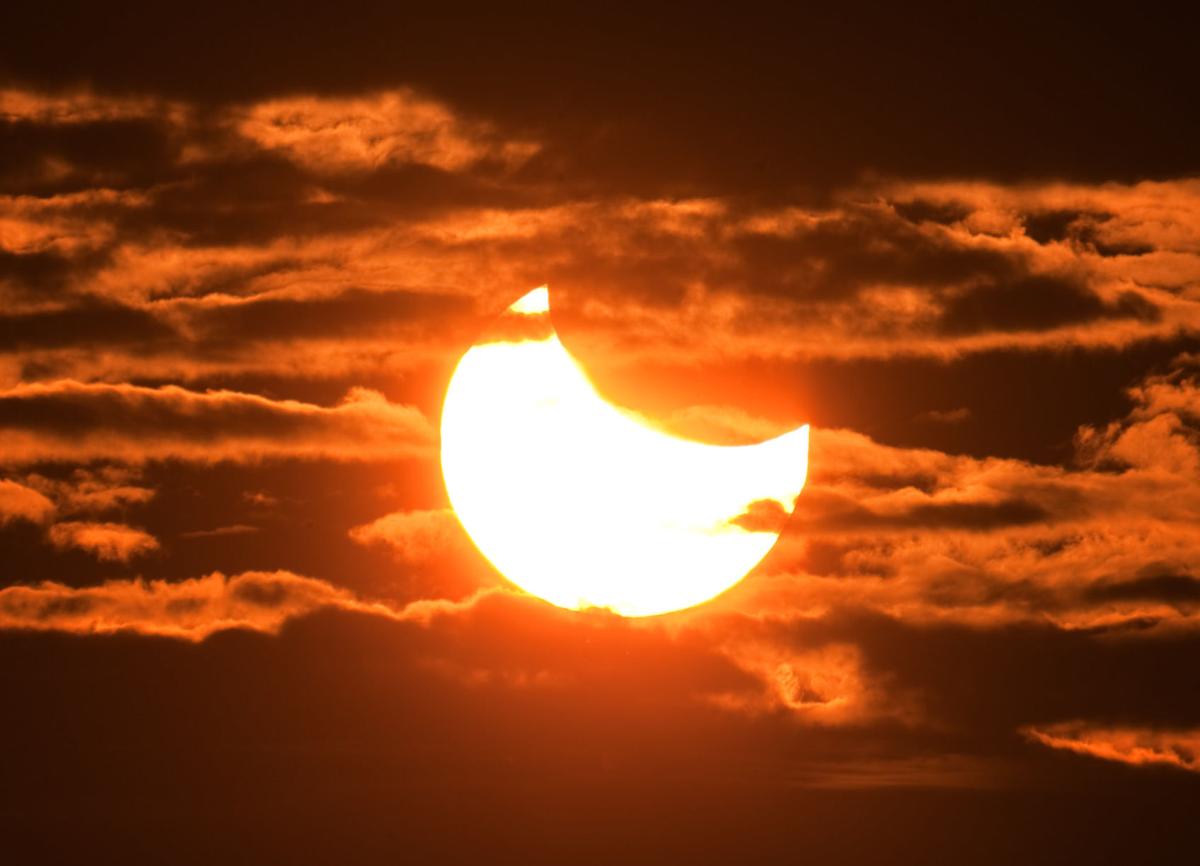
In case you haven’t heard, on August 21st, 2017, a solar eclipse will be spotted flying across the North American sky. If you want to see a total solar eclipse and you live in Colorado, you’ll have to travel to Wyoming or Nebraska, the two closest places that will give you the best view of this rare event. You can see exactly where it will cross the country on the map at the bottom of this page.
Here are a few other things you need to know:
People in Denver will see roughly 92 percent of the sun covered; those further north will see more coverage, and those further south will see less.
The Colorado Department of Transportation has already issued traffic warnings regarding the event, advising those traveling on Interstate 25 and 76 to bring extra water and sunscreen along for the ride.
The next solar eclipse to cross this area of the country will happen on August 12, 2045, passing directly over the middle of Colorado.
Natural phenomenon. Silhouette back view of family sitting and relaxing together. Boy point to solar eclipse on gold sky background. Happy family spending time together. Outdoor.
Natural phenomenon. Silhouette back view of family sitting and relaxing together. Boy point to solar eclipse on gold sky background. Happy family spending time together. Outdoor.
The shadow of the moon will be 60 to 70 miles wide on Earth.
Roughly 500,000 people are expected to travel to both Wyoming and Nebraska for the event.
Experts say that you’ll need special glasses made for the solar eclipse if you plan on safely watching the portion of the event while the sun is still present. These can be purchased online or in person.
A family dons special eclipse glasses. Photo Credit: LeoPatrizi.
A family dons special eclipse glasses. Photo Credit: LeoPatrizi.
The temperature is expected to drop 10 to 15 degrees Fahrenheit during the eclipse.
The lunar shadow will be travelling at roughly 1,500 miles per hour as it moves from coast to coast.
The event will be the first time in 99 years that an eclipse hits both coastlines of the United States.
Oregon will be in darkness for the shortest time period, at barely under two minutes.
Kentucky will be in darkness the longest, at 2 minutes and 44 seconds in Shawnee National Forest.
Here’s an interactive map of the path of the eclipse: