







Six years after fire, Black Forest Regional Park gets major upgrades
Jason Meyer remembers celebrating the completion of three miles of new trail at Black Forest Regional Park the day the fire sparked.
Then, suddenly, “it was starting all over from square one,” said Meyer, an El Paso County project manager.
The Black Forest fire, which destroyed nearly 500 homes and burned more than 14,000 acres, ripped through the park in June 2013, charring 80% of the property.
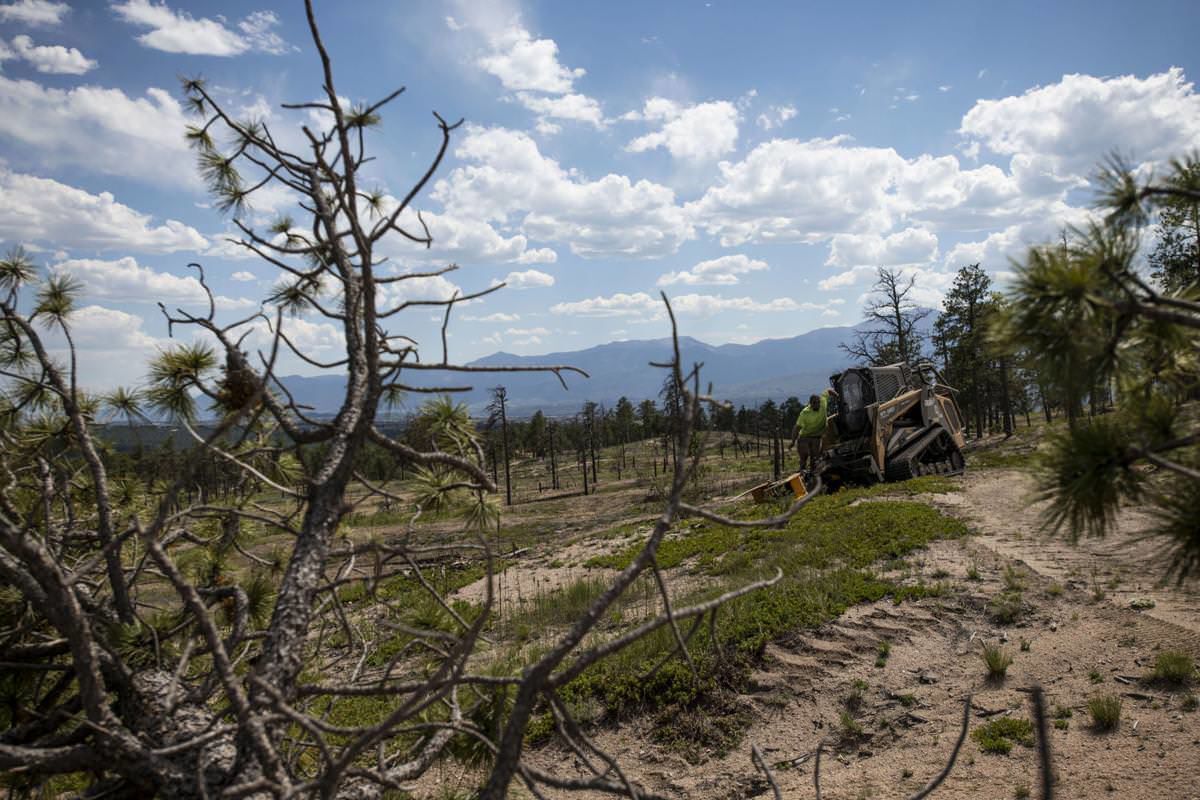
Six years later, contractor crews are at work in the 385-acre park on Shoup Road, toppling and tearing up dead trees as part of the county’s biggest park restoration project since the fire.
When the roughly $900,000 effort is completed at the end of the summer, the park will have six miles of new trail, improved drainage and a fresh cover of native seed.
“After the fire, it was black. There was no vegetation,” Meyer said. “It took about a year for the grasses to start popping up again.”
Now, the homes outside the park’s boundaries, once hidden by dense forest, are clearly visible.
Many of the burnt trees, once a fire hazard, have been reduced to wood chips and tilled into the soil to restore the nutrients the fire stripped away.

A masticator crushed and grinds tree trunks during a forest restoration project on Friday in areas that were affected by the Black Forest Fire in 2013. Photo Credit: Chancey Bush, The Gazette

A masticator crushed and grinds tree trunks during a forest restoration project on Friday in areas that were affected by the Black Forest Fire in 2013. Photo Credit: Chancey Bush, The Gazette
“We’re breaking up the soil, getting the organics back in,” Meyer said. “It’s nice and porous so when it rains it’s going to soak in.”
On a nearby hillside, contractor Front Range Arborists was close to finishing the job. The county hired the company to treat roughly 160 acres of the park, using a 30,000-pound masticator and other heavy machinery to shred the trees.
A few blackened pines still are standing, left as habitat for great horned owls, woodpeckers and other animals.
Since the fire, county workers and volunteers have taken other steps to improve the park and reduce fire risk. Trees along the fence line were removed so that, if another blaze sparks, the flames will be less likely to make it to the road. Limbs were cut from the lower part of tree trunks so to prevent fire from climbing into the canopy.
“We wanted to see how the park was going to initially recover from the fire,” Meyer said.
The county has re-established some trails. This month, another contractor will start working on more.
A third contractor has constructed a catch of riprap in a low-lying area of the park and dug a drainage ditch to deter floodwaters from the playground and athletic fields.
About 1,500 ponderosa pine seedlings, surrounded by cylindrical nets to thwart animals and hikers’ feet, have been planted in the park, Meyer said.
The county hopes to add other varieties, including aspen and mahogany.
Front Range Arborists will return this month to seed the park so that the wood chip-covered ground will one day be dotted with green.
“In about a year, it’s going to just pop,” Meyer said.