




Paid reservations to be explored for Manitou Incline; reopening timetable uncertain
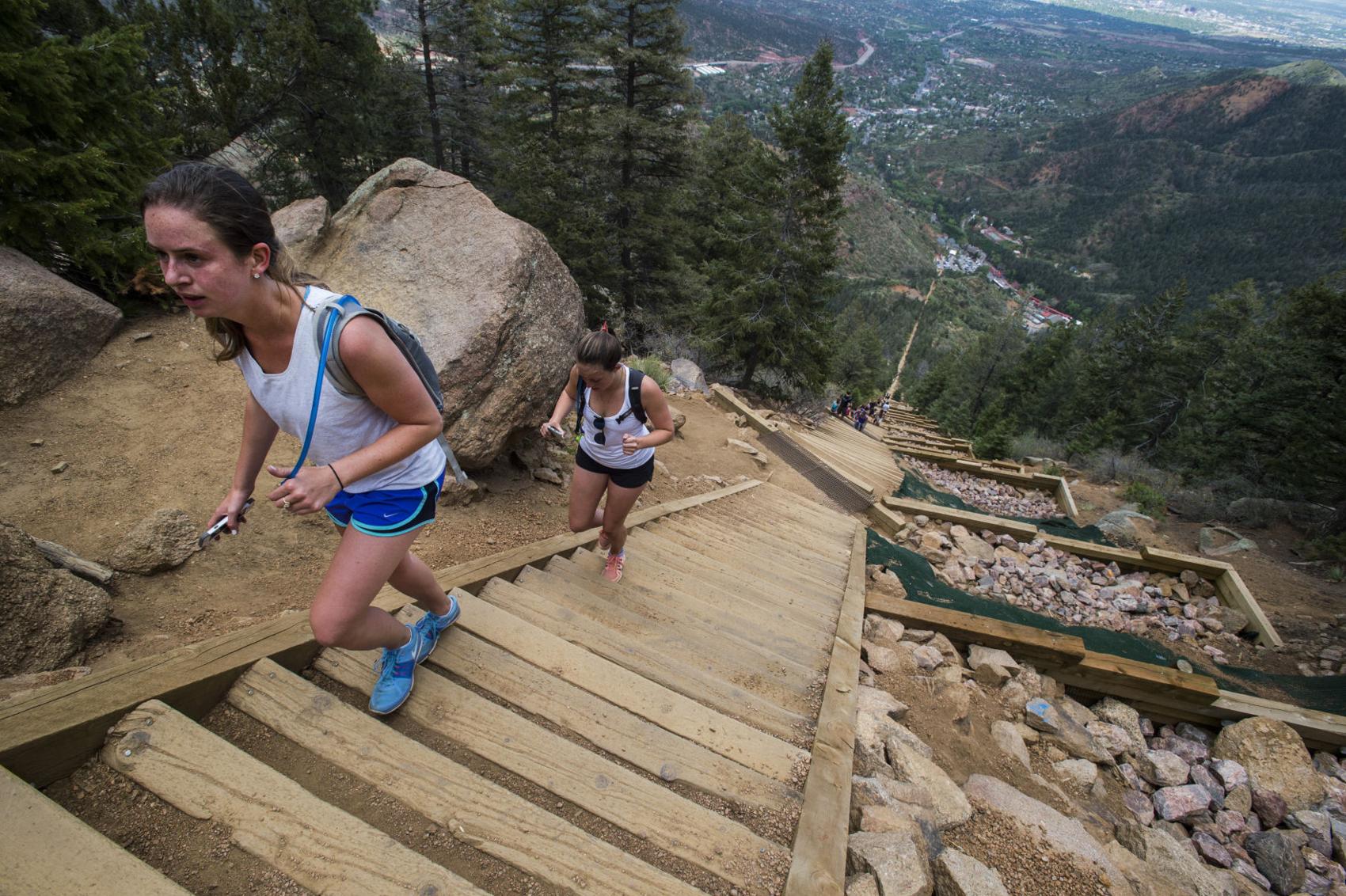
Manitou Springs’ City Council Tuesday night unanimously directed staff to pursue reopening the popular Manitou Incline with a paid reservation system aimed at limiting crowds.
The world-famous fitness test of railroad ties gaining more than 2,000 feet of elevation in less than a mile has been closed since mid-March because of COVID-19 concerns.
“The world has changed in the past two and a half months,” Nancy Fortuin, Manitou’s mayor pro tem, said in a phone call. “It turned out rather coincidental to be an ideal time to look at how we might evolve going into the future.”
The Incline “has been something of a festering issue in Manitou for a number of years,” she said, “and this is really the first time that we’ve had the right staff to fully address it with our partners in Colorado Springs as well as the Forest Service.”
The three parties are bound by an intergovernmental agreement, with the city of Colorado Springs and Forest Service owning the land the trail covers. Colorado Springs parks director Karen Palus — representing the department that oversaw multimillion-dollar jobs on the Incline’s refurbishing in recent years — had firm words for Manitou leaders in March following the Incline’s closure, saying she was not notified in advance of the decision.
On Tuesday, Palus shared another cautionary message.
Incline fees and reservations would mean “a pretty extensive process, with Manitou, the Forest Service and ourselves,” she said in a phone call leading up to Tuesday’s council work session. “It would not be something we could just implement.
“We don’t just start with, ‘Here’s the decision, tell us if you like it or not.’ It’s, ‘These are the issues we need to resolve, and how do we through a public process resolve those?’ What becomes the decision at the end is from an open-ended question, through that process,” she said. “That’s how we get things done. And you come up with compromises and a variety of ideas, and I think the way we do those plans really lends themselves to a good product in the end.
“But we never start with the answer,” Palus added. “We start with the issues and then work toward a resolution.”
Manitou City Engineer Dole Grebenik and Deputy City Administrator Roy Chaney, architects of what they’re calling an “interim active management plan” for the Incline, told city council members talks with the land managers were continuing. They’ve been inconsistent for the better part of 10 years, Chaney said.
“We have to put something in place,” he said, “and (Grebenik and I) both agree, along with other people we’ve talked to, that having some kind of reservation system is probably one of the only ways to control things better.”
Some on the council said they wanted to open the Incline as soon as possible and asked how long it would take to have the system in place. They were given no guarantees.
“But fortunately and unfortunately, the pandemic has opened certain doors to allow certain things to happen that would not normally be happening,” Grebenik said. “So we’ll use that and we’ll go from there.”
Tuesday’s meeting came on the heels of a paper by Grebenik and Chaney. The “Incline Proposed Management Plan” credits the Incline for hosting nearly 3,000 people a day at its busiest, and drawing thousands more vehicles up Ruxton Avenue, the tight, residential corridor also home to the Pikes Peak Cog Railway, which is expected to reopen next year after construction.
The paper lists issues that have been at the forefront in town since 2013, when the previously private Incline became public: parking hassles, Ruxton noise complaints and damage to Barr Trail, the adjacent Forest Service path used by descending Incliners.
The paper asks: “What management plan can Manitou Springs put in place to reduce or resolve the current COVID-19 virus and past issues with the incline and future return of the Cog Railway?”
The city already has software in place that could handle reservations, the proposal explains. Users could pay $5 or $10 for an hourly slot, it states as an example to offset costs of operations, and could receive a receipt or badge that could be scanned by personnel stationed at the Incline’s base.
Multi-trip cards and season passes could be explored, as well waived charges but required reservations for residents, Grebenik and Chaney suggest. They write: “With the current COVID issue and with past capacity problems, we could easily change the per hour incline user limit at a touch of a button.”
But getting to that point might not be so simple.
“My conversations with them is that it needs to be a reservation system as it relates to parking, not a reservation system for the Incline,” Palus said.
Parking “is fully in Manitou’s purview,” she said.
As for Incline reservations: “The only way we could move forward with any of those ideas is to go through a master and management plan, like we do with all of our sites.”
A 2011 plan proposed a future “pay to play” model for the Incline — after the then-jagged set of ties were brought up to safe standards. Refurbishing finished in 2017.
But before fees were discussed, Palus said she has also insisted on the completion of a return route down the north side of the Incline, an alternate to the beaten and battered Barr Trail. The city announced the “northern connector” last week, to possibly be built by the end of July.
That news excited Bill Beagle, president of nonprofit advocate Incline Friends, which is helping fund the project. He was less enthusiastic about the proposed reservations system.
He knows the regulars. “I don’t think they’d like it,” he said.
They’d come around, said Steve Bremner, the ultrarunner who founded Incline Friends and on Tuesday sat for his first work session as Manitou’s new city councilman. He lives on Ruxton Avenue and has seen the Incline surpass the popularity he ever envisioned.
With the reservation system, “you can limit the number of people on it, and we can make it coronavirus compliant by doing that,” Bremner said in a phone call. “I think it’s in the best interest of regulars and general visitors who want to use it.”

Get OutThere
Signup today for free and be the first to get notified on new updates.
Paid reservations to be explored for Manitou Incline; reopening timetable uncertain
Manitou Springs’ City Council Tuesday night unanimously directed staff to pursue reopening the popular Manitou Incline with a paid reservation system aimed at limiting crowds.
The world-famous fitness test of railroad ties gaining more than 2,000 feet of elevation in less than a mile has been closed since mid-March because of COVID-19 concerns.
“The world has changed in the past two and a half months,” Nancy Fortuin, Manitou’s mayor pro tem, said in a phone call. “It turned out rather coincidental to be an ideal time to look at how we might evolve going into the future.”
The Incline “has been something of a festering issue in Manitou for a number of years,” she said, “and this is really the first time that we’ve had the right staff to fully address it with our partners in Colorado Springs as well as the Forest Service.”
The three parties are bound by an intergovernmental agreement, with the city of Colorado Springs and Forest Service owning the land the trail covers. Colorado Springs parks director Karen Palus — representing the department that oversaw multimillion-dollar jobs on the Incline’s refurbishing in recent years — had firm words for Manitou leaders in March following the Incline’s closure, saying she was not notified in advance of the decision.
On Tuesday, Palus shared another cautionary message.
Incline fees and reservations would mean “a pretty extensive process, with Manitou, the Forest Service and ourselves,” she said in a phone call leading up to Tuesday’s council work session. “It would not be something we could just implement.
“We don’t just start with, ‘Here’s the decision, tell us if you like it or not.’ It’s, ‘These are the issues we need to resolve, and how do we through a public process resolve those?’ What becomes the decision at the end is from an open-ended question, through that process,” she said. “That’s how we get things done. And you come up with compromises and a variety of ideas, and I think the way we do those plans really lends themselves to a good product in the end.
“But we never start with the answer,” Palus added. “We start with the issues and then work toward a resolution.”
Manitou City Engineer Dole Grebenik and Deputy City Administrator Roy Chaney, architects of what they’re calling an “interim active management plan” for the Incline, told city council members talks with the land managers were continuing. They’ve been inconsistent for the better part of 10 years, Chaney said.
“We have to put something in place,” he said, “and (Grebenik and I) both agree, along with other people we’ve talked to, that having some kind of reservation system is probably one of the only ways to control things better.”
Some on the council said they wanted to open the Incline as soon as possible and asked how long it would take to have the system in place. They were given no guarantees.
“But fortunately and unfortunately, the pandemic has opened certain doors to allow certain things to happen that would not normally be happening,” Grebenik said. “So we’ll use that and we’ll go from there.”
Tuesday’s meeting came on the heels of a paper by Grebenik and Chaney. The “Incline Proposed Management Plan” credits the Incline for hosting nearly 3,000 people a day at its busiest, and drawing thousands more vehicles up Ruxton Avenue, the tight, residential corridor also home to the Pikes Peak Cog Railway, which is expected to reopen next year after construction.
The paper lists issues that have been at the forefront in town since 2013, when the previously private Incline became public: parking hassles, Ruxton noise complaints and damage to Barr Trail, the adjacent Forest Service path used by descending Incliners.
The paper asks: “What management plan can Manitou Springs put in place to reduce or resolve the current COVID-19 virus and past issues with the incline and future return of the Cog Railway?”
The city already has software in place that could handle reservations, the proposal explains. Users could pay $5 or $10 for an hourly slot, it states as an example to offset costs of operations, and could receive a receipt or badge that could be scanned by personnel stationed at the Incline’s base.
Multi-trip cards and season passes could be explored, as well waived charges but required reservations for residents, Grebenik and Chaney suggest. They write: “With the current COVID issue and with past capacity problems, we could easily change the per hour incline user limit at a touch of a button.”
But getting to that point might not be so simple.
“My conversations with them is that it needs to be a reservation system as it relates to parking, not a reservation system for the Incline,” Palus said.
Parking “is fully in Manitou’s purview,” she said.
As for Incline reservations: “The only way we could move forward with any of those ideas is to go through a master and management plan, like we do with all of our sites.”
A 2011 plan proposed a future “pay to play” model for the Incline — after the then-jagged set of ties were brought up to safe standards. Refurbishing finished in 2017.
But before fees were discussed, Palus said she has also insisted on the completion of a return route down the north side of the Incline, an alternate to the beaten and battered Barr Trail. The city announced the “northern connector” last week, to possibly be built by the end of July.
That news excited Bill Beagle, president of nonprofit advocate Incline Friends, which is helping fund the project. He was less enthusiastic about the proposed reservations system.
He knows the regulars. “I don’t think they’d like it,” he said.
They’d come around, said Steve Bremner, the ultrarunner who founded Incline Friends and on Tuesday sat for his first work session as Manitou’s new city councilman. He lives on Ruxton Avenue and has seen the Incline surpass the popularity he ever envisioned.
With the reservation system, “you can limit the number of people on it, and we can make it coronavirus compliant by doing that,” Bremner said in a phone call. “I think it’s in the best interest of regulars and general visitors who want to use it.”
Get OutThere
Signup today for free and be the first to get notified on new updates.
PREV
PREVIOUS

Construction of Colorado’s first In-N-Out Burger begins
Hoping for a sign of better times? Well, here’s one that was erected recently on Colorado Springs’ far north side: “In-N-Out Burger. Here soon.” How soon? Later this year — possibly in November, although that’s not a sure thing. The popular California fast-food chain, which announced its expansion to Colorado 2½ years ago, has started […]

Here’s a breakdown of current COVID-19 statistics in Colorado
Here’s a look at the current status of COVID-19 in Colorado, according to the Colorado Department of Public Health and Environment (CDPHE). This report was updated around 4 PM on Monday, May 26. Deaths: 1,352 (1,114 directly related to COVID-19) Editor’s Note: The Colorado Department of Public Health and Environment (CDPHE) has now started to […]