







Crashes rare, but devastating, for thrill-seeking bicyclists on Pikes Peak
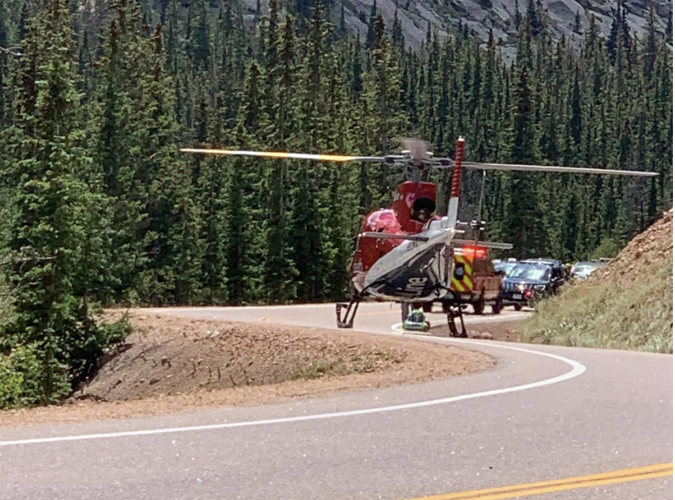
Ann Fox, 66, of Tyler, Texas, was airlifted by emergency helicopter after crashing her bike on Pikes Peak Highway as part of a tour company ride. She suffered multiple broken bones and hard her spleen and parts of two other organs removed.
Courtesy: Fox family


Ann Fox desperately wanted to stop as her bike sped down the Pikes Peak Highway in mid-July.
But around Glen Cove — the spot where motorists’ brakes are checked for overheating — the grade grew too steep. Her bike wobbled.
“I had never quite ridden with disc brakes, and I couldn’t quite get my speed (under) control like I wanted to,” Fox said of her near catastrophic day.
Moments later, she careened off the side of the highway — one of a series of bike crashes this summer that prompted emergency medical helicopters to land on the 14,000-foot peak and take bloodied and broken cyclists to nearby hospitals.
During a single monthlong span this summer, six bicyclists crashed descending the Pikes Peak Highway, according to the highway ranger’s office. At least five of those crashes involved people ferried to the top by tour companies promising the “the ride of your life.”
Fox, 66, of Tyler, Texas, remembers little about her crash except spotting her dislocated thumb and seeing blood. Her daughter rushed to her side and recognized signs of internal bleeding.
“Inside I was hysterics and devastated,” said Michelle Aarant, describing her mother lying crumpled in a ditch. “I’m like, ‘Oh my gosh, how can this happen?’ There were 100 different ranges of emotion.
“If we had known the bike ride was going to be that intense, we would have never done it.”
The crashes offer a window into the dark side of one of the state’s top tourism draws — much as drownings and high-speed collisions have been known to mar river rafting trips or zip-lining adventures elsewhere in the state. That’s especially true as many outdoors revelers arrive from out of state not fully aware of the dangers those activities present.
Most of the time, tourists rolling down the peak leave smiling and raving about the experience, as evidenced by the sterling Yelp reviews they often post afterward.
But descending America’s Mountain presents a unique challenge, with the highway dropping 7,000 feet over about 20 miles at grades that reach 12%. Stretches exist without guardrails, and motorists’ brakes have been known to fail with deadly consequences.
This year’s wrecks so alarmed Colorado Springs officials overseeing the highway that they met with at least one of the Pikes Peak bike tour companies — the company involved in Fox’s crash, which was under new ownership this year — on July 28 to review safety protocols. Since then, zero such crashes have been reported.
“The thing is: You never know on the tours what type of rider it is, what the conditions of the road are, until they’re up there,” said Jack Glavan, manager of Pikes Peak-America’s Mountain, the city of Colorado Springs division overseeing the highway. “So you really have to rely on the tour guides and their staff to make determinations of if riders are qualified” and if conditions are safe.
“We didn’t see any trends that would indicate that we’d have an unsafe condition, or the companies aren’t operating safely,” he added.
Tour operators’ websites say they use bikes with disc brakes. Before each trip, every rider receives a parking lot safety lesson, where they’re taught how to brake properly and what to expect on the peak.
Riders also are given the option of bailing at any point in the ride by climbing into a van that trails each group of bicyclists.
Fox said she considered that as her speed picked up just below tree line.
“I thought, ‘This is a little fast for me,’ and when we get to a stopping point, I felt like I was going to probably get in the van and ride down,” said Fox. “But I didn’t make it to that next stopping point.”
Instead, a $215 bike ride turned into an $45,000 helicopter flight after a crash that led doctors to remove her spleen and parts of two other organs.
Fox still isn’t exactly sure how it happened.
The ride began beautifully from near the top of Pikes Peak’s 14,115-feet summit. Without any trees in the way, each hairpin switchback afforded sweeping vistas of either the Sawatch Range to the west or the Rampart Range to the north.
After descending about 3,000 feet without any problems, Fox said the road straightened out as it dove into the pine trees around Glen Cove.
The tour guides suggested people could go faster on this stretch, said Fox and multiple other people on the tour, and several riders obliged. Even Fox’s daughter said she found it hard to keep her speed in check after hanging back with her mom above tree line.
“Your speed gets away from you really quick,” Aarant, 44, said.
Fox had trouble braking and possibly hit a rock in the road. She veered into the oncoming lanes and off the left side of the road, slamming into a drainage ditch lined with a hard, abrasive material that can tear through flesh. At least one rider suffered a cut hand while leaning over to tend to Fox.
Fox’s helmet was cracked by the impact.
Nancy Hanson, who was celebrating her 45th birthday that day and was the lone rider behind Fox, saw it all. She raced to Fox’s side and tried talking to her.
“She was covered in sand and rocks and there was blood that was flowing from around her helmet and her hands,” said Hanson, of Fulton, Mo. “Her arms were just mangled.
“We were praying a lot the whole time. There was a lot of prayer going on.”
Fox was flown to Memorial Hospital Central and endured two surgeries — one to remove her spleen, a section of her pancreas and a portion of her stomach; another to repair a broken elbow on one arm and a dislocated thumb on the other. She also had a broken collarbone.
Nearly seven weeks later, Fox is still very much in recovery and uncertain when she can return to work as a CT scan technologist. The loss of her spleen also made her more susceptible to disease — a troublesome new concern during the coronavirus pandemic.
Now back home in Texas, she feels the tour company, Pikes Peak Bike Tours, did a poor job articulating the ride’s dangers and training riders how to use the brakes.
“They said anybody could do it, wasn’t a big deal,” Fox said. “But it is a big deal, because you have a very steep grade, and you can get going really fast.”
Fox said she still suffers from nightmares reliving the crash that wake her in the middle of the night.
Aarant and others on the ride also complained that the tour company’s self-described “bubble” — the space on the highway between its lead and follow vans where riders can be insulated from other traffic — became too stretched out. Another vehicle slipped in between the riders and their follow van, Fox said, putting riders at risk.
Other riders voiced concerns about the tour guides’ lack of first aid expertise. They didn’t have gloves, and when asked to get oxygen, one guide brought back a bag valve mask.
Serious crashes are nothing new on the peak.
In 2019, for example, four bicycle crashes were brought to the attention of highway rangers, Glavan said. That was out of 3,465 bike rides.
But the rate of crashes jumped significantly this year.
Six crashes were reported this year out of 2,033 rides, two of which involved 14-year-old riders. During July, tour riders wrecked at least once every 133 rides, and medical helicopters were dispatched about once a week to the peak.
Four of the crashes involved Pikes Peak Bike Tours, which led Fox’s ride. In July, riders with them crashed once every 7.5 times the company led a group up the mountain.
Scott Graham, director of operations for Pikes Peak Bike Tours, which led Fox’s ride, said he thought one or two people crashed every year. He did not respond to several requests to elaborate, or to address safety concerns raised by members of Fox’s tour group.
Greg Wellens, owner of Challenge Unlimited by Adventures Out West, said that his company has myriad safety protocols in place for each ride, including educating people on the dangers of such rides. He also reduces the cost of a summit bike trip when someone decides to stop mid-ride and get in a support van, which he said eliminates the financial incentive to be unsafe. Still, he’s up front about the danger each ride can present.
“There is no adventure out West without risk, and people do crash and fall and get hurt on all activities in the state of Colorado that involve adventure,” Wellens said.
For many tourists, however, the five-star Yelp ratings speak for themselves.
Dozens of people gave Pikes Peak Bike Tours rave reviews over the past several years, with one person this year calling it a “thrilling experience” from a “top-notch company.”
Karen Germain, 43, praised the company for providing a perfect present in early August for her husband’s 47th birthday. She said safety warnings were repeated ad nauseam, almost to the point of annoyance.
Her husband, Daniel Germain, added he was considering taking his children, ages 13 and 11, down the mountain next year.
Pikes Peak Bike Tours earned his trust, he told The Gazette.
“I can’t say enough good things about them,” said Daniel Germain, of Littleton.
But the fellow riders in Fox’s group pushed back against the attitude they sensed from the tour company that riders of all skill levels could make the trip.
Carrie Wetter, 50, of Omaha, Neb., said the crash left her rattled and cast a pall on the remainder of her trip to Colorado.
She came to Colorado seeking an adventure. She left with the frightening memory of helicopter blades echoing across the mountain as Fox was carried away.
“When you’re from the Midwest, the flatlands, you have no idea what 14,000 feet really is,” Wetter said. “Especially on a bike when you’re going down.”