







Airmen at Colorado’s Buckley Air Force Base train to fly against Russian threat
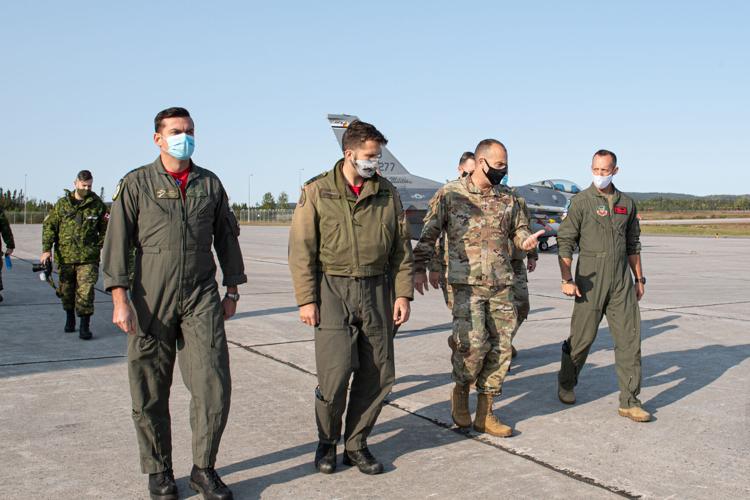
Brig. Gen. Edward Vaughan, U.S. Air Force deputy commander for Canadian NORAD Region, took a tour of tours 5 Wing Goose Bay, Newfoundland and Labrador, September 21, 2020, on Monday during Operation Noble Defender. Behind the group is an F-16 from the Colorado National Guard’s 140th Fighter Wing.
Courtesy of NORAD
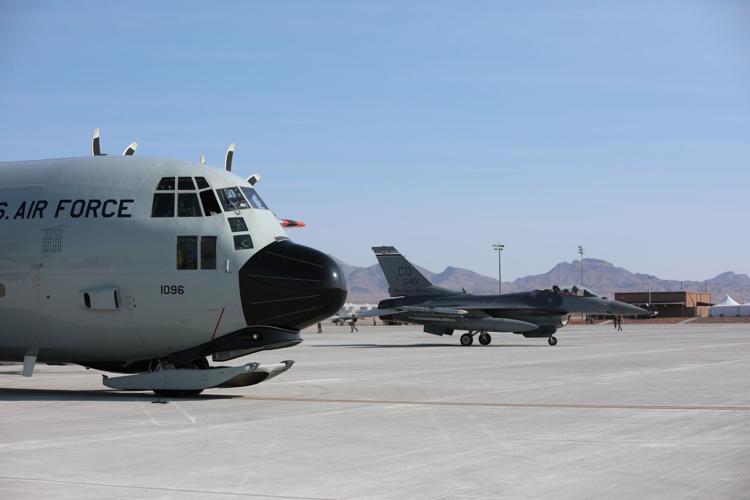
After 19 years of defending Colorado’s skies from a 9/11 style attack, the 140th Fighter Wing at Aurora’s Buckley Air Force Base has an added new mission that’s a throwback to the unit’s Cold War past.
With more than 1,700 Colorado National Guard troops, the wing still has F-16 fighters on alert that can take off within minutes to deal with terrorist threats. But, these days, crews are worried about more than hijacked airliners.
“We are working to make sure we can counter Russia primarily and China secondarily,” said Col. Micah Fesler, the wing’s commander.
This month, that meant sending some of the wing’s F-16 fighters north to join in air defense exercises with Canadian allies. Run by the North American Aerospace Defense Command in Colorado Springs, Operation Noble Defender counters Russian saber-rattling that has sent a string of bombers off the coasts of Alaska and Canada.
This month, that has included a pair of supersonic Blackjack bombers and S-35 fighters, Russia’s newest and most sophisticated warplanes, that came within 50 miles of the Alaskan coast.
“The reemergence of strategic competition between nations, and competitors who overtly challenge the free and open international order, characterizes our complex global security environment,” NORAD boss Gen. Glen VanHerck said in a statement. “As competitors increase their reach, range and capability, our continental defense operations must be ready to detect, deter and defeat against threats in all domains.”
The 140th sent planes to Canada as part of the exercise and sent other aircraft and crews to Nevada to hone their dogfighting skills.
At Buckley, the F-16s are older than some of their pilots, with most of the planes entering service in 1988. But Fesler said the aging fighters are still capable enough to win air battles against even the latest Russian weapons.
“We have been successful taking these airplanes and making them into powerful machines,” he said.
The airplanes have upgraded avionics, the latest in electronic targeting devices and next-generation radars. They also have the capabilities that aviators have loved since the fighter was introduced in the 1970s: high speeds and extreme maneuverability.
“We don’t baby them,” Fesler said, giving a nod to his maintenance troops who keep the vintage planes in the air.
Even while troops from the 140th train to intercept Russians, the mission in Colorado continues. Begun on Sept. 14, 2001, it’s the Colorado Guard’s most enduring mission.
Pandemic Math Team has Air Force Academy on path to beating COVID-19
The goal is to detect and intercept suspicious planes, preventing 9/11 style attacks and defending American skies.
At Buckley, that means having F-16s fueled up, armed and ready for takeoff with crews ready to hop in and light the F-16’s afterburner.
Prior to the coronavirus pandemic, keeping up the mission was simpler, with crews seamlessly rotating in from their civilian lives to Buckley where they covered the Noble Eagle missions in shifts.
But the pandemic has meant keeping crews in on-base quarantine, safely isolating them from the virus so they are ready to fly.
Pandemic Math Team has Air Force Academy on path to beating COVID-19
“To be honest we have never skipped a beat,” the colonel said.
Fesler worked with other Buckley units to move his pilots and crews into housing on the base. Each pilot lives in isolation.
“When one person gets sick they are not taking out those entire crews,” Fesler explained.
The new housing arrangement came with another addition: lights and sirens.
“We actually gave our pilots and maintainers police cars,” Fesler said, explaining how they can race from their nearby rooms to the airfield for a quick takeoff.
The pandemic also brought a strange upside to the part-time Guard unit: More available pilots.
With a worldwide slowdown in travel, airline pilots who usually spend one weekend a month with the wing found themselves furloughed.
Air Force mulls pills as it claims secret new fighter prototype | Tom Roeder
Fesler capitalized on that to build depth into the wing’s Noble Eagle work.
“If one person gets sick I have another seven or eight behind them,” he said.
The pandemic has meant plenty of other work for the National Guard.
Troops from the 140th have helped run coronavirus testing sites, set up temporary housing for homeless people afflicted by the virus and offered transport to haul medical supplies around the state.
“Watching our airmen do all of these different missions, they were just crushing it left and right,” Fesler said.
Contact Tom Roeder: 636-0240
Twitter: @xroederx