







The swing county : Pueblo caught between GOP fervor, Dem base | Voices of the Voters
Editor’s note: This article is part of an occasional series on the views of Colorado voters.
When the polls close on election night this year, many eyes will be on Pueblo County in Southern Colorado, to see if the once-reliably Democratic stronghold will return to its roots after swinging four years ago to support Donald Trump.
Pueblo didn’t swing hard for Trump — the Republican ran 390 votes ahead of Democratic nominee Hillary Clinton, out of 78,646 cast, or just under one-half of a percentage point difference — but Trump’s victory marked the first time the county voted for a Republican for president since 1972, when Richard Nixon won 49 states in a landslide.
One of five counties in Colorado that voted for Trump in 2016 after voting for President Barack Obama in 2012, Pueblo’s shift fueled speculation about Trump’s appeal to traditionally Democratic blue-collar workers, mirroring the Republican’s surprise wins in Pennsylvania, Michigan and Wisconsin that handed him the presidency.
Even while barely losing Pueblo and the smaller, mostly rural counties that Obama had won, Clinton carried the state by about 5 percentage points, the third time in a row a Democrat won Colorado’s electoral votes.
“Youngstown on the Arkansas,” some wags dubbed Pueblo, highlighting the Democratic Party’s loosening grip on working-class voters, though Democrats say they’re confident 2020 nominee Joe Biden will win the county in November despite more evident enthusiasm for Trump heading into this year’s election than was apparent four years ago.
Democrats and Republicans in Pueblo are well aware of their county’s history, including its recent tilt toward Trump, along with its century-old reputation as an ethnic melting pot and its enduring standing as one of the largest steel-producing towns west of the Mississippi.
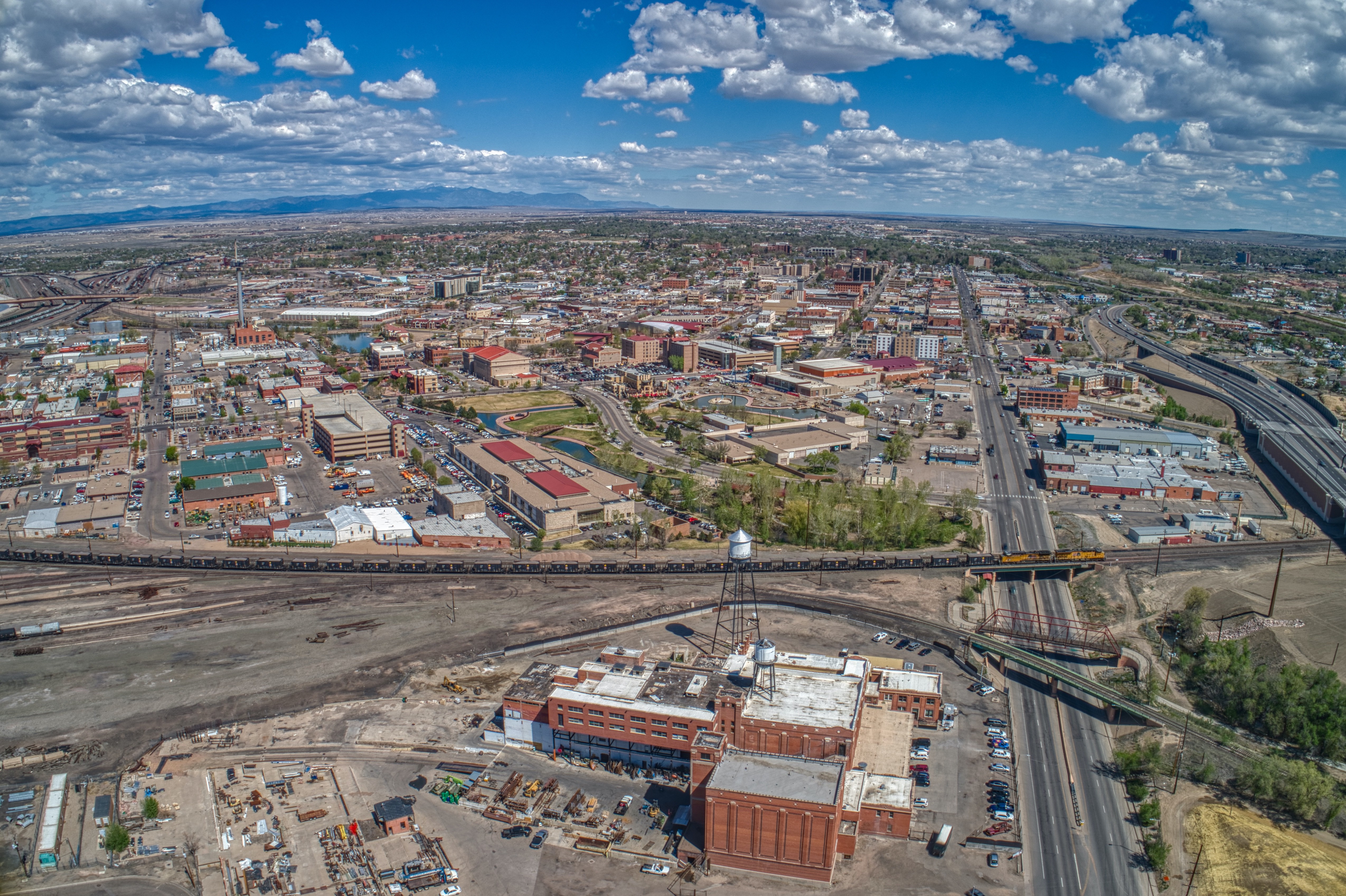
Pueblo, the county seat that shares the county’s name, is known as the “Home of Heroes,” boasting more Medal of Honor winners than any other city. Pueblo anchors the southern end of the Front Range, and locals say it shares as much with the surrounding Southern Colorado counties bordering New Mexico as it does with the larger and more prosperous cities to the north on Interstate 25, from Colorado Springs through the Denver metro area to Fort Collins.
The median household income in Pueblo County is $51,276, about two-thirds of the state median of $77,127, according to census data. The share of Pueblo residents living below the poverty line is 17.9%, almost twice Colorado’s rate of 9.4%.
The county has been known for its political orneriness in the last decade, including in 2013 when it was home to one of the two Democratic state senators recalled by voters over their support for gun-control legislation, though the Democrats won the seat back in the next regular election. Until the 2018 election — when Democrats swept the county the same way they swept the state — one of Pueblo’s two state House seats had been comfortably held for most of the decade by a Republican, who resigned before her term was up to take a job with the Trump administration.
Colorado Politics spoke with Democratic and Republican organizers and voters in Pueblo to get a sense of the county’s political lean as the election approaches.
Times, attitudes have changed
“Growing up in an ethnic family, a blue-collar family, a family that was primarily Catholic, we would tell people that we were ‘genetic Democrats,’ because you were raised with a picture of the pope on the wall, a picture of FDR and a picture of John Kennedy. Those were the iconic images that fed that community,” said Joe Koncilja, a criminal defense attorney and Democratic stalwart.
The town he and his politically active family grew up in has grown and changed over the decades, but he notes that so, too, has the Democratic Party, loosening its ties to the working men and women who were long its mainstay.
In recent years, the community of Pueblo West has exploded, appreciably changing the county’s demographic as its namesake city’s industrial roots have receded. The new development has turned into a sort of bedroom community for retired military and corrections workers who staff the state and federal prisons in nearby Fremont County, as well as commuters to Colorado Springs seeking more affordable housing.
“The narrative of the Democratic Party was based on ‘The Grapes of Wrath,’ and we love that narrative, but things have changed,” Koncilja said.
“Traditionally, Pueblo at its heart was a community that gravitated toward the underdog. Most people believed they had been from an underdog background, and they very much appreciated that progressive agenda that started with, ‘You can’t feel good about yourself if you’re eating and your neighbor’s not eating, you can’t feel good about yourself if you have access to health care and your neighbor doesn’t.’ For whatever reason, that narrative is just different, you don’t have that sense now. To an extent, people have progressed financially but they lost a little of the spirit of the underdog.”
At the same time, the Democratic Party has reoriented itself, Koncilja said, leaving an opening for Republicans who try to speak to voters the Democrats could be leaving behind.
“I think what happened here was emblematic of what happened with the entire blue-collar vote,” he said. “The unions are not as strong as they used to be. We have felt that the Democratic Party has really not catered to blue-collar workers the way they used to. If they’re worried about unions, they’re worried about the teachers union, the public employees union, but in terms of the trade unions they haven’t spent the time reaching out to them.”
Explaining the distinction another way, Koncilja said, “We used to tell people when they’d come down from Boulder that Pueblo was the heart and soul of the Democratic Party, and Boulder was the intellect of the Democratic Party.”
In 2016, when the choice was between Clinton and Trump, he said, the party didn’t do enough to attract its core voters.
“Culturally, down here you would have guys that came from hunting families, and they didn’t like the idea of someone screwing with their opportunity to have whatever kind of weapon they wanted, for whatever reason,” he said. “That plus the arrogance, the elitism of the Democratic Party, I think Trump’s election was a perfect storm of all those things.”
He said that as the election nears, it feels more like the old days around Pueblo, 30 or 40 years ago, with Biden recapturing some of the energy of the old Democratic coalition.
Koncilja added that he expects former Gov. John Hickenlooper to beat Republican U.S. Sen. Cory Gardner in the state’s most expensive race, though more by default because of Gardner’s links to an unpopular, divisive Trump than by dint of the Democrat’s campaign, which he described as lackluster.
“I feel people were legitimately offended by George Floyd’s death, that they understood that could easily be them in a different circumstance, there’s that humanity you get from your own experience,” he said. “I do believe that this vote people are going to wage down here this time is going to be with courage and compassion, and Pueblo will be a little more like the Pueblo we remember.”
Reaction to leftward ‘lurch’
Marla Reichert, who has chaired the Pueblo GOP since early 2017, said she thinks the county’s voters are only moving further away from the Democrats, and she expects a repeat of the 2016 results.
“The response for sign waves has been so much more positive than it was in 2016; there’s just a ton of enthusiasm,” she said, adding that Republican congressional nominee Lauren Boebert’s candidacy has brought out new supporters and volunteers “we’ve never met before.”
The flamboyant Boebert, who owns a restaurant on the Western Slope where the wait staff is armed, knocked off five-term U.S. Rep. Scott Tipton in the 3rd Congressional District’s Republican primary. The upset turned the race against Democratic former state Rep. Diane Mitsch Bush into Colorado’s premier congressional match.
“What we’re hearing is that this election comes down to a choice between socialism and the America that people know and love,” she said. “Pueblo’s a Democrat town, but the party has moved steadily away from the Pueblo-style Democrat.”
People have been coming in to the Republican office, telling her that as the Democrats have “lurched hard to the left,” they’re leaving the party.
“They’re not ready to all become Republicans tomorrow, but we share the same core values, of hard work, the salt-of-the-earth work ethic. Pueblo’s not the stronghold it used to be. It’s evolving.”
She said to expect more surprises on election night, based on the unprecedented zeal she’s seeing among Republican voters.
“It was quiet in 2016, but now people are hanging out the car windows and leaning on the horn, screaming and yelling, whenever we do a honk-and-wave. They’re just super excited. I’ve never seen enthusiasm like that ever, in any race. But Trump is generating that, and Boebert is generating that.”
An ‘activated’ Democratic base
Tara Trujillo, a veteran Democratic consultant who grew up in Pueblo in a union household, said she’s seeing more Trump signs and evidence of support for the incumbent than she’d expected, but believes Biden will win the county due to the intense reactions Trump has generated.
“Trump has overpowered any Republican candidate on the ticket,” she said. “I don’t ever hear anyone talking about Cory Gardner unless it’s a Democrat saying we need to get him out of office. What I hear about is Trump — the things he’s tweeting, the fact he said COVID isn’t a threat and then he had it. Trump overshadows everything politically now.”
For Democrats, she said, it’s a boon.
“So many people don’t like his style that it’s activated the Democratic base in a way I haven’t seen in a long time,” she said. “People on both sides are not afraid to be public about who they’re supporting.”
Trujillo said she’s felt Pueblo changing from the Democratic bastion it once was for years, recalling that her letter carrier father used to talk about how other carriers didn’t want to be part of the union because they were concerned about gun rights and abortion, issues where disagreements with the Democrats deterred them from the party.
“You have more single-issue voters here than we did maybe 15 years ago, along with Pueblo West,” she said. “I think guns are very important here in Pueblo, and the single-issue voters helped Trump with his election here last time.”
Few in middle of the road
Todd Johnson, a Republican who owns a landscape company and was born in Pueblo but mostly grew up outside the city near Rye before returning, said he was one of the area’s early Trump supporters before the 2016 election, when other Republicans were jumping aboard the Ted Cruz bandwagon.
“But I kept saying with what Obama’s done, there are enough pissed-off people, he’s got this. And I was right,” he said. “After four years, I’m even more convinced.”
He gives Trump credit for doing what he said he’d do, though Johnson said he wants the president to get busy on infrastructure and replacing the Affordable Care Act.
Johnson said he’s turned in his ballot already but didn’t vote a straight-party ticket, picking a couple Democrats at the county level because he knows the candidates.
“I don’t know too many people who are still middle of the road,” he said. “They pretty much all have their mind made up. There’s a couple voting Democrat because they don’t like Trump, not because of policy, but they don’t like the way he does things.”
After voting for Tipton in the primary, Johnson said he researched Boebert and likes that she’s also a small-business owner. Gardner has his vote, too, “because you know what you’re getting.”
He’s ready for the election to be over.
“We need to get a little more stabilization going,” Johnson said. “I’m anxious to see what’s going to happen, and hopefully there’s no shenanigans being played. Things are crazy right now. Hopefully after this election, that’ll settle down. Hopefully they’ll figure out this whole COVID mess.”