







President of Colorado Medical Board accused of lobbying on behalf of bidder

A deputy attorney general accused the acting president of the Colorado Medical Board of lobbying on behalf of a bidder for a state contract and asked the board to block the official from the process, an accusation and request reportedly supported by Gov. Jared Polis’s office.
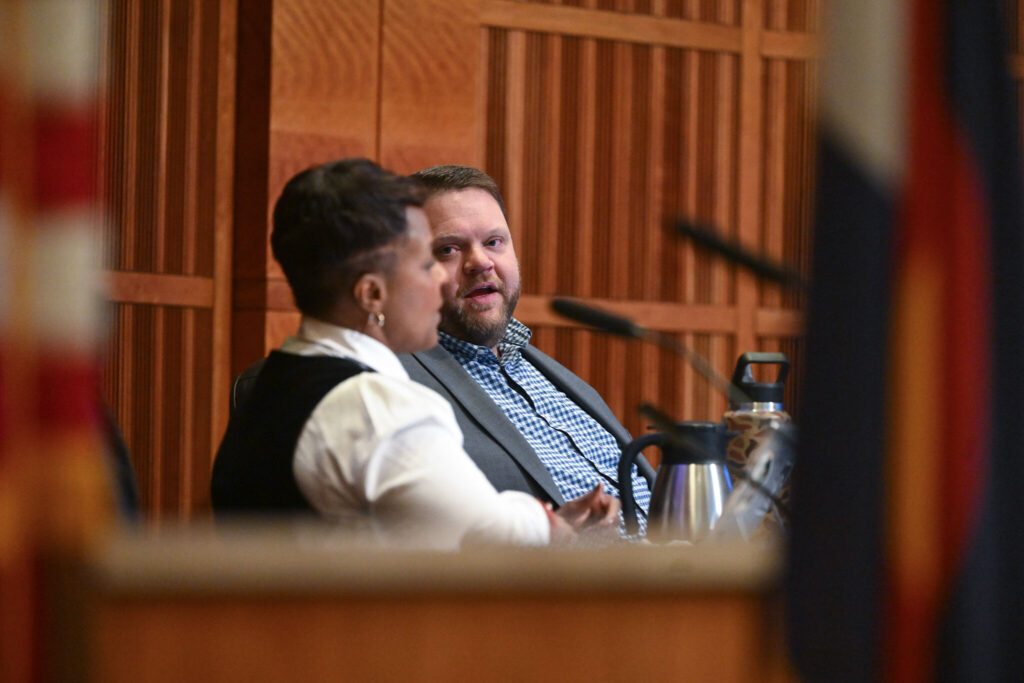
During the board’s meeting Friday, Deputy Attorney General Christopher Beall presented evidence that board president Donald Lefkowits had coordinated with various organizations, including the state medical society and hospital association, to give preference to the company that currently provides psychological assistance and counseling to Colorado’s physicians. The contract for those services was open for bid earlier this year, and the state awarded it to a competitor.
Beall walked the board and Lefkowits through a slideshow that contained emails Lefkowits had sent to those organizations, which Beall said indicated Lefkowits’s “firm position to keep the current provider.”
Beall said Polis’s legal counsel agreed with DORA’s decision that Lefkowits’s actions constituted a conflict of interest and that Lefkowits must recuse himself. Beall said the board had been provided a letter from Polis’s office supporting that finding.
Early Friday evening, a spokeswoman for DORA declined to provide the letter and other meeting materials to The Denver Gazette. Messages sent to the governor’s office were not returned.
Beall told the board that Lefkowits had declined to recuse himself, though another board member in a similar position had already done so. Beall asked the rest of the board to block Lefkowits from participating in the process. If he was not removed, Beall said, the state opened itself up to a challenge from the losing bidder, a challenge it would likely lose.
“It has been the case that Dr. Lefkowits has been involved in lobbying activity aimed at the governor, aimed at legislators and aimed at the board,” he said.
Lefkowits said he was insulted by some of Beall’s accusations and that he was biased only toward the “fair and ethical treatment” of physicians.
“I can tell you that as I see it, what I have is an informed decision and an informed opinion about what I think is best,” he said. “For instance, I know we have board members who have very informed and set opinions opposite of how I may feel, and (they) would very much like to see a change in peer provider. I’ve heard nothing of asking for recusal for them.”
The disagreement between the medical board and its parent organization, the Department of Regulatory Agencies, has been simmering for months.
In June, DORA unilaterally selected a new vendor to provide the counseling services, a decision that drew outcries from members of the medical community and the various organizations that represent them. The critics contended that DORA violated the Medical Practice Act, which gives the medical board sole authority to choose the vendor. They also feared that the new provider would not keep confidential the physicians who used the service, which, those critics say, would have a chilling effect on providers seeking help for fear that it could impact their medical license.
The current provider, the Colorado Physician Health Program, challenged DORA’s decision to give the Peer Assistance Services the contract. In November, an administrative law judge found that DORA acted improperly in selecting PAS, and she voided the decision, effectively restarting the process. Both CPHP and PAS are expected to submit bids again.
In a statement, a spokeswoman for CHPH declined to comment beyond saying that it was committed to physicians and providing “confidential expert peer assistance services” to them.
PAS did not return a request for comment.
The disagreement between the board and DORA came to a head Friday. In addition to the alleged lobbying, Beall accused Lefkowits of exploring with his attorney the possibility of “bringing a lawsuit against the medical board and DORA,” which “reflects, we believe, a clear conflict and requires his stepping away from the process.” Lefkowits denied that accusation.
Beall said that Lefkowits had violated the board’s code of conduct and the state’s rules governing procurements.
“We believe that the evidence reflected in the materials … demonstrated that Dr. Lefkowits has indeed been subject to external influence and that there is a risk that his involvement in the decision of a selection would advance the private interests of the coalition members who’ve been petitioning the medical board with regard to this issue,” Beall said.
Lefkowits responded by criticizing DORA for excluding the board in the process earlier this year, and he criticized PAS, the challenging bid, because it had “never, in its entire history, evaluated a physician, a physician assistant or an anesthesiologist.”
He said that after researching PAS, “the entire concept of protection of confidentiality was not even going to be a possibility.” He said he did not stand to gain anything from CPHP receiving the contract.
He said the organizations he’d communicated with weren’t a “cabal” but rather a group concerned “about the physicians they represent and the citizens for whom they provide care.”
“That’s been their motive,” he said. “That’s been my motive.”
Beall said Lefkowits’s suggestion about PAS having confidentiality issues was “inconsistent with what PAS proposed” and is “based entirely on supposition.” He said Lefkowit’s claims had “no merit.”
Lefkowits’s replied that he didn’t believe Beall.
The two went back and forth until other members of the board interjected. Lesley Brooks said she found the entire process and exchange “really uncomfortable.” She said that the central question facing Lefkowits was whether he could remain impartial, a question that she had not heard the board’s president address directly.
“I believe I’m fair minded, I believe I’m ethical, and I believe I can keep an open mind and make decisions based on being as informed as I possible can be,” Lefkowits replied.
Board member Keith Marks said he didn’t question Lefkowits’s integrity. But he did say the president was biased and that the emails Beall had displayed “show your intent to manipulate the board with your position.” He criticized Lefkowits’s violation of the code of ethics.
“My opinion is you were led, unfortunately — not because you’re a bad person — down this path without knowing what this would look like if there was a different vendor,” Marks said. “As if this board or DORA would abandon any of the physicians that are under care and put them in jeopardy. In all seriousness, Don, how dare you think that. I am personally offended, and I’m disappointed that you violated so many ethical issues.”
After a 10 second pause, Lefkowits said he disagreed, that a “fair amount” of what Marks said was inaccurate and again criticized the suggestion that the medical organizations were a “cabal.”
In statements to The Denver Gazette, two members of that “cabal” — the state medical society and hospital association — expressed their commitment to confidentiality for physicians seeking care. The medical society said it applauded Lefkowits’s efforts.
Fellow board member Roland Flores chimed in to say that he was inspired by Lefkowits and the strength of his convictions. But he worried that the board and DORA were losing the confidence of the medical community.
Beall again noted that the governor’s office and DORA wanted either Lefkowits or the board to recuse the president. Instead of making a motion to do so, board member Kian Modanlou asked the board to hold off on voting until more information about the bidding process was available. But that motion was defeated, with only three voting yes and seven voting no.
Before another motion was called, Lefkowits agreed to recuse himself, which prompted multiple board members to thank him, and another, Amanda Mixon, to tell him she looked up to him. Lefkowits briefly grew emotional before the board took a break.
Despite Lefkowits’s recusal and the criticism from Beall, the board voted at the end of the meeting to keep Lefkowits on as president. They also gave him the authority to appoint members of a panel to codify confidentiality policies, which would ensure that physicians’ use of the assistance program — regardless of provider — remains private.

Aurora lawmakers cast final vote to adopt tobacco, psychoactive substance retail license
Kyla Pearce
kyla-pearce@denvergazette.com
Updated 8 hours ago
Aurora City Council members cast a final vote Monday creating a retail license that limits and imposes certain restrictions on businesses that sell tobacco and other age-restricted psychoactive products. The intent of the license is to prevent youth access to...

Kyla Pearce
Reporter
Measles outbreak prompts 80 exclusions at Broomfield schools
Nicole C. Brambila nico.brambila@denvergazette.com
nico.brambila@denvergazette.com
Updated 8 hours ago
Eighty unvaccinated students and staff at Broomfield middle and high schools are not allowed to attend class in the wake of a measles outbreak, state health officials confirmed Tuesday. The majority of the exclusions are students, but they also include...

Challenging your brain helps keep it healthy. Here’s how to do it
Lauran Neergaard
lauran.neergaard@associatedpress.com
Updated 2 days ago
WASHINGTON (AP) — “Exercise your brain,” experts advise people hoping to stave off dementia. But how? Stretching your brain might be the better description. Do a crossword puzzle a day and you may just get good at crosswords. Instead, research...

Lauran Neergaard
Reporter

Colorado board delays vote on banning soda purchases with SNAP benefits
Marissa Ventrelli
marissa.ventrelli@coloradopolitics.com
Updated 2 days ago
The Colorado Board of Human Services voted to delay its decision on whether to allow Supplemental Nutrition Assistance Program recipients to use benefits to buy soft drinks. Under the “Healthy Choice Waiver,” SNAP recipients would be prohibited from using benefits...

Marissa Ventrelli
Reporter

Democrats eye new taxes on alcohol, marijuana to fund Colorado mental health spending
Marissa Ventrelli
marissa.ventrelli@coloradopolitics.com
Updated 2 days ago
Facing hundreds of millions in budget shortfall, Colorado lawmakers are searching for ways to fund mental health services in a state that consistently ranks among the worst in the nation for mental health outcomes. Several proposals this session aim to...
Marissa Ventrelli
Reporter

U.S. House probes reports of fraud, waste in Colorado’s Medicaid program
Marianne Goodland
marianne-goodland@denvergazette.com
Updated 2 days ago
A congressional committee is probing reports of waste, fraud and abuse in Colorado’s Medicaid program, citing recent stories outlining over-billing in transportation spending and alleged improper payments in autism services. The U.S. House Committee on Energy and Commerce has sent...

Marianne Goodland
Reporter

Data: U.S. maternal deaths fell in 2024 and may have dropped again last year
The Associated Press
the-associated-press@denvergazette.com
Updated 6 days ago
NEW YORK — Fewer U.S. women died around the time of childbirth in 2024, a government analysis shows, and provisional data suggests the trend may have continued last year. The U.S. Centers for Disease Control and Prevention on Wednesday reported...

The Associated Press
Reporter
Colorado declares measles outbreak after third case linked to Broomfield school
Nicole C. Brambila nico.brambila@denvergazette.com
nico.brambila@denvergazette.com
Updated 6 days ago
An unvaccinated Adams County child who tested positive for measles is tied to a case from Broomfield High School last month, leading state health officials to declare an outbreak. Colorado has four measles cases to date, amid a national outbreak....

Federal audit finds $77.8M in improper Medicaid payments for Colorado autism therapy
Nicole C. Brambila nico.brambila@denvergazette.com
nico.brambila@denvergazette.com
Updated 6 days ago
Colorado’s Medicaid payments for a therapeutic program for individuals with autism increased 172% in four years, prompting a federal audit by the Office of the Inspector General. Auditors found Colorado made $77.8 million in improper Medicaid payments for Applied Behavior...

Is your diet causing UTIs? Here’s how it may be at fault
Tribune News Service
tribune-news-service@gazette.com
Updated 1 week ago
Miriam FauziaThe Dallas Morning News UTIs can be painful, and they’re not something people like to talk about. But they happen often, affecting an estimated 60% of women and 20% of men in their lifetimes. While we might view these...

Tribune News Service
Reporter
PREV
PREVIOUS

Members of state eviction task force ask Polis to extend moratorium through 'at least January'
Facebook Twitter WhatsApp SMS Email Print Copy article link Save Six members of Gov. Jared Polis’s eviction task force have asked the governor to extend his moratorium blocking landlords from removing tenants from their homes, days before both his and a federal order are set to expire. “Many of us expressed concern during our tenure […]

Questions raised about Custer County public health director's education, qualifications
In mid-2020, when the coronavirus pandemic was raging in Colorado, Custer County was about to lose its public health director. It would be one of 12 counties in Colorado at that time without one. But the county got lucky. It found someone who appeared to be qualified in its own backyard: Dr. Clifford Brown, who […]