







Reaction to Colorado Health Care Option draft bill: Industry groups hate it, consumer health advocates love it

Reaction to the first draft of the Colorado Health Care Option bill, sponsored by Rep. Dylan Roberts, D-Eagle, and Sen. Kerry Donovan, D-Vail, runs the gamut.
The draft bill, first reported by Colorado Politics, sets a two-year timeline for the health industry to reduce premiums by 20% for the individual group market. Should that fail, the state would set up a quasi-public health plan to cover the individual and small group market, a total of about 15% of all insured people in Colorado. The state option, which would go into effect Jan. 1, 2025, would set rates for healthcare services in an attempt to reduce costs.
The responses to Colorado Politics ranged from full-throated support to equally full-throated opposition, with a view that stayed between.
Support from health groups
“Reducing premiums would undoubtedly help the many patients Colorado physicians see who worry about paying for their care and medications, and even people who put off care,” said Dr. Kristen Nordenholz, an ER physician in Aurora and member of the Colorado Chapter of the Committee to Protect Medicare. “Literally every day I see patients in the ER who end up there with life-threatening conditions because they didn’t have access to preventive care and medications like insulin. If the Colorado Option is implemented, my patients and all Coloradans will have more affordable choices for their healthcare. That means more will be able to get the preventive healthcare, medications, and therapy that will help them stay healthy and thrive.”
The Colorado Consumer Health Initiative, which played a major role in the 2020 bill, called the 2021 version an opportunity for the healthcare industry to do what it says it can: lower the costs. CCHE Deputy Director Adam Fox said in a statement that “Even before the pandemic, 1 in 5 Coloradans — over 1 million people — were struggling to afford their health coverage and care. The situation has only gotten worse because of COVID as people have lost coverage and small businesses struggle even more to provide expensive coverage for their employees. The pandemic has highlighted the racial disparities that have long existed in our health care system and this legislation will help alleviate those inequities with better coverage at a more affordable cost.”
If the industry cannot reduce costs or refuses to do so, Fox said, “the Colorado Option will be established to lower costs and improve affordability. Either way, this proposal ensures more affordable and quality coverage options are available to all people living in Colorado.”
“Affordable health care is not political,” said Healthier Colorado‘s deputy executive director Hillary Jorgensen. “This bill is an earnest attempt to give the healthcare industry the space and support to lower costs on their own. They repeatedly asked for this opportunity last year. We look forward to lifting the voices of people across this state who desperately need this bill to pass. Now is the time for bold movement and we applaud Rep. Roberts and Sen. Donovan for their work on this critical piece of legislation.”
Good Business Colorado, a left-leaning business group, also weighed in. Executive Director Debra Brown said that “small businesses in Colorado need relief, especially during this pandemic. Lowering the cost of healthcare is a top priority for Good Business Colorado and our members … we appreciate that the draft includes a small group option from the get-go and that it prioritizes public health equity. While the details are still in motion, it is well on its way, and that is good because our small business members don’t have time to let another session go by without health care reform that lowers costs and helps our business community build back.”
In the middle, but talking
Katherine Mulready, senior vice president and chief strategy officer for the Colorado Hospital Association, said Tuesday that the CHA had been in discussions with the bill sponsors since the beginning of the year, but Tuesday was the first time that they had seen draft language.
“Those conversations have been productive in trying to ascertain the goals. The bill takes a market-based approach, at least initially, allowing the healthcare industry two years to come up with a 20% premium rate cut. “I’ll take a market-based approach over a state-based approach any day,” Mulready said.
But at the same time, “we have a long way to go to see if the draft really sets the market up for success in phase one, or if it seems to be a predetermined outcome that we will migrate to phase two. Obviously that’s not our preference. “
Hospitals are committed to improving affordability and healthcare value, she added. “Does the draft strike it on the head and we don’t have changes? No. Is it something we’re willing to discuss, at this stage? Yes.”
The bill’s timeline for its first hearing — likely before month’s end — is also something of a concern. “It would have been better to engage the industry on the front end if they want this to work,” Mulready said. It doesn’t leave the industry a lot of time to find a workable solution. “We’ll do everything we can, but the clock is ticking.”
Opposed, adamantly
Colorado’s Health Care Future, an advocacy organization tied to the Partnership for America’s Health Care Future Action, which is funded by hospitals, pharmaceutical companies and health insurers that are opposed to Medicare for All or similar public-option-style plans.
In a statement Tuesday to Colorado Politics, spokesman Tyler Mounsey said that much of the healthcare community had been left out of the conversations around the Colorado Health Care Option, including analysis and actuarial estimates. The draft bill “only offers more of the same from last year’s failed public option bill. It is disappointing that lawmakers are willing to check-the-box instead of providing answers to important questions about the impacts of the bill and respond to concerns raised by vested stakeholders.”
The only difference between last year’s bill and the draft this week is that the sponsors propose a two-year timeframe for the health care community to meet the financially unattainable cost-cutting measures, Mounsey said. “No matter what the timeframe, the state government option would put politicians in control of Coloradans’ health care, could increase costs for Coloradans, and hurt patients’ access to quality care, services, and coverage choices.”
Colorado’s Health Care Future also released a study, conducted by FTI Consulting, that looked at the impact of the Colorado Health Care Option on racial and ethnic minority groups. The bill purports to deal with racial health care equity and to address long-standing racial disparities in health care.
The study was based on the 2020 version of the public option bill, which has similarities to the 2021 draft on Tuesday. Rate setting under the state government option, which the study assumed would be capped at 185% of Medicare, would lead to significant losses in hospital reimbursements over time, the study said. That reduction in revenue could put as many as 23 rural hospitals at increased risk of closure and result in millions in lost revenue for hospitals statewide.
And that could hurt both Black and Hispanic residents, the study warned. Nearly one-third of at-risk hospitals serve communities with Black populations; hospitals serving Hispanic communities all over the state would be especially hard hit.
The study listed 22 hospitals that would be at high financial risk; nine are in counties with at least 33% minority populations; seven of the nine are in the greater Denver metro area.
The study was paid for by the Partnership for America’s Health Care Future Action.


Almost 40 apply for board to oversee revitalization of Colfax Avenue
Kyla Pearce
kyla-pearce@denvergazette.com
Updated 10 hours ago
Aurora officials received almost 40 applications for the Aurora Downtown Development Authority Board that will oversee the revitalization of Colfax Avenue. The application period ended Saturday, and an Aurora spokesperson said 38 people applied. Of the 38 applicants, 32 met...

Kyla Pearce
Reporter

Denver police chief on mask ban, mayor’s orders: ‘What enforcement looks like, I’m not exactly sure’
Deborah Grigsby
deborah.smith@denvergazette.com
Updated 8 hours ago
Denver bans wearing of face masks by law enforcers, use of city property to stage immigration operations As Denver takes steps to restrict federal agents conducting immigration enforcement in the Mile High City, its police chief said he is unclear...

Deborah Grigsby
Reporter
Colorado Gov. Jared Polis ignites fierce debate after raising clemency questions in Tina Peters case
Marianne Goodland
marianne.goodland@coloradopolitics.com
Updated 9 hours ago
Gov. Jared Polis ignited a political firestorm Tuesday night after weighing in on the prison sentences of two former Colorado officials — a Democrat and a Republican — convicted of attempting to influence a public servant. The comments quickly fueled...

Marianne Goodland
Reporter

Gov. Jared Polis, Upper Basin states criticize federal draft plan for managing the Colorado River
Marianne Goodland
marianne.goodland@coloradopolitics.com
Updated 11 hours ago
With no agreement among the seven Colorado River states, which missed multiple federal deadlines, the Upper Colorado River Commission on Monday sharply criticized the U.S. Department of the Interior’s draft plan for managing the river after the current guidelines expire...
Marianne Goodland
Reporter
Colorado lawmakers tackle legislation on sexual assault
Jenny Deam
jenny.deam@gazette.com
Updated 15 hours ago
A panel of Colorado lawmakers on Monday unanimously approved a bill that supporters say will offer protections and support to victims of domestic violence, stalking, sex trafficking and sexual assault, including mandatory training for law enforcement on trauma. The measure,...

Jenny Deam
Reporter

Denver adopts face mask ban for law enforcement
Deborah Grigsby
deborah.smith@denvergazette.com
Updated 1 day ago
Members of the Denver City Council unanimously approved an ordinance Monday that prohibits law enforcement officers, including federal immigration agents, from wearing a mask or face covering while interrogating, detaining, or arresting an individual within Denver, including in city-owned buildings....
Deborah Grigsby
Reporter

More than 20 Colorado counties receive grants to improve land record-keeping systems
Maren Prince
maren.prince@denvergazette.com
Updated 1 day ago
More than 20 Colorado counties received a total of $2.5 million to improve their land record-keeping systems, according to a Monday news release. The State’s Electronic Recording Technology Board awarded 22 counties with grants ranging from $5,000 to $350,000, according...

Maren Prince
Reporter

Denver among top 5 finalist cities for 2028 DNC
Deborah Grigsby
deborah.smith@denvergazette.com
Updated 22 hours ago
Denver is among the five cities that could host the 2028 Democratic National Convention, the Democratic National Committee announced Monday. Along with Denver, Philadelphia, Atlanta, Boston and Chicago have advanced in the application process to host the next DNC, which...
Deborah Grigsby
Reporter
Colorado Senate swears in Adrienne Benavidez after SD 21 vacancy win
Marianne Goodland
marianne.goodland@coloradopolitics.com
Updated 3 days ago
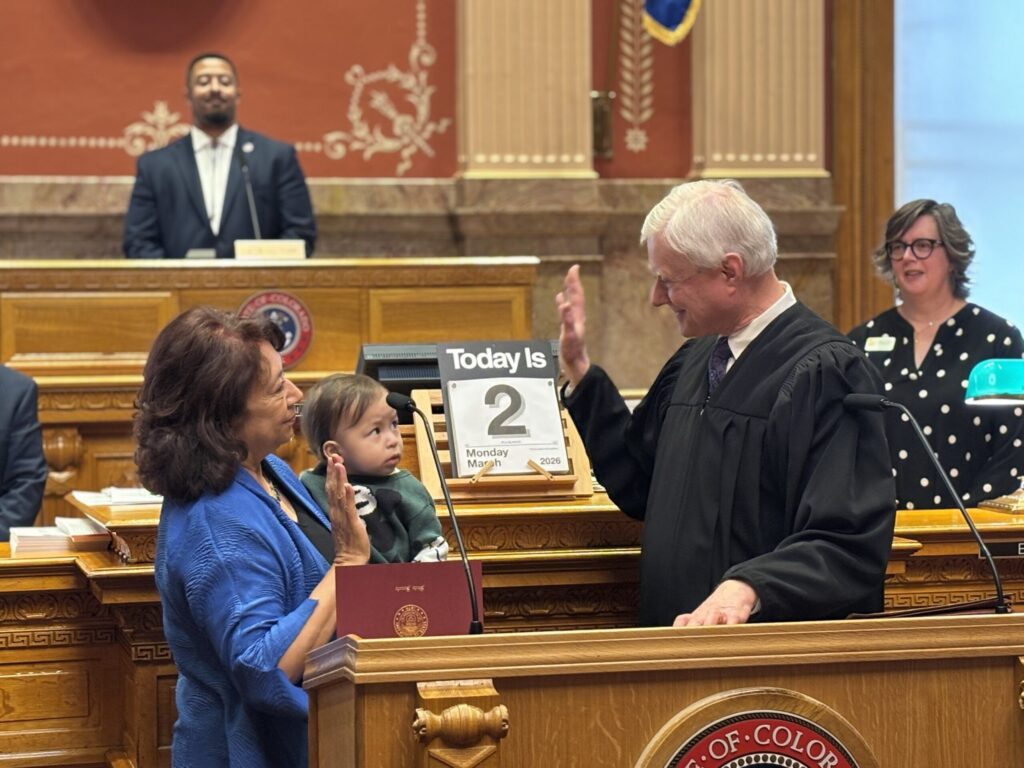
Sen. Adrienne Benavidez, D-Adams County, was sworn in Monday to the Colorado Senate, just four days after winning a vacancy election in District 21. She was sworn in by Colorado Court of Appeals Justice Lino S. Lipinsky de Orlov. Usually,...
Marianne Goodland
Reporter
Colorado Senate swears in Adrienne Benavidez after district vacancy win
Marianne Goodland
marianne.goodland@coloradopolitics.com
Updated 3 days ago
Sen. Adrienne Benavidez, a Democrat from Adams County, was sworn in Monday to the Colorado Senate, just four days after winning a vacancy election in District 21. She was sworn in by Colorado Court of Appeals Justice Lino S. Lipinsky...
Marianne Goodland
Reporter
PREV
PREVIOUS

Draft of public option bill shows healthcare industry has two years to reduce premiums by 20%
Facebook Twitter WhatsApp SMS Email Print Copy article link Save This article has been updated with initial reaction from the Colorado Hospital Association and the advocacy organization Colorado’s Health Care Future, funded by leaders in healthcare. Colorado Politics has obtained a copy of the draft bill that could soon become the Colorado Option Health Benefit […]

Denver City Council to consider social equity plan for marijuana delivery, hospitality
Facebook Twitter WhatsApp SMS Email Print Copy article link Save The Denver City Council Finance & Governance Committee discussed a series of bills Tuesday to establish marijuana delivery and hospitality businesses with a social equity plan. Ashley Kilroy, executive director of Denver’s Excise and Licensing division, presented the bills during the committee meeting. “Together we […]