







Analysis: Biden could face test if battle erupts for Taiwan | Tom Roeder

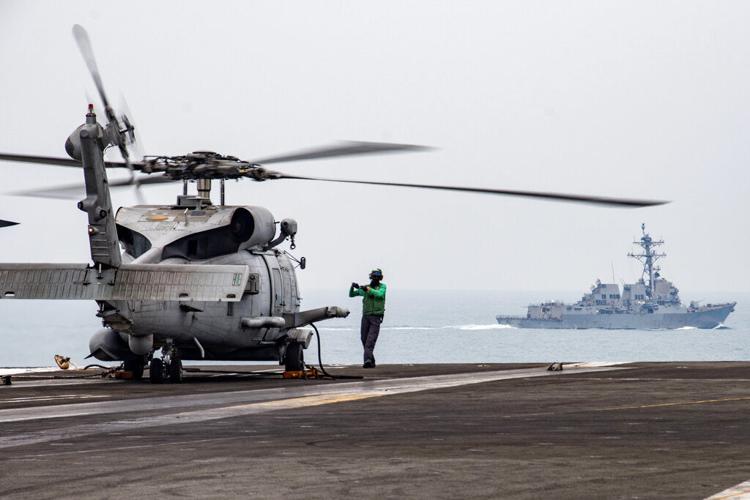
The USS Ronald Reagan and USS Nimitz Carrier Strike Groups in formation in the South China Sea in July.
Petty Officer 3rd Class Jason Tarleton/Navy via the associated press

The White House and the Pentagon have unveiled an early look at the Biden administration’s national security policy and two items top the list: growing alliances and countering China.
The first reverses course from the Trump administration, which backed away from many partnerships with its “America First” policy.
Instead, President Joe Biden wants to make more friends around the globe, extending America’s influence, especially in Asia.
Analysis: Defense boss Austin missed chance to showcase troops | Tom Roeder
That focus on Asia and the Pacific lines up with Biden’s view of the top threat facing America
In a report titled “Interim National Strategic Guidance,” the Biden administration sounded the alarm over growing Chinese threats.
“China, in particular, has rapidly become more assertive,” the report said. “It is the only competitor potentially capable of combining its economic, diplomatic, military and technological power to mount a sustained challenge to a stable and open international system.”
The administration’s top goal is deterring China to stave off a future conflict. But it remains unclear how the U.S. would approach the conflict most likely to erupt: a battle between China and Taiwan.
In a letter to troops, Defense Secretary Lloyd Austin outlined the Pentagon’s plan for countering the rising Chinese threat.
“The Department will prioritize China as our number one pacing challenge and develop the right operational concepts, capabilities, and plans to bolster deterrence and maintain our competitive advantage,” he wrote. “We will ensure that our approach toward China is coordinated and synchronized across the enterprise to advance our priorities, integrated into domestic and foreign policy in a whole-of-government strategy, strengthened by our alliances and partnerships, and supported on a bipartisan basis in Congress.”
For two decades, China has grown and modernized its military. From stealthy jets to aircraft carriers, China followed American examples to build a modern force that is unmatched in Asia.
Colorado Springs Mayor Suthers: Air Force’s Space Command decision ‘absolutely comical’
China’s defense ministry issued a statement last week saying its military might is purely defensive. But at the same time, the statement sent a disturbing signal about Taiwan.
“China must not lose an inch of the territory that the country’s ancestors have left behind.” the ministry said.
That bolsters China’s ambition to take over Taiwan, which split from the mainland at the end of the Chinese civil war in 1949 when he U.S. backed-nationalists retained Taiwan as the communists took over.
China has continually asserted that Taiwan is part of it, claiming it is a rebellious province rather than a separate nation. In 2019, China’s President Xi Jinping said Taiwan “must and will” be reunited with the mainland.
China has sought dominance over the Taiwan Strait separating the territories and has built artificial islands laden with airstrips and military installations to bring more force to bear against its neighbor.
Biden has offered statements of support for Taiwan and has put the Navy on patrol in the Taiwan Strait.
In recent weeks, China has worked to ease tensions with Washington.
“As for what is other people’s, China does not want at all,” the Chinese defense ministry said. “The building and development of China’s national defense and armed forces is entirely driven by the need to safeguard China’s national sovereignty, security and development interests, not targeting any country or not posing threat to any country.”
But if war erupts between China and Taiwan, Biden will have a tough decision to make. Backing away from Taiwan could lead to more Chinese aggression in Asia.
Defending Taiwan would pit American troops against a superpower with nuclear weapons.
Contact Tom Roeder: 636-0240
Twitter: @xroederx