







Metro Denver’s newest subdivision growing rapidly

Tyson Hellmich and Chris Binkley at their Sterling Ranch home.
Stephanie Renae Hall Photography


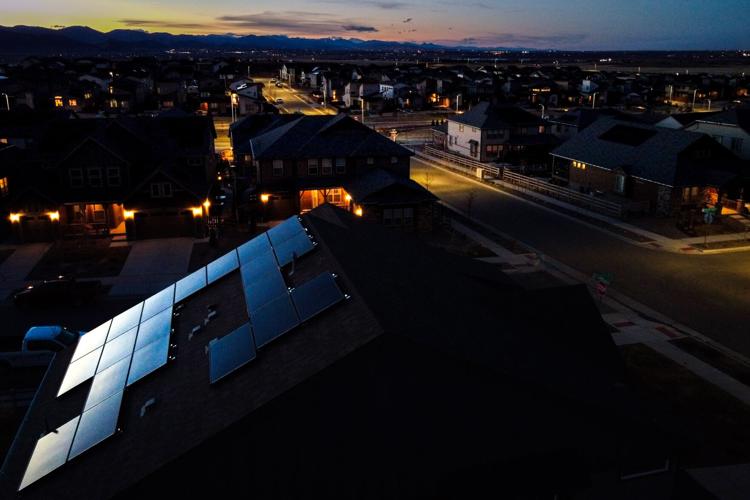


After more than 10 years of legal wrangling, infrastructure building and two economic downturns, the Sterling Ranch subdivision in northwest Douglas County has become one of the hottest-selling master planned communities in metro Denver.
The brainchild of Harold and Diane Smethills, Sterling Ranch will eventually cover six square miles, 3,400 acres, in the Chatfield Valley.
“Sterling Ranch have really been pioneers,” said Natasha Gandhi, division president for Richmond American Homes. “They really put the consumer in the forefront. In developing this community, and brand and place – it’s more customer-centric, rather than builder or developer-centric.”
Richmond, owned by M.D.C. Holdings Inc., was Sterling Ranch’s original homebuilder. It delivered the master-planned community’s first homes in late 2017, early 2018. Now there’s 850 occupied homes, and 120 more have been sold since Jan. 1, said Brock Smethills, president. Homes there range from $490,000 to $1.2 million.
As Denver emerges post-pandemic, will shared streets stay?
Sterling Ranch has 620 lots adjacent to Roxborough under development – all but 109 are sold.
What’s more, homebuilding companies have snapped up another 2,445 lots – ensuring robust development for years to come. It’s permitted to grow up to 12,050 dwelling units.
“It’s the top-selling master planned community in metro Denver,” said Smethills, Harold and Diane’s son.
The housing market here couldn’t be better for its growth, with home inventory at record lows and the average sales price in Denver soaring to almost $600,000, according to the Colorado Association of Realtors.
Harold Smethills’ vision for the community has taken a bit longer to materialize than they first estimated. But the former executive vice president and CFO of Adolph Coors Co. said they’ve held tight to the design standards, community emphasis and sustainability efforts.
“We here in Colorado grew up with sustainability as a way of life,” he said.
The development took longer than other master-planned communities because of Douglas County’s requirement that infrastructure like roads, sidewalks and sewer lines be in place before homes start going up.
Brock Smethills said in addition to the community’s roads – sprinkled liberally with roundabouts – Sterling Ranch has inter-governmental agreements to help extend Titan Road, build a Waterton Road extension connecting the development with Colorado’s third largest employer Lockheed Martin’s Waterton Campus, and create a second access road from Santa Fe Boulevard.
Around the House: Don't let unwanted snow dampen your day
Sterling Ranch also built a $27 million water pipeline. And, to provide one of the most popular features of the development, it built its own fiber-optic line network for strong internet connections. Since Comcast and CenturyLink had no plans to provide service to the area “the only way to ensure it was to build our own,” Harold Smethills said.
Hana Renstrom and her family are members of the “Pioneer Club” – the first residents to own homes in Sterling Ranch.
“We moved here for the location,” Renstrom said. “I grew up in Highlands Ranch. My parents were one of the first homes in Highlands Ranch, before it even existed. So we’re part of the first 100 for Sterling Ranch. Being a part of something growing is exciting.”
Renstrom said the emphasis on community was apparent from the get-go.
“We got to know our neighbors right off the bat,” she said. “It still focuses on that small town feel. These short fences were a very specific decision by developers to better create community.”
The family appreciated the way Sterling Ranch held events and social gatherings every Wednesday for two months during the summer of 2019. Then they got creative in 2020 and did video conference events like a murder mystery night, bingo and cooking classes, Renstrom said.
High and Dry: Colorado in Drought — Scientists preparing for 'chaotic weather' future
Residents enjoy the coffee shop and Grist Brewery outlet at the community center called Sterling Center. And the daily food trucks are popular, as there’s no restaurants in the development yet.
Lumiere Fiber Chief Operating Officer Walker Hinshaw said conservation and sustainability elements are baked into home buying/building process.
“I credit the Smethills for being visionaries for conservation here,” he said. “Energy conservation is a big focus …Our homes go above and beyond efficiency standards set by code – we set the bar higher.”
They consulted with the Denver Botanic Gardens for low-water plant options for landscaping. The company has partnered with two solar companies to offer home buyers discounts on solar roofs on new homes.
“With our solar made simple program, we actually make it harder to opt out of solar,” he said.
Even if homebuyers don’t take the option immediately, the homes are solar-ready, Hinshaw said. Garages either have 220 volt outlets – electric vehicle ready – or are pre-wired for easy installation.
“Our goal is to be powered by 100% renewable electricity by 2030,” Hinshaw said. “We hope to have carbon-neutral energy supply by 2040, which isn’t going to be easy.”
Resident Tyson Hellmich said those efforts attracted him and his husband, Chris Binkley.
“When we were doing our research on what the community would be, that absolutely attracted us,” Hellmich said. “That 1G internet was super attractive, as we both work from home – so reliable, fast internet is important.”
Like the Renstroms, Hellmich and Binkley felt welcome from the beginning.
“What struck us immediately was the community and the people,” he said, noting Harold Smethills is a regular presence at the Sterling Center.
“He’s always out there talking to people,” Hellmich said. “He’s not shy about telling residents the behind-the-scenes stuff going on, like how they designed the streets and pockets of homes to deter possible foothills fires.”
The development isn’t only single family homes, either. Dream Finders Homes have built townhomes there, and an apartment complex is on the horizon.
“We sold out almost all of our first phase of 48 units, so we’re on to our second phase of 48 and there’s two other phases coming,” said Jamie Mott, Dream Finders division president. “We just kept buying land.”
The townhomes give a little lower price point at $440,000, and also appeal to the retirees or singles who don’t want the size or maintenance of a single-family home, he said.
“Potentially at some point we’re going to have standing inventory, but we’ve been pre-selling everything,” Mott said. “They’ve done a great job of setting the standard, which is not typical in other communities, as far as things like architecture and color. The attention to detail is amazing.”