







Colorado Option Health Benefit bill introduced to cheers and jeers

(Photo by Foremniakowski, iStock)
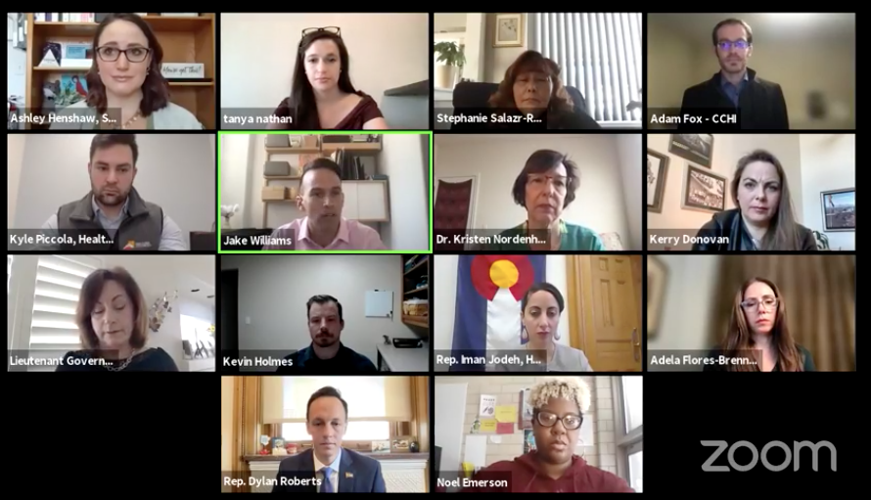
The Colorado Option Health Benefit bill, scheduled for introduction Thursday afternoon, is now on its journey through the legislative process.
The 2021 version is sponsored by Reps. Dylan Roberts, D-Eagle and Iman Jodeh, D-Aurora; and in the Senate by Sen. Kerry Donovan, D-Vail. Roberts and Donovan sponsored the 2020 version that went by the wayside because of the pandemic and the need for more work on the bill.
The fight over the 2021 bill is not likely to be any less contentious.
An earlier draft set up a two-year window for the health industry, including insurers and hospitals, to reduce premiums in the individual market by 10% per year. However, the latest version also adds the small group market as part of the 20% target. Roberts told Colorado Politics that “small businesses are struggling just as badly, if not more badly, as individuals from high insurance costs. It doesn’t make it harder, if they are coming together to negotiate on how to accomplish reductions in the individual market, it will not be that challenging for them to also consider the small group market (a market only as big, if not smaller, than the individual market).”
The individual market is for those who buy their own health insurance plans, often through the Colorado Exchange. That’s about 8% of the total insured market. The small group market, which is employers with fewer than 50 employees, is about 15% of the insured market.
The bill’s latest version stripped out a requirement that there be at least two health insurers per ZIP code.
Under the introduced version, should the industry not be able to reduce premiums by 20% by 2024, the state would launch in 2025 a state-run nonprofit plan, complete with price controls to ensure lower premium costs.
According to a fact sheet from the sponsors, the healthcare industry wanted the chance to control costs and bring down premiums on their own. The two-phased approach outlined in the bill gives the industry (hospitals, insurance carriers and drug manufacturers) the chance to work together to lower healthcare costs.
The Colorado Health Insurance Option, which would be developed by the Commissioner of Insurance if the industry fails to meet targets, is a long-term solution for affordable insurance options, and holds the entire healthcare industry accountable, proponents said in the fact sheet. “A standardized plan will ensure out-of-pocket costs are low and make it easier to shop for plans.”
Part of the bill’s intent is to address the affordability of health insurance in rural areas and for historically underrepresented groups, including people of color and undocumented Coloradans.
During a Thursday news conference, Lt. Gov. Dianne Primavera said the bill is a balanced approach to bringing more affordable health insurance options to the individual and small employer markets. “The bill does not advocate … for government-sponsored health care. Instead, the Colorado Option provides an opportunity for industry partners to innovate to make healthcare more affordable with minimal government direction.”
By offering carriers the opportunity to negotiate to meet premium reduction targets, the Colorado Option allows for private sector innovation and to add competition to the market, she added.
Roberts said during the news conference that in the counties he represents, Eagle and Routt, there is only one health insurance option. The price of a plan for a family can be close to $40,000 per year; for a business, it’s unrealistic because of the cost. “My area of the state has an uninsured rate higher than the rest of the state,” he said. “Our number-one priority for the bill is to provide cheaper care for Coloradans.
“We are coming forward with a new, innovative and collaborate two-phased approach” based on pledges from the industry to lower premium costs on their own, Roberts added. “This year’s proposal will take them at their word,” to provide cheaper care without compromising quality.
For the one in five who struggle to pay for health care, the current system that protects profits and not patients isn’t working, Donovan said.
“We refuse to accept that there’s nothing that can be done. Mountain and rural communities have the highest health care costs in the country,” she added. The Colorado Option “is our best chance” to increase access and lower the cost of health insurance.
First-term lawmaker Jodeh said she’s sponsoring the bill because of her own experience with health care, including being uninsured.
“This bill will help keep people healthy at a time that’s more urgent than ever,” she said. She also blasted the corporate health care industry for its million-dollar campaign against the bill.
“These negative ads claim [the bill] will increase premiums. The industry doesn’t need any help on that point,” Jodeh said. Decades of systemic racism in healthcare has hurt communities of color who are uninsured at far higher rates than white Coloradans, she explained. They are burdened with more medical debt than white people, and “those that benefit from these inequities are crying foul.”
At 15, when she was diagnosed with a pre-existing condition, she remembers her mother writing a $350 check for a 15-minute doctor visit. Her father, who owned a business, couldn’t afford health insurance. “I want to fix the problem” for small businesses, she said.
But health insurers claim the bill sets up the industry for failure, and question how the provisions will actually benefit the targeted groups who can’t afford health insurance.
Price controls for health services feature prominently under the state’s phase two plan, according to Katherine Mulready of the Colorado Hospital Association. The association likes the market-based approach in phase one, she said, but it needs to be crafted in a way that allows the market a fair shot to meet the goals. As currently drafted, “we’re being set up for failure,” feedback that they have provided to the sponsors.
Phase two goes too far, she added, by giving too much authority to the commissioner of insurance. It also causes a lot of uncertainty that could damage health care access and quality. “We and our members are deeply committed to providing health care affordability, supporting legislation and being at the table for solution such as reinsurance We’re now just seeing results of those efforts. This proposal ignores those improvements.”
The association is committed to collaboration and to be part of the market-driven solution, Mulready said.
The base upon which the reductions would be taken also is different from a previous version. Under a March 1 draft, the base from which premium reductions would be taken included any mandates in health benefits adopted before Jan. 1, 2023. However, the new version allows for continuous addition of new benefit mandates that aren’t even in law now, creating a moving target designed to ensure health insurance carriers will not be able to meet the premium reductions, the opponents claim.
While Gov. Jared Polis told lawmakers last year he did not want any more benefit mandates from the General Assembly, in an effort to keep health insurance premiums down, that hasn’t stopped lawmakers from sponsoring bills in the 2021 session that would add more mandates (and cost) to health insurance coverage. That includes annual mental health wellness exams (House Bill 1068), and preventive services for osteoporosis screening; urinary incontinence screening; and counseling, prevention, screening, and treatment of a sexually transmitted infection (Senate Bill 16).
Roberts was asked Thursday how insurers can reach the 10% annual benchmark while health benefit mandates that increase costs could be added at the same time. Roberts didn’t directly answer the question, instead saying that the benchmarks are a realistic target. “We’re asking for a reasonable reduction in prices,” Roberts said. “We think this is fair,” adding that sponsors will continue to talk to stakeholders if they want to provide alternatives to the benchmarks.
The Colorado Association of Health Plans, in a statement Thursday, said the bill “is not feasible and is destined to move Colorado towards one government option for your healthcare where people will have to pay more, to wait longer, for worse care.”
CAHP Executive Director Amanda Massey said health plans have worked hard to reduce premiums by 28% in the last two years and to increase competition across Colorado counties.
That includes reducing the number of counties without at least two insurers from 22 to 10 in the last year, without it being required by state law, Massey told Colorado Politics.
“Instead of continuing to partner with health plans to build upon this unprecedented progress, this proposal ignores these recent successes achieved by the market in favor of arbitrary, moving targets that will ensure industry failure,” Massey said.
Tyler Mounsey, spokesman for Colorado’s Healthcare Future, a project of the industry-backed Partnership for America’s Healthcare Future, said in a statement that the proposal “would put politicians in control of Coloradans’ health care – instead of patients and medical professionals – and could increase costs for Coloradans, while threatening patients’ access to quality care, services, and coverage choices. Coloradans deserve proven solutions that provide access to affordable, high-quality health coverage and care. Lawmakers should slow down, conduct a full analysis of the proposal and instead work together to build on and improve what’s working in health care – not start over by creating a one-size-fits-all new government health insurance system.”
Colorado’s Healthcare Future is running a million-dollar media campaign (including ads on Colorado Politics) against the bill.
Kelly Brough, executive director of the Denver Metro Chamber of Commerce said in a statement that although being pitched as a market solution, “the truth is directing carriers to provide a specific government product and dictating the cost of that product ensures we lose all the value associated with creating a competitive marketplace. We also have ongoing specific concerns about the legislation as well. The timelines and arbitrary thresholds in the bill are intended to guarantee that the private sector isn’t going to be given the time or the opportunity to meet the goals of the bill, which means a public option is a foregone conclusion.
“Health care is complex, fragile and far too important to the wellbeing of Coloradans and the stability of our economy to allow for a risky and sweeping plan like this to advance,” Brought added. “While the introduced bill is not something we can support, we are hopeful that we can find common ground with sponsors and advocates to advance a more reasonable, truly market-based and stepwise approach that reduces costs for Coloradans.”


Colorado lawmakers tackle legislation on sexual assault
Jenny Deam
jenny-deam@denvergazette.com
Updated 41 minutes ago
A panel of Colorado lawmakers on Monday unanimously approved a bill that supporters say will offer protections and support to victims of domestic violence, stalking, sex trafficking and sexual assault, including mandatory training for law enforcement on trauma. The measure,...

Jenny Deam
Reporter

Denver adopts face mask ban for law enforcement
Deborah Grigsby
deborah.smith@denvergazette.com
Updated 10 hours ago
Members of the Denver City Council unanimously approved an ordinance Monday that prohibits law enforcement officers, including federal immigration agents, from wearing a mask or face covering while interrogating, detaining, or arresting an individual within Denver, including in city-owned buildings....

Deborah Grigsby
Reporter

More than 20 Colorado counties receive grants to improve land record-keeping systems
Maren Prince
maren.prince@denvergazette.com
Updated 15 hours ago
More than 20 Colorado counties received a total of $2.5 million to improve their land record-keeping systems, according to a Monday news release. The State’s Electronic Recording Technology Board awarded 22 counties with grants ranging from $5,000 to $350,000, according...

Maren Prince
Reporter

Denver among top 5 finalist cities for 2028 DNC
Deborah Grigsby
deborah.smith@denvergazette.com
Updated 40 minutes ago
Denver is among the five cities that could host the 2028 Democratic National Convention, the Democratic National Committee announced Monday. Along with Denver, Philadelphia, Atlanta, Boston and Chicago have advanced in the application process to host the next DNC, which...
Deborah Grigsby
Reporter
Colorado Senate swears in Adrienne Benavidez after SD 21 vacancy win
Marianne Goodland
marianne.goodland@coloradopolitics.com
Updated 2 days ago
Sen. Adrienne Benavidez, D-Adams County, was sworn in Monday to the Colorado Senate, just four days after winning a vacancy election in District 21. She was sworn in by Colorado Court of Appeals Justice Lino S. Lipinsky de Orlov. Usually,...

Marianne Goodland
Reporter
Colorado Senate swears in Adrienne Benavidez after district vacancy win
Marianne Goodland
marianne.goodland@coloradopolitics.com
Updated 2 days ago
Sen. Adrienne Benavidez, a Democrat from Adams County, was sworn in Monday to the Colorado Senate, just four days after winning a vacancy election in District 21. She was sworn in by Colorado Court of Appeals Justice Lino S. Lipinsky...
Marianne Goodland
Reporter

Aurora, Holmes reach settlement in First Amendment lawsuit
Kyla Pearce
kyla-pearce@denvergazette.com
Updated 21 hours ago
Aurora officials and activist MiDian Holmes (Shofner) announced a settlement Monday in a First Amendment lawsuit filed by Holmes almost a year ago. The lawsuit claimed the decision by Aurora City Council members to end public comment pending a decision...

Kyla Pearce
Reporter

Denver mayor says his commute time tripled following ‘road diet’ change
Mark Samuelson
mark-samuelson@denvergazette.com
Updated 19 hours ago
Mayor Mike Johnston is pushing back sharply against the claim by Denver councilmembers and bike activists that the city succumbed to lobbying pressure in revising a “road diet” plan for East Alameda Avenue, while noting that his own commute time...

Mark Samuelson
Reporter

Rural legislators, Colorado farmers defeat pollinator bill backed by Gov. Polis
Marianne Goodland
marianne.goodland@coloradopolitics.com
Updated 2 days ago
A proposal to limit the use of neonicotinoid-coated crop seeds collapsed in the Senate Agriculture and Natural Resources Committee last week, as rural lawmakers, including two Democrats, joined Republicans to reject what they called an expensive, impractical mandate on farmers....
Marianne Goodland
Reporter

Competing overtime bills for agriculture workers split Colorado Democrats
Marianne Goodland
marianne-goodland@denvergazette.com
Updated 2 days ago
Competing bills setting the overtime threshold for farmworkers have split legislators at the Colorado state Capitol, with one group saying a law passed in 2021 has harmed, rather than helped, farming operations and workers alike, while the other side insists...
Marianne Goodland
Reporter
PREV
PREVIOUS

A moment to honor Latinos, Irish and Atlanta shooting victims turns heated in state House
Facebook Twitter WhatsApp SMS Email Print Copy article link Save A moment to honor Latinos and St. Patrick’s Day turned into a battle over white supremacy on the House floor Wednesday. It started off as a vote on Senate Joint Resolution 5, which recognizes Latino Advocacy Day. The resolution stated that Latinos are a key […]

Griswold testifies in support of bill to prevent foreign influence in Colorado elections
Facebook Twitter WhatsApp SMS Email Print Copy article link Save Facebook Twitter WhatsApp SMS Email Print Copy article link Save Secretary of State Jena Griswold testified in front of the Colorado Senate Affairs Committee on Thursday in support of a bill aiming to prevent foreign influence in the state’s elections. The Preventing Foreign Influence Act […]