







We could use a Bill of Duties to go with our Bill of Rights | Vince Bzdek

Special to the Gazette/Kelsey French
My family and I recently visited The Wall in Boulder. It’s a fence full of flowers, tributes, pictures, balloons, poems, hearts, flowers, posters, hats, drawings, flags and yet more flowers outside of the King Soopers where 10 shoppers and employees were killed. The experience left me overwhelmed by the power of communal grief.
Hundreds of people mill at that fence all day long, and into the night, day after day, laying bouquets, paying respects, rolling up prayers and sticking them in the chain-link like it was Jerusalem’s Wailing Wall.
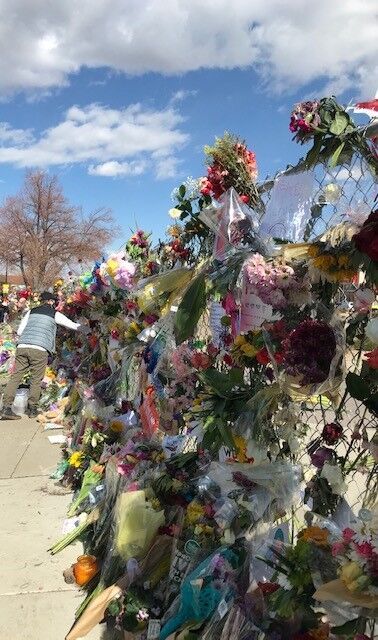
The Wall outside King Soopers in Boulder.
Kelsey French, Special to the Gazette


The Wall outside King Soopers in Boulder.
I’m sure most of the people there didn’t know the victims personally, but they took it personally that their fellow Boulderites had been attacked. You can see the community itself palpably responding at The Wall, like a single-celled organism to an infection.
Days later, I found myself wishing that power of community I witnessed could better manifest itself before a tragedy rather than after. Like white blood cells that protect the body from infection before it sets in.
What if our bonds of community were so strong in our neighborhoods and social networks and church congregations that not a single person fell through the cracks the way Ahmad Al Aliwi Alissa somehow did.
More than they are now, churches used to be the main weavers of that communal safety net, reinforcing some sense of our duty to one another. Tight ethnic neighborhoods I’ve been in are good at that, too. I’ve been told stories by my father of how immigrant enclaves of Polish residents in Chicago used to keep such close tabs on everyone in the community that if someone lost a job, they’d find a new one for them, and neighbors would pool money to help foundering families or the newly arrived. Nobody in those neighborhoods went without a turkey at Thanksgiving.
It may be that we’ve atomized ourselves too much around our rights as individuals at the expense of our shared obligations to each other.
Any country that holds a Bill of Rights sacred was probably in danger of those rights becoming more of a Bill of Entitlements over time. They were never meant to be, of course. They were meant to protect individual rights from being encroached on by the state, not assert that those rights are more important than our obligations to each other, the bonds that create the very fabric of society.
You see this unbalance between rights and duties most vividly on social media right now: My selfie right to say and do whatever I want drowns out any sense of esprit de corps. Screaming into our laptops, we become a nation of narcissists. Our national motto, E Pluribus Unum, has warped online. Instead of “Out of the many, one,” it’s become “Out of the many, many.”
Perhaps it’s time we added a Bill of Duties to our Bill of Rights. After 240 years, we may have gotten too far out from the sense of obligation the framers took for granted, and we need to write something out to remind ourselves of the importance — and joy — of serving others.
What do we citizens owe our cities?
If every right implies a responsibility, every opportunity an obligation, every possession a duty, as John D. Rockefeller once said, then every right listed in the Bill of Rights comes with an obligation to others embedded in it.
So heretofore proposed, a Bill of Duties.
Our “right” to free speech means we have a “duty” to respect the rights, beliefs and opinions of others.
Likewise, we have a duty to be open to ideas and perspectives different from our own.
In a democracy, we have a duty to participate in the democratic process, otherwise it simply doesn’t work. My dad reminds me that the word “govern” comes from the nautical word that means “steer.”
“And remember,” dad always said, “you steer a ship from the back and the bottom.”
We have a duty to stay informed so that we the people understand enough to actually run our own country. (Yes, that’s right, you have a duty to read a newspaper.)
We have a duty to obey the law, and pay income and other taxes honestly, and on time, to federal, state and local authorities. And serve on a jury when called upon.
We all have a duty to defend the country if the need arises.
We have a duty to defend the Constitution of the United States.
We have a duty to understand how American government works. In other words, we have a duty to understand our civic duty.
Speaking of civic duty, we have a duty to be civil to each other as well, to be honorable to each other, true to each other. We have a duty to deliberate with others to reach consensus, not gridlock.
And here’s the toughest one of all. If we truly believe we are all created equal, then we have a duty to truly care for the people less fortunate than us, and lift them up to be our equals, so that we all share equally in the bounty of our country.
These aren’t new ideas. It just seems like more than ever, right now is a time we need to be reminded of them.
Way back in 1883, Teddy Roosevelt gave a speech along the same lines, called “The Duties of American Citizenship.”
“The first duty of an American citizen, then, is that he shall work in politics; his second duty is that he shall do that work in a practical manner; and his third is that it shall be done in accord with the highest principles of honor and justice,” Roosevelt said.
“Grave perils are yet to be encountered in the stormy course of the Republic,” he observed in his closing, no doubt looking ahead to years like 2020 and 2021. “Perils from political corruption, perils from individual laziness, indolence and timidity, perils springing from the greed of the unscrupulous rich, and from the anarchic violence of the thriftless and turbulent poor.”
“There is every reason why we should recognize them,” he told the crowd, “but there is no reason why we should fear them or doubt our capacity to overcome them, if only each will, according to the measure of his ability, do his full duty, and endeavor so to live as to deserve the high praise of being called a good American citizen.”