‘We never knew she existed’: Long-lost sisters finally meet, after a lifetime apart
Virginia Garduño was raised in a Pueblo orphanage in the late 1940s and 50s, after her unwed teenage mother surrendered her to state care.
She grew up knowing nothing of her true heritage, bearing a surname that wasn’t her own and believing she was alone in the world. When she had her own children and they asked about their history, why they looked and maybe even were they way they were, Virginia’s tale always began with an ending.
It was the only story she knew.
“No one every told her where she came from, and she always felt like she was abandoned. She had no one and thought no one cared, and I really believe that hole, that pain, got passed down to us kids,” said Virginia’s daughter, Rae-Gina Anderson.
Rae-Gina was in her 50s, with three adult sons, when she decided to sign up for an account with Ancestry.com, genealogy company, and submit a DNA sample.
She thought maybe — if she got lucky — she’d find some missing pieces that would help her flesh out, and make sense of, the fractured tale her mother had shared during rare, forthcoming moments.
She never expected to discover that her mom was the missing piece to someone else’s life-long puzzle.
Last week, 76-year-old Virginia and her 63-year-old half-sister Josie Lopez met for the first time, in the parking lot of an IHOP on the east side of Colorado Springs.
“She’s the spitting image of my mom, and I look just like my mom. Our mom,” said Josie, who lives in Riverside, Calif. “We looked at each other and I thought, ‘I’m going to look like you,’ and she’s, like, ‘I used to look like you … ”
An upbringing of trauma
Rae-Gina remembers all the years she spent contemplating the mystery of those looks, which never fit with the information she’d gotten from Virginia or found listed on her mom’s official paperwork.
“On my birth certificate, it says that my mom is Caucasian … but my mom has a different look, like I thought we might be Native American or Hispanic. I always looked at mom and thought, she’s got the hair but her look is a little bit different,” said Rae-Gina, 56, the elder of Virginia’s two daughters.
All she really knew about her mom was that she’d grown up in Sacred Heart Orphanage in Pueblo, and that though there were some fleeting good times, the trauma of that upbringing and subsequent foster care ran deep. Deeper perhaps than the pain of abandonment.
“I don’t know what happened to her at the orphanage, but I know it hurt her and she learned to hide her emotions. She never cries,” said Rae-Gina, who only knew that her parents had met in the Springs when her mom was a teenager. “My dad is Black, but in my mom’s case, she didn’t even have a culture. We were walking around … like, are we Hispanic? Hawaiian? We had no idea.
“I decided I was going to figure out who we were and where we came from.”
When she first set out to try to track down the family’s backstory in Pueblo, though, she met with a series of dead ends.
“I was ready to go start knocking doors … but those would have been the wrong doors,” Rae-Gina said.
She figured there might be clues in old records kept by Catholic Diocese of Pueblo, which ran Sacred Heart. Opened in the early 1900s, the orphanage was built to hold 135 but had an average annual occupancy of between 150 and 160 children that were kept fed and clothed by Franciscan sisters who often had to beg door-to-door to make ends meet.
By the time the information from Sacred Heart made it to her Rae-Gina had almost forgotten she’d made the request.
“One day out of the clear blue, a letter showed up with a big manila envelope that showed me my mom’s name was not Gardino but Garduno,” Rae-Gina said.
And her mom had not, as she’d always been led to believe, been left on the doorstep of the orphanage “in a basket, as a newborn.”
“She was 19 months when she went to the orphanage in 1946, and who has a baby for 19 months and says ‘Nope, I don’t want this baby anymore?’” Rae-Gina said. “That let me know that there was probably a lot more going on there than what we had thought, and it was probably pretty awful.”
The information provided painful insight, but it was also a Rosetta Stone that inspired and informed her mission — one that ultimately led her online, and to a photograph of a woman in the desert who looked so much like her mom it couldn’t be coincidence.
Secrets to the grave
More than 1,000 miles away in Riverside, California, retired teacher Josie Lopez was deep into a quest of her own, to find out more about her ancestry and the family of her late mother, Antonia Garduño, a hard-working woman and mother of five who’d taken many of her secrets to the grave when she died in 1992.
“My mother spoke Navajo fluently, and Spanish and English, and I would wonder, where is this person from?” Josie said. “She always told us she was an orphan … but if you’re an orphan, you still have to have a parent?”
Josie’s mother talked about her time on the reservation, being raised by others after her own mom died in childbirth and her father perished in a mining accident. Antonia never mentioned Colorado, or a baby given up for adoption before she got married and started a new life, and family, outside the Centennial State.
“She would give me little clues during her lifetime … but she always talked about Arizona, not Colorado,” Josie said. “And when I did my (online) ancestry, the strongest hit was in White Mountain Apache, in the Southern Navajo Nation … So that’s where I was focused.”
Josie had submitted her DNA to Ancestry.com, crossing her fingers that maybe she’d be able to connect with someone in White Mountain who remembered her mom, or her family. Antonia may have been more than 20 years gone, but the mystery — and sadness — she had left behind lingered.
“I still carried this … I was always very sad for my mom, when her birthday would come, Christmas would come, holidays, because I thought my poor mom, she’s alone,” Josie said.
The depth of her mom’s sadness hinted at even bigger tragedies than those she chose to share.
“She’d told us she had a younger sister that passed away from lupus, at 23, and she was sad about it but there was something else. I didn’t know what it was but she would tell me, ‘It hurts when you lose a child. And I never want you to lose your child.’ I look back now and know what she meant, and I can see how it really affected her,” Josie said.
‘Lady from the desert’
Last summer, Rae-Gina was out with her grandkids, enjoying a day of fun after months of pandemic shutdown, when her cell phone rang. She didn’t recognize the number or the name, so figured it was a telemarketer.
“I almost didn’t answer,” Rae-Gina said. “For some reason, though, I was compelled to answer that phone.”
The woman on the other end introduced herself as Josie Lopez.
“She said, ‘You’ve probably seen my name in your Ancestry.com,” Rae-Gina said. “I said, ‘Oh, are you the lady from the desert photograph?’”
The photo had popped up along with a “leaf” — meaning a potential genetic connection had been found — on Rae-Gina’s Ancestry account. She’d been out shopping with her mom when it happened, and she’d shared the news excitedly with Virginia, who moved into the Springs’ Sunny Vista Living Center in 2017 after suffering a stroke.
“I was, like, ‘Mom, look, look at this! We got a leaf!’” Rae-Gina said. “Mom said she didn’t care about that stuff, and she didn’t even believe that stuff was real. She said, ‘They put me in an orphanage, whoever they were they didn’t care anything about me … and I don’t want to hear anymore about it.’”
Rae-Gina backed off, but she didn’t forget.
In the call, the woman from the photo shared details that echoed what Rae-Gina knew about her mom’s history. The woman told her that Virginia’s maiden name, Garduno, originally had a tilde over the “n.” Rae-Gina was hopeful she’d finally found the missing link she’d long sought.
Then providence sealed the deal.
“We had a good conversation and I said, ‘Nice talking to you, we’ll have to get together another time,’” said Rae-Gina, explaining that she would be heading out in the coming days for a short trip to visit San Bernardino, Calif. “She said, ‘Well, I live 20 minutes from San Bernardino. You should come visit. That timing, it was all God.”
Based on the results of their DNA tests, which were a 96% match, Rae-Gina and Josie thought they were cousins. Josie said she was excited to someday visit Colorado Springs and “meet her tia.”
“She thought my mom was her aunt, so we left it at that. And I was happy with just finding out I have family on that side,” said Rae-Gina.
The two long-lost relatives stayed in touch after Rae-Gina returned to the Springs, where Rae-Gina was finally able to talk her mom into a DNA test.
Josie was the first to see the results, and she immediately called with the news.
“She said, are you sitting down? You’re not going to believe this, but your mom is not my auntie. She’s my sister,” Rae-Gina said.
A time for healing
Josie Lopez, her husband, Noe, and daughter Noemi, had wanted to visit earlier, but the pandemic postponed plans.
They arrived in the Springs last week, and on Tuesday visited the old neighborhood in Pueblo where Virginia grew up. They met up with Rae-Gina and one of Virginia’s former foster sisters, who led them on a tour of the city and the Salt Creek community, by the former orphanage and the nearby home where Virginia had lived for a few years as a foster child.
Then on Wednesday, the two long-lost sisters finally met.
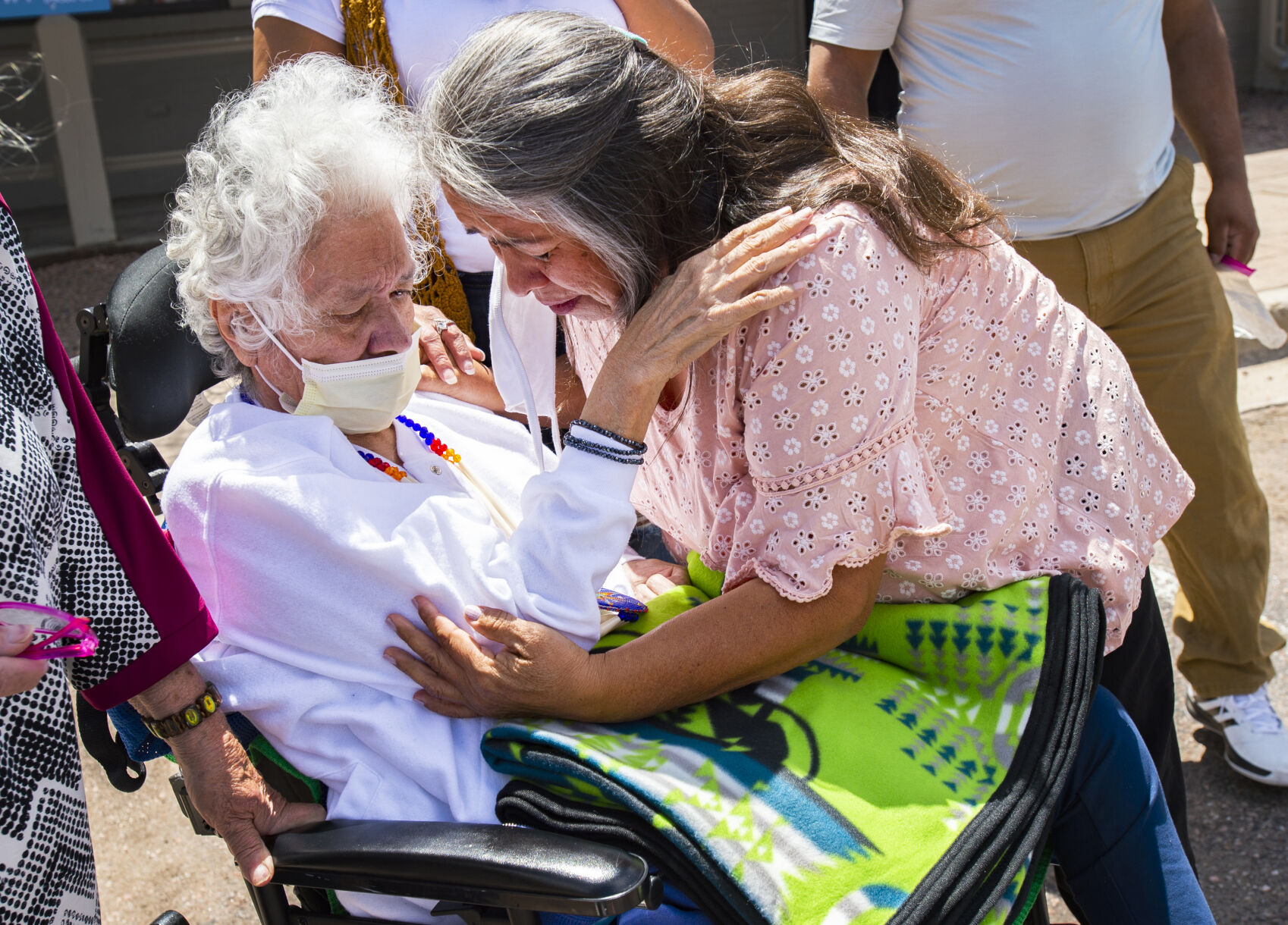
In the IHOP parking lot, Josie draped a beaded healing necklace decorated with cowrie shells around Virginia’s neck and placed a cozy Navajo print blanket on her lap. Virginia is in a wheelchair, so Josie had to stoop to give her a hug.
Virginia was silent but clung tightly to her sister, and closed her eyes for several long seconds, until the embrace ended.
Josie said she wanted her sister to know that their mom loved, and never forgot, her first born daughter.
“My mom named her after her mom that died, so she remembered her daughter through her mother,” Josie said. “And there were aunties who continued to write to my mom about her. The aunties were always watching over her.”
They’ll never know the full story, why Antonia became a mom at 15 and, 19 months later, felt compelled to give up her daughter. But now, finally, they know enough.
“Our story has come full circle and my search is done, I found my sister,” Josie said.
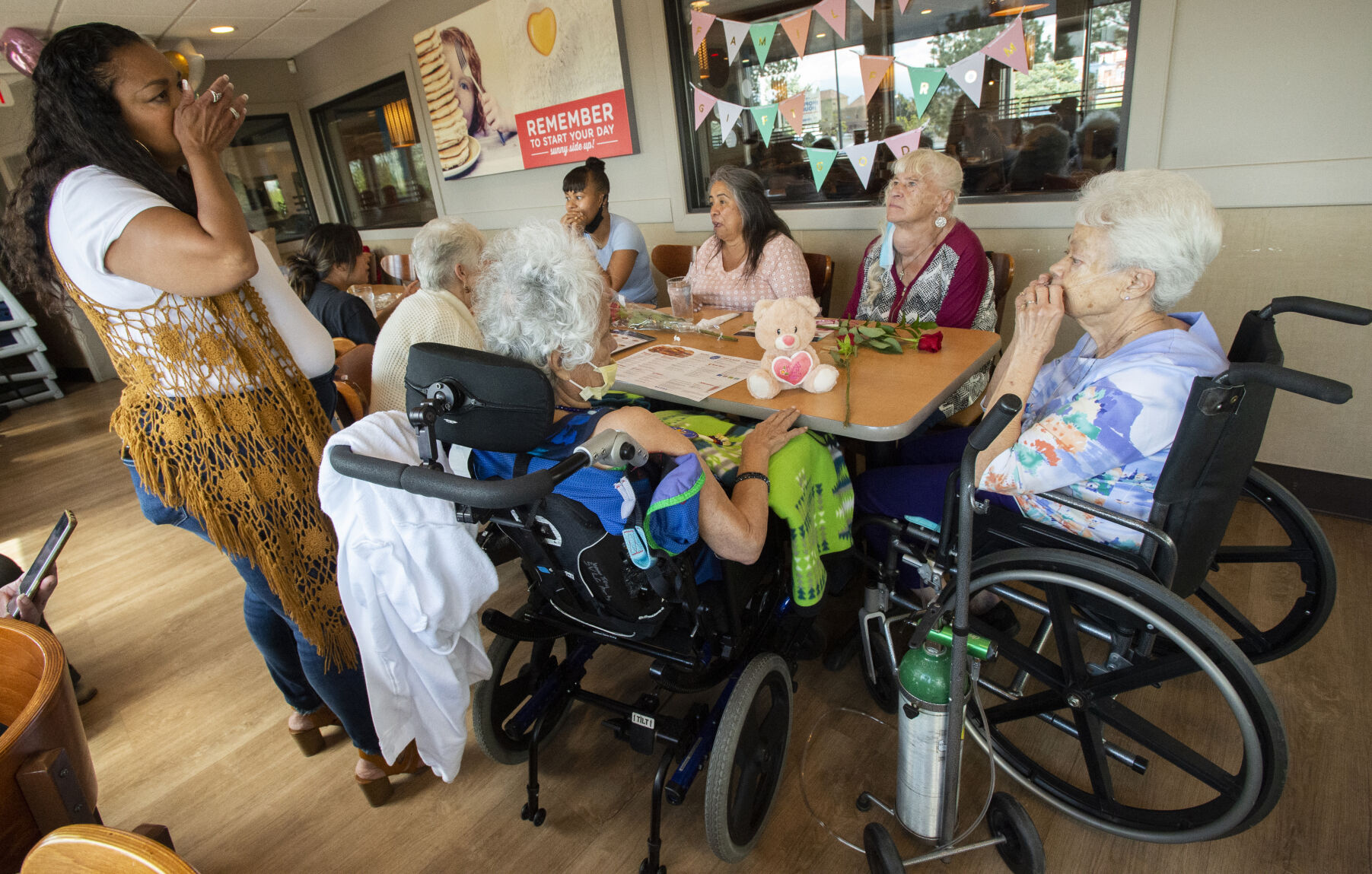
Later that day, as her extended family — the ones she knew before and those she just met — settled around a long table in a back room at IHOP, an overwhelmed Virginia took it all in. Her fingers occasionally drifted up to rub the beaded medallion that hung from her neck.
A gift, from her brother-in-law and her sister. A Navajo healing necklace, part of a tradition and culture she now knows is hers, too.
“Yes it is beautiful,” she said, her face relaxing into a smile. “I need to be healed.”