







Woody Paige: Ellis, Elway combined to make Manning acquisition work
David Zalubowski, Associated Press
“Come together, yeah.’’ –
— The Beatles
CANTON, Ohio – The genesis of Peyton Manning uniting with the Denver Broncos occurred on New Year’s Day 2012.
As Joe Ellis watched from a stadium suite while Tim Tebow completed only 6 of 22 passes for 60 yards, and threw an interception, the Broncos’ president formulated a plan. Ellis had seen enough of the erratic quarterback in the final regular-season game against the Chiefs, especially considering the Nov. 13 loss in Kansas City when the most provocative player in the NFL connected with his receivers just twice — two freaking times — in eight attempts — eight?
Quite early on the morning of Jan. 2 Ellis — who was in control of the franchise’s business side and a faithful follower and leader of the Broncos — walked down the second-floor hall at Broncos’ headquarters to John Elway’s office. Elway was executive vice president of the team’s football operations.
The two weren’t close associates then, even with equal authority under owner Pat Bowlen. Ellis hadn’t endorsed owner Bowlen’s decision to bring Elway back to the Broncos.
But, on this day, Ellis sought a strong advocate for his initiative.
Ellis, a regular Joe, said to The Duke of Denver: “Let’s go get Peyton Manning.’’
***
After a Friday flight of fancy Friday afternoon — a Boeing 737 packed with Manning devotees adorned in their orange or blue No. 18 jerseys bound from Denver to Cleveland — landed, Ellis told me, in response to a question, that when he mentioned his outlandish scheme a decade ago, “Elway’s eyes lit up.’’
Ellis says now the Broncos were “strapped for cash, but I said to John if Peyton comes we’ll borrow the money ($100 million) if we have to.’’
Complicated issues created obstacles: Manning was under contract to the Indianapolis Colts, and he hadn’t played at all in 2011 because of four surgeries on his severely injured neck, including one operation that fused two of his vertebrae, and nobody knew if he could play at an elevated level again or would play at the high altitude in Colorado.
Nevertheless, Elway and Ellis decided then and there to make a Hail-Peyton play for the future Hall of Fame quarterback.
It wasn’t the first time the Broncos’ franchise had made a wild-horse effort at a future Hall of Fame quarterback.
***
During the strike season of 1982, I chose to attend games of the top college stars every week. On Oct. 30 I inspected a Stanford quarterback as he ripped Washington, 43-31. The following Monday, I went directly into the office of Dan Reeves (when an appointment wasn’t necessary and security was nonexistent), and the Broncos’ coach looked up from a sub sandwich and acted confounded. “I have witnessed the future of the NFL, and its name is John Elway,’’ he heard.
Reeves replied: “We got no chance at him. He’ll go No. 1 in the draft.’’
The Broncos were picking fourth overall.
The Colts, located in Baltimore, had first choice.
Trouble for the Colts was Elway had absolutely no intention of playing for Colts coach Frank Kush, hated by John’s father Jack Elway (who had known Kush when they both coached in college football) and Robert Irsay, a maverick owner despised by his players. Elway threatened to sign a baseball contract with the Yankees. The Colts drafted him, anyway.
Edgar Kaiser Jr., the Canadian heir to the Henry J. Kaiser shipbuilding industry fortune, had purchased the Broncos in 1981. He didn’t know a football from a Frisbee, but he knew power brokering. He and Irsay became fast friends not included in the NFL ownership inner circle. Irsay referred to him as “that nice Kaiser boy.’’
Edger had an outlandish scheme, long before Ellis did. On draft day, April 26, 1983, he called Irsay and asked if the Colts would be willing to trade Elway to the Broncos. Kaiser later told me that Irsay said “he wasn’t about to give in to Elway, but would get back to me if he changed his mind.’’
A week later, over the protests of his Colts’ executive team, Irsay phoned Kaiser and began working out the details of what would be the most lopsided deal up to then in NFL history and the greatest transaction ever for the Broncos.
The Broncos would make their second-greatest transaction 29 years later, and Elway again was involved — on the other side.
***
Even though Elway told Ellis on the second day of 2012 that he believed the Colts and Manning would reach an agreement for the quarterback to continue in Indianapolis, the rumors were owner Jim Irsay, the son who had succeeded the late Robert Irsay (who had moved the Colts from Baltimore in the middle of the night, literally), in 1984 after the Elway Debacle, didn’t want to risk paying Manning a $28 million bonus in 2012 because of the injury and was prepared to select Stanford (yes!) quarterback Andrew Luck No. 1 in the draft.
Tebow and the Broncos won the 2011 division title with an 8-8 record (in a tiebreaker), and the polarizing QB passed for the winning touchdown to beat the Steelers on the first play of overtime in the playoff game in Denver. But the Broncos were overwhelmed the next week by the Patriots, and Tebow injured his ribs.
The seed of the Ellis-Elway conversation germinated. They told only coach John Fox and Pat Bowlen, who was experiencing more concerns with his Alzheimer’s disease during 2011. Bowlen had acknowledged for the first time publicly, in a phone interview with me in 2009, that he had developed short-term memory loss.
Bowlen did approve of the Manning proposal.
No matter what happened, Tebow would be replaced by someone — a draft choice or a free agent.
But Manning was Plan A if he were to become available.
“John went to Indianapolis for the Super Bowl (Feb. 5 at Lucas Oil Stadium),’’ Ellis said Friday. “When he came back John said Peyton would have interest in us if he were a free agent.’’ That assessment, however, was made by Peyton’s people, not the man himself.
Irsay announced March 7, 2012, that the only four-time NFL MVP, who had been with the Colts for 14 seasons, was released.
Manning’s reported destinations were Miami, New York (Jets), Seattle, Arizona, Tennessee (the state where he played college football) and Washington (where former Broncos coach Mike Shanahan was in charge).
Denver was not among the initial teams.
“We thought we had a good chance at Peyton,’’ Ellis told me. “He played for Fox in the Pro Bowl and really respected him as a coach. Peyton’s wife (Ashley) had a close friend in Denver, and Peyton was close with Brandon Stokley,’’ who had played with Manning for four years with the Colts, then joined the Broncos for three seasons. Despite moving on to two other teams, Stokley still lived in the Denver suburbs. Historically the Broncos had a record consecutive streak of sellouts and a winning team (six Super Bowls, two victories). “And,’’ Ellis said, “we had John’’, The Helicopter Man, the Hall of Famer, The Great Salesman of automobiles.
The Broncos indeed became one of the finalists for Manning with Miami, Tennessee, Arizona and San Francisco.
Denver was his first visit March 9.
“John handled it incredibly well. He didn’t oversell, but he was persuasive about Denver and the Broncos as a place and a team that would be comfortable,’’ Ellis said. Elway and Manning talked man-to-man, friend-to-friend, quarterback-to-quarterback over dinner and drinks at Cherry Hills Country Club, and Elway advised Manning to take his time making the difficult decision.
The Titans did the hard sell. Owner Bud Adams offered Peyton a lifetime contract as a player and, after retirement, as a top team executive, and Peyton bonded with coach Mike Munchak (who has since become the Broncos’ offensive line coach). Peyton and Ashley owned a home outside Chattanooga (Tenn.) and a hotel in Knoxville where he graduated from UT, and had relatives in Memphis, where Ashley grew up.
The Dolphins, the Cardinals and the 49ers dropped out of contention, and Shanahan’s team in D.C. wasn’t a factor because Manning didn’t want to play in the same division as his brother, Eli. Peyton had some desire about Houston, whose coach was Gary Kubiak, but the Texans were satisfied with their quarterback situation.
A contingent of Broncos led by Elway flew to Duke University and watched Manning work out — and believed he was still recuperating, but would be able to physically perform. Fox told Manning the Broncos would give him control to integrate his own offense with the team’s playbook, and the coach would concentrate on defense.
Peyton “wanted to get it done and not drag out the process like college recruiting,’’ his father Archie Manning told me. The elder Manning will give Peyton’s introductory speech Sunday evening. The First Family of Football will be in full force in Canton.
At the end of a 12-day ordeal Manning made up his mind March 19. Peyton called the Titans and the 49ers to tell them he wasn’t signing with them, then he called Elway and Fox with the startling news.
They informed a thrilled Bowlen — “Damn straight’’, he told me — and Ellis, whose job was to work out a five-year, $96 million contract, with injury waivers and without a usual signing bonus. In the first season Manning would receive 17 $1 million checks. “The negotiations with Tom Condon (Manning’s agent) were easy,’’ Ellis said.
The Broncos didn’t have to borrow money to sign Manning, who played four years in Denver, prevailed in 50 regular-season games, set the NFL record for touchdown passes and points scored and returned the Broncos to Elway-like glory. Manning beat Tom Brady and the Patriots in AFC Championship games in 2013 and 2015 and won Super Bowl 50, his final game.
Manning’s work as a player was done, but he continues to live in Denver permanently, and, on Sunday, his bust will be in Canton, Ohio, permanently.
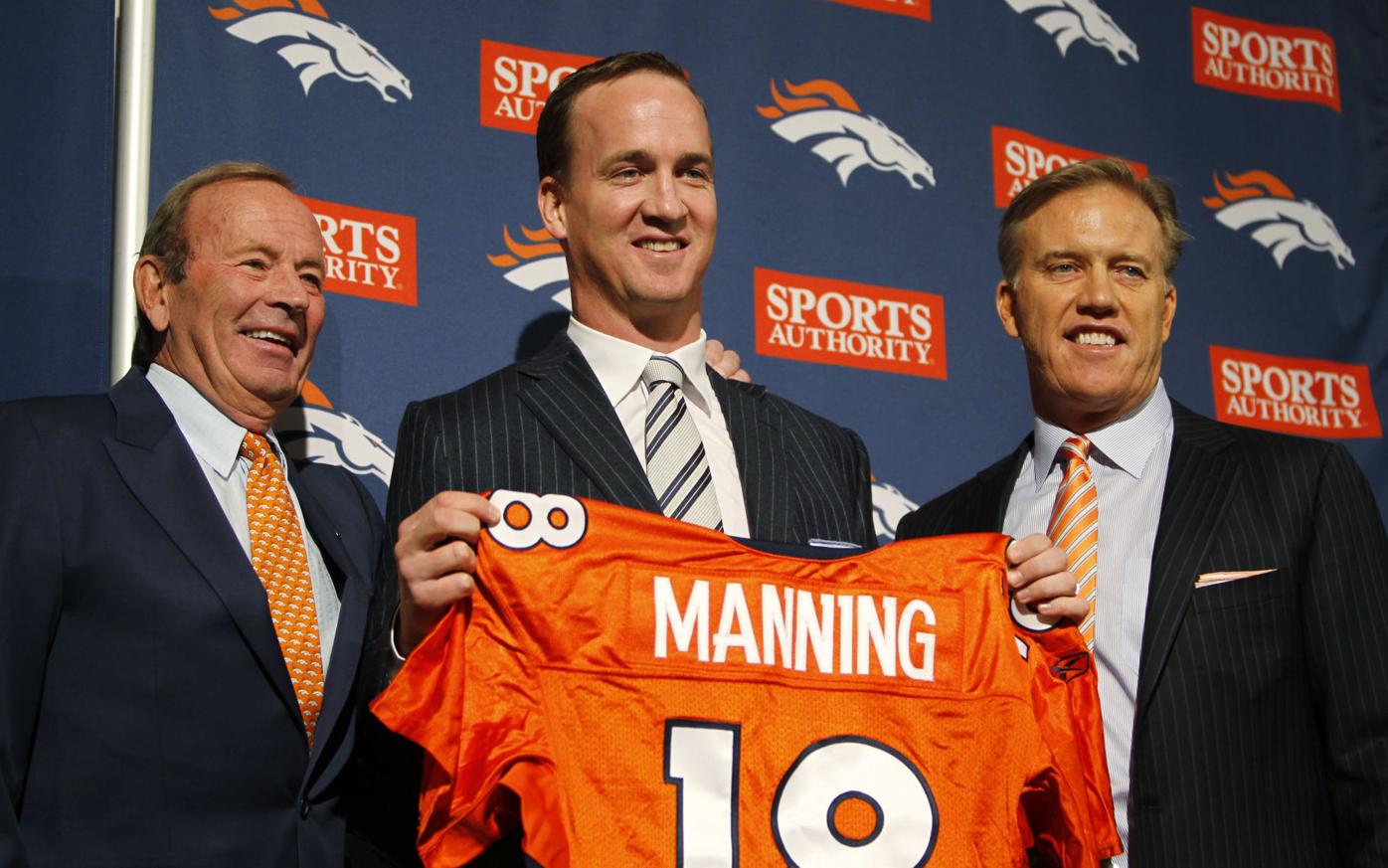
On the day of Manning’s introduction at Dove Valley, Bowlen presented him with an orange No. 18 jersey. Elway was asked if he had a Plan B if Manning hadn’t signed. Elway replied: “Plan B? I don’t have a Plan B. We’re going with Plan A.’’
Off to the side of the Broncos’ auditorium, Ellis smiled.
The Broncos didn’t have a Plan B.
***
Wearing shorts and a sports shirt, Ellis stood at the luggage carousel in Cleveland on Friday before making the hour-and-a-half drive to Canton, and none of the 189 Manning loyalists who had been on the plane from Denver asked for his autograph or even recognized the president, chief executive officer and de facto owner of the Broncos.
In 1983, when the Broncos made the trade for Elway, Ellis, who had played soccer and majored in history and political science at Colorado College, was selling T-shirts when he interviewed for a job selling advertising for the Broncos’ game programs. Ellis and Elway went to work for the Broncos about the same time. They’ll probably be leaving at the same time.
Joe Ellis will retire from the Broncos after what he hopes is a successful season and before next season following an uncertain transition in the Broncos’ ownership. A week ago Ellis took personal blame for the past five years of Broncos’ failures, but he deserves credit for many of the franchise triumphs over the years — and for being the man who conceived of the idea of Manning to Denver.
Ellis is here with the dominant Manning throng to celebrate.
Peyton will take center stage Sunday night at the Pro Football Hall of Fame.
Peyton Manning of the Colts … and the Broncos.
“It came together,’’ Joe said.
Yeah.