‘I got to see everything’: Denver music writer G. Brown a pioneer in the industry

G. Brown is a man of 3,248 stories (and at least as many bad jokes). That’s the number of music personalities he interviewed in his 26-year career as pop-music writer for The Denver Post.
Brown can tell you about the time in 1978 when he had a chance encounter with Bruce Springsteen on an otherwise empty L.A. sidewalk. Brown, then still a student at the University of Colorado in Boulder, was hoofing it 6 miles to an appointment at CBS Records because he didn’t have enough change in his pockets for bus fare. Springsteen was taking a break from recording that day and just felt like taking a walk in a city where, apparently, only broke college students and Jersey Boys walk anywhere. A friendly conversation ensued before The Boss got back to work on an album that turned out to be “Darkness on the Edge of Town.”
“I was hoping for ‘Born to Walk,’ ” Brown says now. (Rim shot.)
He can tell you about the time in the early 1970s when he saw a young Bonnie Raitt perform at Tulagi in Boulder, then pick up a broom and help the crew clean the bar. And he can tell you about the time he saw The Police play at the Rainbow Music Hall for $3 in 1979 — and chatting up Sting when he was just a guy traveling across the country in a van with two mates. (Thirty years later, people eagerly paid $250 to see the reunion tour.)
Brown was part of a golden era in music coverage for daily newspapers that coincided with an explosion of growth in the record industry — and they each fed the other. For the first time, newspapers were hiring writers to cover pop music as an actual beat. Brown made his pitch to cover music for The Denver Post in 1977 while still a sophomore at CU — and his profile of the band Genesis landed him the gig.
At the same time, record companies were releasing mega-albums like Fleetwood Mac’s “Rumours,” sending their artists out on tour to sell them and serving up superstar interviews to eager regional beat writers as an integral part of the marketing machine.
That put Brown and about two-dozen other daily beat reporters in some of the most envied — and respected — jobs in music journalism. Even Huey Lewis says so.
“I’ve always thought that the music journalists from large daily newspapers were more credible than others, if only for the fact that they saw and heard so much more music than anyone else,” Lewis said. “G. Brown proves my point with his ‘On Record’ books.”
Lewis was commenting in support of Brown’s ongoing series of 21 slickly designed coffee-table books that each takes an encyclopedic, 350-page look at one year in popular music from 1978 to 1998 through the albums that were released. Not only was Brown given access to just about every working superstar and rising unknown in the industry, he was mailed every new release in advance, and the press kit that went with it.
And he kept all of it.
We’re talking 50 banker’s boxes in his basement filled with albums, tapes, CDs, press notes and the holy grail: The often hilarious (in retrospect) official press publicity photos that accompanied each release and now stand as a kind of band-by-band musical time capsule. Brown’s collection has survived four house moves thanks singularly to the benevolence of a wife he refers to as “Saint Bridget.”
“I just had that collector’s gene,” said Brown, who grew up in Arvada gathering stamps, coins, baseball cards and Denver Broncos Coca-Cola bottle caps. So, from the start of his reporting career, he somehow knew to save every press kit he received from musical acts spanning pop, rock, country, punk, grunge, R&B, rap and more.
“I just sensed there was a value to them,” he said. “I didn’t know what it was at the time.”
He sure does now.
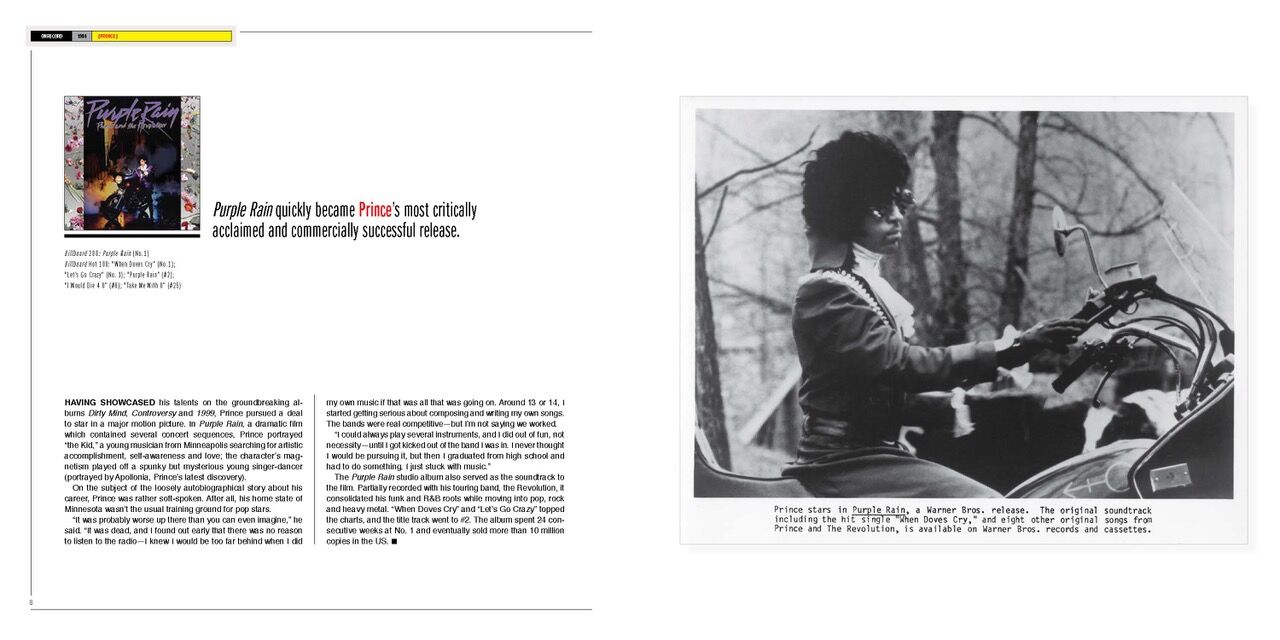
Brown is having the time of his life organizing his treasure trove into a definitive look at those seminal years in music history. Each volume presents most every major album release as a two-page spread: One for those irresistibly funny publicity photos; the other for a tight, 300-word Brown essay that incorporates quotes from key band members he interviewed at the time. He even includes an epilogue covering albums from artists he didn’t get to speak to — so he leaves no groove unscratched.
“These books have a nostalgic component that is undeniable, and they also have value as reference books,” Brown said. “But I am most fiercely proud that the essays are not just first-person bloviating on what it all meant. It’s simple reporting on a band talking about a given release in a given year.”
Brown is releasing the books, edited by Jon Rizzi and designed by Kate Glassner Brainerd, through a cultural and educational nonprofit he founded called The Colorado Music Experience. To date, three books in the series, which are not being released chronologically, are published and available through colomusic.org: 1978 (think Billy Joel, The Cars and Devo), 1984 (think Prince, Joe Jackson and “The Curly Shuffle”), and 1991 (think Garth Brooks, Hammer and Nirvana). Brown hopes to keep cranking out one new tome every three months until the job is done.
Together, Brown says the series represents a unique archive of music history that doesn’t exist in the same way anywhere else. Perhaps because none of his national colleagues had as much foresight — or basement space — as Brown.
“I think the series is a celebration of the hard-goods era when we cared about album-cover art and liner notes and an album’s release date,” Brown said, “because that meant you could go to a record store and get it and actually hold it. That doesn’t exist anymore.”
Brown wrote for The Denver Post through 2003, but he is mindfully ending his book series at 1998 because he sees that year as a line in the sand between eras in the record industry. “That’s when Shawn Fanning showed up with Napster, and that was the beginning of everything turning digital,” he said. “That’s when everything changed in the recording industry.”
And in music journalism. Brown barely recognizes the landscape today, now that pretty much all those beat jobs that were once held by specialists in specific disciplines have been consolidated into usually one (if that) general entertainment reporter hopelessly tasked with covering music, TV, film, theater and fine arts at once. The idea of one job at a daily newspaper dedicated to chatting up three or four popular music stars a week is now unthinkable. Brown knows how good he had it.
“I was lucky to write for a major daily newspaper when newspapers meant something,” he said. “I got to cover the beat as a newspaperman, using my journalism. I got to cover it in a unique way.
“And I got to see everything.”
Denver Gazette contributing arts columnist John Moore is an award-winning journalist who was named one of the 10 most influential theater critics by American Theatre Magazine. He is now producing independent journalism as part of his own company, Moore Media.