







Glenwood Canyon now has emergency cellphone service
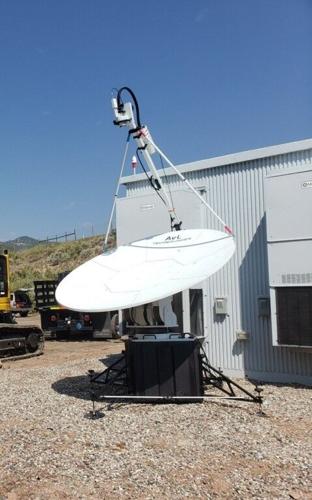
Stationary portable cellphone satellite uplink of the type used during Glenwood Canyon mudslides
Courtesy of AT&T

When torrential monsoon rains pelted the slopes high above Glenwood Canyon on July 29, runoff from the 2020 Grizzly Creek forest fire caused mountains of mud and boulders to roar more than 3,000 feet downhill and cover parts of Interstate 70 as much as 10 feet deep in debris.
More than 100 motorists found themselves stranded between multiple mudslides. While 29 people were able to take shelter in the Hanging Lake tunnel, the rest were forced to wait overnight for rescue.
No one was hurt or killed by the mudslides, though some vehicles were damaged or destroyed.
But when the rain and rocks came down, communications in the canyon were, as they have long been, nonexistent. Radio waves travel in a straight line and are blocked by canyon walls due to the narrow, serpentine course of the Colorado River, which carved the canyon.
But that is no longer the case.
Two years ago, construction started on a system to bring reliable emergency cell phone coverage to the entire length of the canyon as part of a nationwide effort to improve emergency communications called FirstNet®.
FirstNet® is a high-tech nationwide communication system that leverages AT&Ts existing cellphone network by adding cellphone bandwidth using frequencies previously allocated to UHF television.
The system is dedicated primarily to emergency services use and special SIM cards issued to authorized users for their personal or agency-issued cellphones can access the network nationwide, giving them priority over all cellphones except 911 emergency calls.
As a result of the 9/11 attacks, in 2012 Congress recognized the need for an advanced nationwide emergency communications system and that cellphone technology provides opportunity for advanced digital communications going far beyond traditional voice-only radio systems.
The system can serve many emergency services roles.
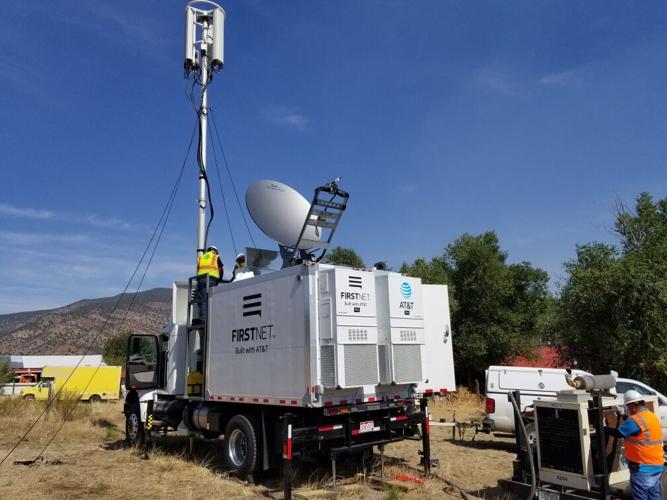
Using stand-alone trucks with built-in cell towers and satellite uplink/downlink, FirstNet® services can be provided anywhere the truck can go.
“One is to provide coverage in a location that is often very remote and provide temporary cell service for first responders,” said Garret Doyle, a FirstNet® regional manager. “The most common one that you probably can think of is wildland fires.”
Other missions include search and rescue and disaster recovery such as tornadoes or hurricanes.
The First Responder Network Authority was created as a public/private partnership under the Department of Commerce to try to prevent the crippling emergency communications failures seen during the 9/11 response. Using funding from the sale of radio spectrum rather than taxpayer funds, Congress provided $7 billion to start the program.
But when the mudslides happened in July, the Glenwood Canyon system was not yet operational. To cope with the emergency, AT&T deployed several stand-alone portable cellphone sites with satellite uplink/downlink to connect to the AT&T cellphone network.
While the FirstNet® network primarily consists of added hardware and programming to existing cell tower sites, the Glenwood Canyon system is different.
Engineered specifically to deal with canyons and other places where terrain blocks radio signals, the Glenwood Canyon installation is an “outdoor Distributed Antenna System (oDAS).”
Along the 17-mile length of the canyon, 15 antennas are strategically located along the railroad tracks on the south side, opposite the highway. The antennas are all connected by a fiberoptic cable to cellphone towers at both ends, near Dotsero and Glenwood Springs, which receive digital cellphone signals from motorists and pass them along the chain to either end.
While data from authorized devices always takes priority, the system also operates as an ordinary cellphone system for AT&T customers traveling through the canyon. At the same time, anyone dialing 911, even if they have a cellphone with a SIM card but no service plan, can reach emergency dispatchers without charge.
Roberta Robinette, president of AT&T Colorado, told The Denver Gazette that distributed antenna systems are used in other places, including sports stadiums. The idea being that the antenna nearest the user gets the best signal which is then passed into the main network.
“The distributed system approach that we used in Glenwood canyon is a permanent solution with the extensions of fiberoptic cables to be able to get around corners as you go through canyons,” said Doyle. “We use those systems in other areas; Clear Creek County between Golden and Central City/Blackhawk is a good example.”
“The state of Colorado opted into FirstNet® in December of 2017,” said Robinette.
But the Gypsum Fire District was one of the first agencies in Colorado test the prototype system.
“We participated in the 2015 Alpine Ski Championship in Vail and Beaver Creek, which was the proof-of-concept for FirstNet® up here. And I think as soon as it became commercially available, we transitioned into that,” said Gypsum Fire District Chief Justin Kirkland.
Kirkland told The Denver Gazette his department’s experience with FirstNet® has been excellent. While the Gypsum Fire District uses Colorado’s statewide digital trunked radio system, and Kirkland said FirstNet® was not essential, he said there are other uses, including interagency communications with federal agencies and live data transmissions that make it a valuable and worthwhile communications medium.