






Denver to hold community meetings on redistricting
The Denver City Council has scheduled six community meetings in February to get public feedback on the city’s redistricting process.
Redistricting happens every 10 years with the release of new census data. The goal is to break the city up into 11 council districts of relatively even population, while keeping together established neighborhoods and cultural communities.
Which council district a resident falls into determines which council member represents them and which council seat they can run for themselves. The City Council has until March to redraw its council districts.
The first community meeting will be held from 5:30 to 7 p.m. Feb. 2 via Zoom. All subsequent meetings will be held in-person, pending no further changes in local COVID-19 rates.
The other meetings will be held on Feb. 9 at Montbello High School at 5000 Crown Blvd.; on Feb. 12 at Cook Park Rec Center at 7100 Cherry Creek S. Drive; on Feb. 15 at All Saints Parish Hall at 2559 S. Federal Blvd.; on Feb. 16 at Lake Middle School at 1820 Lowell Blvd.; and, lastly, on Feb. 23 at Manual High School at 1700 E. 28th Ave.
All of the meetings will take place from 5:30 to 7 p.m., except for the Cook Park Rec Center meeting on Feb. 12, which will be held from noon to 1:30 p.m.
Each meeting will begin with a presentation about the redistricting process and maps of new, proposed districts. Attendees will get to walk around to look at each map and provide feedback using sticky notes. There will then be a full-group discussion and, finally, a cellphone poll to decide which map is preferred.
An independent third party will facilitate the meetings, though two to three City Council members will be present at each meeting.
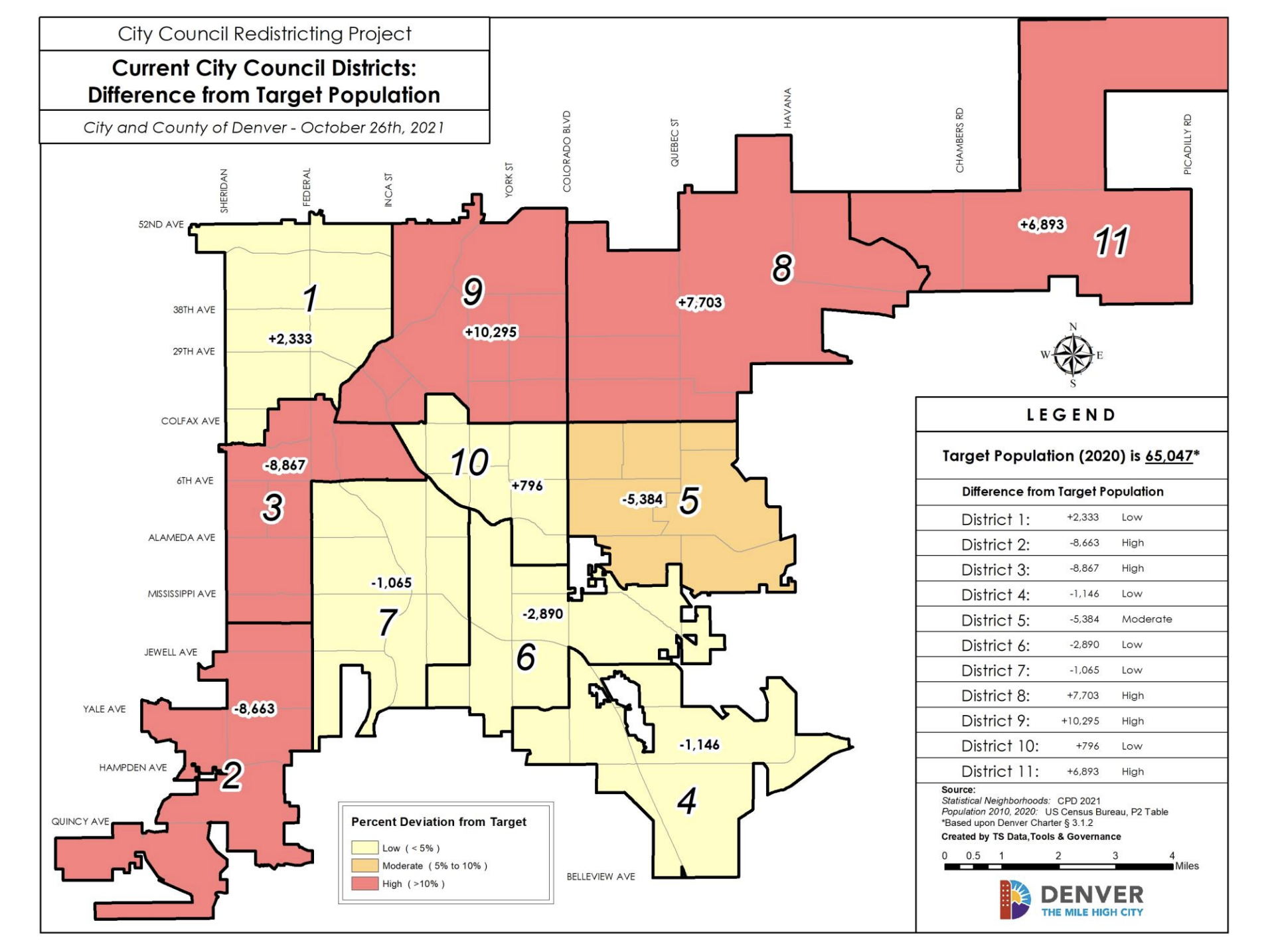
The Denver redistricting commission said the new council districts should have around 65,000 residents each — an even 11-way split of the more than 715,000 people living in Denver. That would be the largest average district population in Denver’s history. Since 1950, Denver council districts have ranged from 42,000 residents to 55,000 each, according to city data.
Several districts are far above the 65,000-population goal, with Districts 8, 9 and 11 each having over 71,000 residents, data shows. In contrast, Districts 2 and 3 have just over 56,000 residents each. Those districts can expect significant changes to their borders during redistricting.