







Colorado school staffs get new violence prevention training
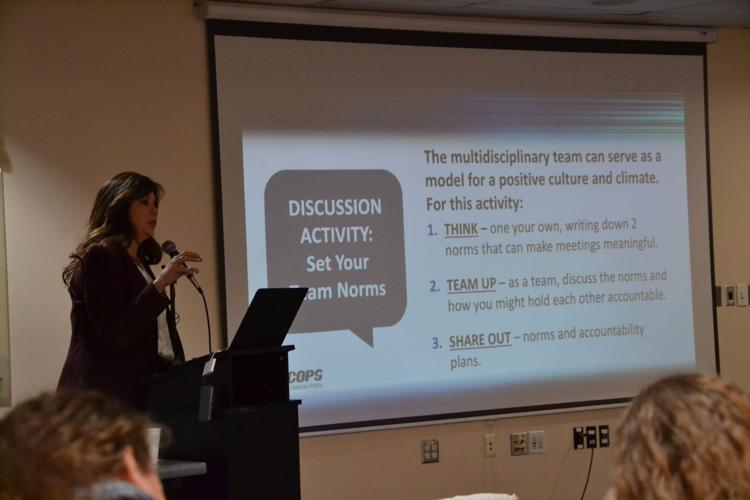
Susan Payne, director of safety and security at Cheyenne Mountain School District 12, is one of the presenters at the Project Unite training of a new model of preventing school shootings. (Debbie Kelley/The Gazette)
CASTLE ROCK — After more than two decades of analyzing school shootings, the nation’s top prevention specialists believe they have come up with a framework that presents the best ways to ward off such violence.
It’s not an easy fix, they say.
But the strategies have advanced significantly since the April 20, 1999, mass shooting at Columbine High School in Littleton, which left 15 people dead, including two student perpetrators, and elevated school safety to a perpetual high-alert status.
“Through 20 years of research on violence prevention, it’s very clear what kind of secret sauce is needed,” said former Colorado Springs Police Officer Susan Payne, who, as an adviser to the U.S. Secret Service’s National Threat Assessment Center coauthored a recent study on school shootings.
Colorado’s school tip line sees 23% increase
“It involves a multi-disciplinary approach that takes into account threat assessment, culture and climate, bystander reporting and response, information sharing and suicide risk management — and how they all work together,” she said Tuesday, during a pilot training program for school districts in Colorado and other states.
The two-day training on the most effective prevention tactics is being held at the Douglas County Fairgrounds in Castle Rock.
Law enforcement officials and representatives from 18 pilot schools, including Douglas County RE-1, and five school districts in El Paso County — Harrison D-2, Cheyenne Mountain D-12, Manitou Springs D-14, Colorado Springs D-11 and Academy D-20 — are assessing their existing safety and security systems, identifying gaps and being tasked with adding what they’re learning to their repertoire.
It’s the second training of its kind; the first was held two weeks ago in Alexandria, Va., for other pilot schools in the nation.
A full nationwide rollout of the program, Project Unite, sponsored by the National Association of School Resource Officers and funded by a grant from the U.S. Department of Justice’s Office of Community Oriented Policing Services, will begin in the fall, said Michele Gay. She founded Safe and Sound Schools after her daughter died in the Dec. 14, 2012, shooting at Sandy Hook Elementary School in Newtown, Conn., in which a 20-year-old gunman killed 26 children and school employees, and then himself.
‘Vigilant teacher’ notices gun at Colorado school, student arrested
Colorado has had five shootings at schools since Columbine. What’s different today?
Douglas County Sheriff Tony Spurlock gave this example in an interview: As the school-violence prevention training was happening Tuesday morning, a shooting incident broke out in downtown Castle Rock.
It didn’t happen at a school, but in seconds, schools in the area were notified by radio communication to secure their perimeters, he said.
“Now we have this opportunity for everybody involved to do early intervention,” he said. “We’ll never know how many school shootings have been prevented, but everybody — counselors, bus drivers, cafeteria workers, janitors, teachers, coaches — are tied into keeping schools safe.”
That such a training is taking place in itself represents an important evolution in how the issue is being addressed, Spurlock added.
“School districts were in their little cocoons, but we’ve started to break down barriers,” he said. “They’re pushing this message outward, and imagine it being multiplied in every school district in the nation, reflecting the same message: everything is about safety for kids, and how do we make sure they’re safe when they’re at school.”
The purpose of the new model, Gay said, is not to reinvent the wheel but for schools to optimize the main focuses of developing a positive school culture and climate, learning how to share information with other schools and agencies, training bystanders how to report and respond to what they see and hear, and assessing potential threats, as well as suicide ideation, and properly managing such situations.
“Our goal is to bring them all together,” Gay said. “We’re not going to be able to prevent everything on the spot or intervene in everything, so we have a larger reach, knowing that prevention involves parents, kids, school resource officers, bus drivers, educators, administrators — it’s all hands on deck.”
In addition to schools creating a safety plan, forming a multi-disciplinary team to address safety and security, and placing armed law enforcement or other security guards in schools, following the consistent standards and best practices are among the recommended steps, Payne said.
Manitou Springs police arrest juvenile suspect in connection with threats against school district
The methodology has been four years in the making, she added.
“In the last 20 years we’ve had a huge emphasis on response to acts of violence. We’re looking for early intervention and how to prevent it,” Payne said. “Do you want to put a life ring or a life vest on a child that doesn’t know how to swim? Or should you teach them how to swim?
“It’s action versus reaction — we’re going to search your backpack, and we’re not waiting.”
Teachers or other staff who notice students drawing representations of acts of violence or hurting animals, which are often precursors to violence on people, should know to report the incident immediately, said Payne, director of safety and security for Cheyenne Mountain School District 12.
Since bullying, isolation from peers and other negative experiences involving classmates are among the top reasons teens and young adults decide to carry out a school shooting, Payne said it’s often the small things that have a big impact on prevention.
One idea she said that works is positive reinforcement, such as school administrators giving high-fives, other greetings or praise to students in hallways, or through recognition programs for students who report a concern about another student who appears to be acting out of character, for example.
Participating schools will measure their successes, as they continue to monitor and assess their safety and security work, constantly scan and adjust their procedures and provide feedback on the model, Gay said.
This academic year, as schools work to come out of the pandemic, more students seem to be exhibiting challenges with mental health and are overwrought, angry, acting out and disrespectful, school representatives said.
“The social stressors are very high for children during the pandemic, which increases the likelihood of suicide ideation, depression and anxiety,” Payne said.
Several representatives from Colorado Springs School District 11 attended the training.
Elaine Charney, assistant principal at Doherty High School in D-11, said she’s hoping to glean a better understanding of what staff at her school need to do to keep kids safe and ensure learning.
“If kids don’t feel safe, they won’t learn, they won’t achieve, and that needs to be a priority,” she said.
Jim Hastings, D-11’s commander of security operations, said like most school districts, D-11 has a pretty good safety plan and procedures in place for handling incidents.
“I still think schools are one of the safest places for kids, but you can always improve,” he said, “and that’s why we’re here, to see what more we can do.”
Contact the writer: 719-476-1656.