







A tragic fall for a towering Denver sculptor
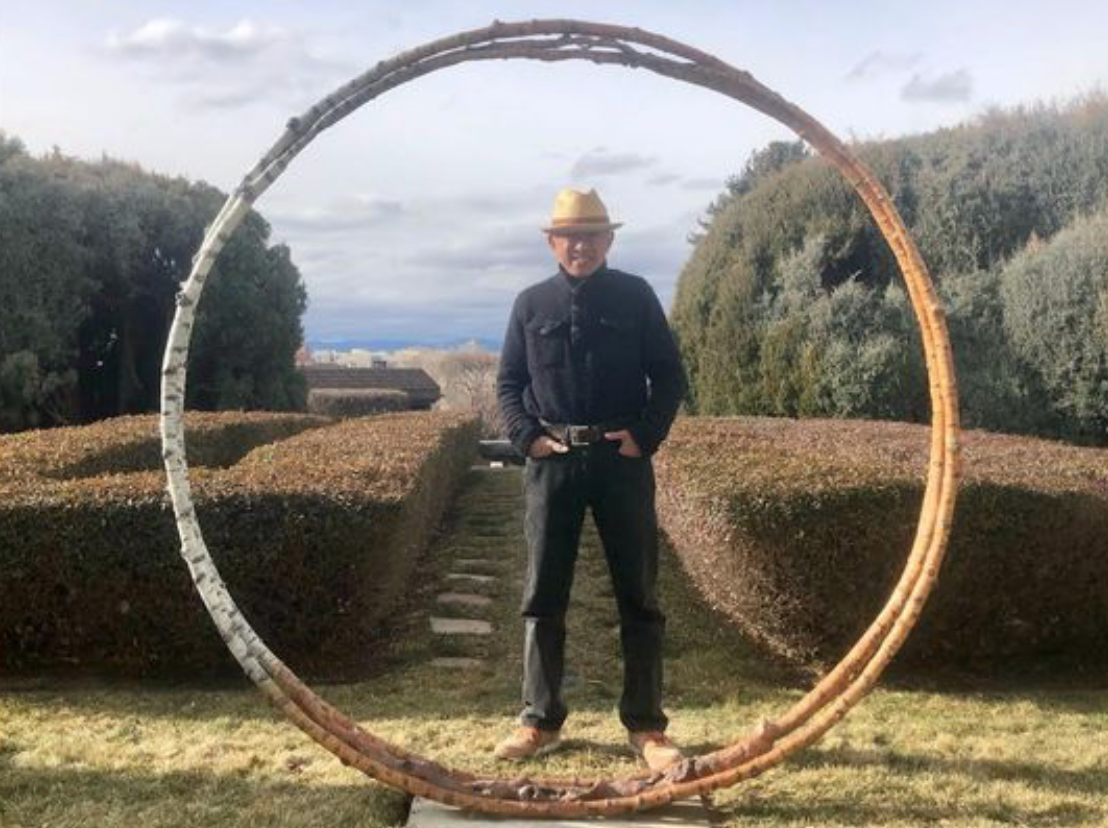
Courtesy of Denver Botanic Gardens
Yoshitomo Saito, a bronze sculptor based in Denver, took 10 years to create the works for “Of Sky and Ground,” an exhibition of his nature poetry series shown in the indoor galleries at Denver Botanic Gardens recently. The sculptor acknowledged the exhibit as a culmination of his 35 years of sculpting bronze.
A highlight of the exhibit was “millionyearseeds,” the artist’s astonishing wall-mounted installation of 1,748 original, life-sized bronzes of pine cones, pomegranates, seed pods and banana peels. The exhibit spotlighted several other Saito sculptures, including “Gateway,” a large, graceful loop of bronze with a patina evoking aspen or birch branches.
“Gateway” sold to one of Denver’s most prominent art collectors. On Dec. 31, 2021, Saito finished overseeing the installation of his piece on an ideal site in the garden of the collector’s Streamline Moderne residence in Hilltop. The installation had taken several days.
After the gratifying installation, upon returning home, the artist had climbed into a tree in his Lakewood yard.
“He was thinking about creating a new piece,” said Bill Havu, the owner of William Havu Gallery, which has represented Saito the past five years. “He was so intent on studying the minutiae of the tree that he didn’t realize he wasn’t anchored.”
It took a fraction of a second for Saito to fall from a 10-foot ladder. It took a fraction of a second for the fall’s impact to fracture the artist’s back in three places. He suffered broken thoracic and lumbar vertebrae.
His wife, Yokiko Saito, had been preparing dinner for New Year’s Eve. She was listening to music, unaware of her husband’s fall until a neighbor found him after about 40 minutes.
Hospitalized, it didn’t take long after Saito’s surgery for pneumonia to set in while the sculptor was sedated and on a respirator. Several serious complications arose over the past month.
A popular Japanese proverb encourages “Fall down seven times, get up eight.”
Saito, still too fragile to answer questions, has managed to get up again, yet faces a grueling recovery.
“It’s great to see him on the other side of this now. He keeps saying he’s 80 percent, but he will need a lot of therapy,” said Heidi Jung, a fellow artist and a friend of Saito’s for the past 20 years. “It was both sad and poetic because he was on Cloud 9 about a major sale and installing that really beautiful piece.”
William Havu Gallery launched a $50,000 Go Fund Me campaign for the artist. As of this week, Havu said the effort for Saito had raised $21,400 from about 130 donors as near as here in Denver and as far away as Japan.
Jung said, “The outpouring of love and respect warmed his heart.”
Havu said that the Saitos have insurance, but possibly a high deductible.
“I didn’t want Yoshi to feel that the commission from the sale would all go to medical bills. Yoshi will most certainly be unable to make work for some time to come.”
Saito’s work is his ikegai, a Japanese word for one’s life purpose and bliss. In his riveting artist’s talk posted on YouTube, Saito acknowledged the Japanese concept of wabi sabi: “The more I age, the more I know it’s with me and under my subconscious — the essential aspects of pathos and poignancy …”
In his book Wabi Sabi: The Japanese Art of Impermanence, Andrew Juniper defines the Zen Buddhist philosophy of wabi sabi as “an intuitive appreciation of ephemeral beauty in the physical world that reflects the irreversible flow of life in the spiritual world.”
Wabi sabi celebrates the perfection in imperfection, the exquisite qualities of natural aging, the crack in the teapot and possibly even the vertebrae.
Saito is a deep-thinker, intellectually and culturally curious. Prior to Christmas, the artist had taken a shine to Greek philosophy.
“Yoshi found several books written in Japanese on Greek philosophy that arrived just before his fall, and it was very Zen of him to think of his fall in a positive way. He said the Universe was telling him he needs to sit and read these books,” Jung said. “He is holding positivity and seemed he was taking his accident in stride and fully expecting to be fine.”
In his artist talk that coincided with the Gardens exhibit, the sculptor spoke of earlier times in his life when he “had to go down, mentally, and sit under the blanket of misery.” In his presentation, Saito said, “I bounced back. I kept going.”
The artist’s resilience is evident, Jung said, “Every day, he is stronger, but he’s still unable to eat.”
Meanwhile Saito collaborates with Havu to ship his sculpture to an exhibit in California. Even from his hospital bed, his concern lies with his art.
“Yoshi Saito’s sculpture is contemporary, yet timeless,” said Lisa Eldred, head curator of art at Denver Botanic Gardens. “His work illustrates how he navigates and observes the natural world, paying attention to the smallest of details and beauties. Together with his aims to connect people with nature and each other, these traits made for a relevant and powerful exhibition at the Gardens.”
Saito is almost singular among bronze sculptors because of his hands-on involvement in every step of the process, including the foundry.
“He’s so unique. Most bronze sculptors don’t know how to do all the steps. A foundry is a very intense process. He’s got a big kiln. He pours molten bronze, a very complicated and dangerous process. There are a few other bronze artists in Denver, but I’d say Yoshi is the most prominent in Colorado,” Jung said.
“Yoshi calls himself a Bohemian, so he’s a very nontraditional Japanese man in that way, a gritty artist in the U.S. He loves Colorado. He loves his studio. His mindset on the longevity of bronze came back to him. He does have the longevity factor in his mind. That’s how he operates,” she added.
“I talked to him yesterday, and he feels like he has been given a second life and is very motivated to get back to work. He thanks everyone for the generosity shown to him.”
Havu said, “Yoshi is one of our most unique artists. What he does is extraordinary. It’s 10 percent inspiration and 90 percent perspiration. His attention to detail is like I’ve never seen. He turns something like a pine cone into something that lasts forever. Ceramic and bronze will be left after civilization. If you’re an alien coming to Earth in the future, if nothing else is left, what you’d see would be ceramics and bronzes. Bronze will outlast everything.”