







Last year’s polar vortex highlights flaws in energy production
Courtesy of NASA

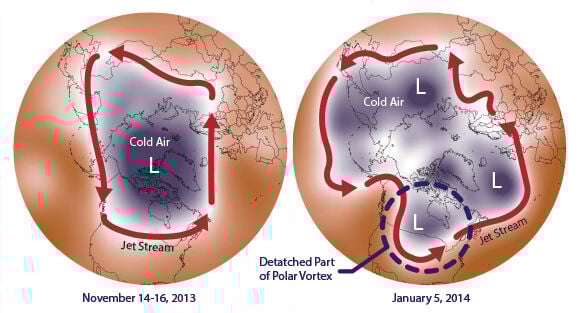
On Feb. 14, 2021, a subzero air mass called a polar vortex blasted its way into the Southwest and Mountain West, bringing disaster to Texas and enormous energy bills to Colorado as it washed up against the Rocky Mountains.
Between Feb. 10 and Feb. 19, 2021, winter storm Uri gripped much of the U.S. in below zero temperatures as low as minus 45 degrees Fahrenheit. The temperature in Denver plunged to minus 16 on Feb. 15.
The 2021 Valentine’s Day polar vortex cost energy customers billions of dollars at a time when many were struggling to pay their bills because of the COVID-19 pandemic and a skyrocketing inflation rate.


Meanwhile, many utility companies including Xcel Energy are recording record profits for their shareholders because the fuel costs are passed on to consumers.
The storm highlighted weaknesses in Colorado’s natural gas production and the ability of electric providers to meet the energy needs of consumers without burdening them with unaffordable energy costs.
A drop in natural gas supplies in areas affected by the freeze drove prices up even as gas suppliers on the East Coast tried to move gas west.
Limited capacity in interstate pipelines added to the scarcity. Pipelines can’t carry unlimited amounts of gas, and much of the supply was being directed toward Texas and the Southwest.
Public Service Company of Colorado, a division of Xcel Energy, says it spent some $650 million to pay for natural gas in Colorado alone when wholesale prices in the region spiked from around $2 to, in some cases, $600 per million BTUs.
Xcel is requesting authority from the Colorado Public Utilities Commission to recover those costs from customers.
Also pending state approval are fuel-cost adjustment requests from Black Hills Gas and Black Hills Electric amounting to $94.7 million.
The Public Utilities Commission has already approved rate hikes totaling $32.5 million for other Front Range providers including Atmos Energy, Public Service Steam and Colorado Natural Gas.
If Colorado’s energy regulators approve Xcel’s rate increase requests — $263 million for gas and $287 million for electric — Colorado ratepayers are on the hook for a total of $677 million.
Nor do the costs apply just to Front Range customers.
Xcel also sells wholesale electricity to smaller cooperatives including Grand Valley Power in Grand Junction and sent the co-op a fuel-cost adjustment bill that will have 18,000 Grand Valley Power customers paying as much as $93 per month extra for residential customers.
Other co-ops including Yampa Valley Electric Association, Holy Cross Energy and Intermountain Rural Electric Association are in the same position.
While Colorado power producers were able to keep the lights and heat on during the 2021 polar vortex, Texas saw widespread blackouts and generation breakdowns that left 4.5 million residents without power for as many as four days.
At least 210 people died of hypothermia and carbon monoxide poisoning, according to a November 2021 report by the Federal Energy Regulatory Commission.
As a result of moisture freezing in natural gas lines and valves, supplies were cut off to some gas-powered generating plants. Freezing water lines shut down some coal-fired power plants as well as a nuclear generating station.
In Texas, much of the natural gas infrastructure lies on the surface, and controls are not adequately insulated against freezing.
In all, 164 hours of freezing temperatures caused more than $195 billion in damages in the Lone Star State.
Texas, the nation’s largest natural gas exporter, both interstate and by ship to foreign markets, essentially used its entire available output within Texas, and for a short time became an importer of natural gas to serve the critical needs of Texans.
Politicians, policymakers, regulators and the public demanded answers because this was not the first time the Texas energy system had failed during sub-freezing weather.
In 2011, a nearly identical polar vortex hit the Southwest, including Texas. Between Feb. 1 and Feb. 4, 2011, nearly 4.4 million people in the region lost power and experienced rolling blackouts.
Such events are not unprecedented.
According to the Federal Energy Regulatory Commission report, “There were prior severe cold weather events in the Southwest in 1983, 1989, 2003, 2006, 2008, and 2010. The worst of these was in 1989, the prior event most comparable to 2011.”
When natural gas supplies are low, either because the infrastructure cannot deliver it or production and storage are low, deliveries are prioritized, with the highest priority being residential customers and other buildings, with power generation coming second in priority.
Life and safety are the primary concerns with prioritization, and secondarily the protection of buildings from damage caused by water pipes freezing.
As electrical loads begin approaching the generating capacity of a power grid, the frequency of the alternating current power begins to drop. All U.S. power grids operate at 60 cycles per second (Hz).
If the frequency remains above 59.4 Hz the grid can remain stable. At 58.4 to 59.4 Hz, generators will continue to operate for not less than nine minutes. Below 58.0 Hz, generators will fail within two seconds or less.
To avoid damage or destruction of generators caused by vibrations or heat caused by frequency variations, as demand approaches the capacity of the system, “load shedding” can be ordered, or it can happen automatically.
This involves cutting off power to parts of the grid using switches at transformer and distribution stations, creating rolling blackouts as power producers shut off parts of the grid for several hours and then return power as they shut off power to another part. This is to make sure that as many people as possible will have electric power for at least some period of the day to run heaters and other appliances while keeping demand low enough to preserve the grid.
According to after-action reports, on the morning of Feb. 15, 2021, the entire power grid in Texas was within eight minutes and 37 seconds of a potential complete grid failure.


Understanding the rise of VPN friendly casinos in online gambling
Sponsored Content
sponsored-content@denvergazette.com
Updated 2 months ago
The landscape of online gambling has evolved dramatically in recent years, with the emergence of VPN friendly casinos playing a pivotal role in this transformation. As restrictions tighten around the globe, more players are turning to Virtual Private Networks (VPNs)...

Sponsored Content
Reporter

Exploring the dynamic landscape of new casinos in the UK
Sponsored Content
sponsored-content@denvergazette.com
Updated 2 months ago
The realm of online gambling in the UK continues to evolve, with new casinos uk making their mark on the industry. These fresh platforms are gaining traction by offering unique experiences, enhanced features, and enticing bonuses to attract players from...
Sponsored Content
Reporter

How an 815 Credit Score Secures Better Loan Options
Sponsored Content
sponsored-content@denvergazette.com
Updated 3 months ago
Most borrowers notice a quiet shift once their credit moves into the upper tiers. The offers feel different, the terms seem lighter, and the entire borrowing process carries less tension. An 815 credit score sits squarely in that space where...
Sponsored Content
Reporter

Exploring Denver From Home: Digital Experiences to Try Locally
Sponsored Content
sponsored-content@denvergazette.com
Updated 4 months ago
Denver buzzes with life, from its iconic skyline all the way to the glorious mountains surrounding the city. Here’s a secret that not everyone knows: some of the best experiences occur without ever having to navigate traffic, crowds, and parking...
Sponsored Content
Reporter
Denver’s Quarterback Situation: Early Expectations And Real Tests
Sponsored Content
sponsored-content@denvergazette.com
Updated 4 months ago
Facebook Twitter WhatsApp SMS Email Print Copy article link Save Denver opens the season with public title ambitions and a second-year starter at the controls. Bo Nix arrives from a record-setting rookie year, yet the test now shifts from surprise...
Sponsored Content
Reporter
Managing Financial Stress: Can Short-Term Loans Help?
Sponsored Content
sponsored-content@denvergazette.com
Updated 4 months ago
Facebook Twitter WhatsApp SMS Email Print Copy article link Save More Americans are struggling to stay financially afloat. With inflation raising the cost of basics like rent, groceries, and car repairs, many households are left with little margin for emergencies....
Sponsored Content
Reporter
Underdogs to Watch: Sleeper Picks for the 2025 Belmont Stakes
Sponsored Content
sponsored-content@denvergazette.com
Updated 4 months ago
Facebook Twitter WhatsApp SMS Email Print Copy article link Save Picture Credit The 2025 Belmont Stakes brings a shift in tradition and a reshuffling of expectations. Moved to Saratoga Race Course due to ongoing renovations at Belmont Park, this year’s...
Sponsored Content
Reporter
Key Matchups to Watch: Broncos vs. Chargers 2025 Season Preview
Sponsored Content
sponsored-content@denvergazette.com
Updated 4 months ago
Facebook Twitter WhatsApp SMS Email Print Copy article link Save Picture Credit The 2025 NFL season brings renewed intensity to the AFC West, particularly between two ambitious rivals—Denver and Los Angeles. The Broncos and Chargers are poised for two critical...
Sponsored Content
Reporter
The Evolution of Women’s Sports: Redefining Engagement for the Next Generation
Sponsored Content
sponsored-content@denvergazette.com
Updated 4 months ago
Picture Credit Photo by Jeffrey F Lin on Unsplash Women’s sports have evolved from being a marginal athletic attraction to becoming a vibrant and integral part of the global sports landscape. This evolution, shaped by perseverance, advocacy, and cultural shifts, has not only...
Sponsored Content
Reporter
Factors That Allowed Bitcoin to Exceed $100k
Sponsored Content
sponsored-content@denvergazette.com
Updated 4 months ago
source Bitcoin has finally hit the $100k mark, a huge psychological barrier people have been discussing since 2017. Every time it spiked, people started talking about the $100k mark, and every time it went down, crypto skeptics gloated that it...
Sponsored Content
Reporter
PREV
PREVIOUS
12 icons of the Colorado outdoors seek dates for Valentine's Day
For Valentine’s Day, let’s give ourselves the gift of imagination. We know online dating isn’t for everyone, but there seems to be options for everyone. Between Christian Mingle and Farmers Only and Plenty of Fish, there are plenty of apps in the sea. But what about one for mountains, parks and other natural beauties? We’re […]

Full Send Bike Ranch project facing local opposition
A proposal to build a downhill mountain bike park in western Jefferson County, two miles west of Conifer on Shadow Mountain Drive, is meeting resistance from area residents who say it’s not an appropriate use in a forested area surrounded by mountain subdivisions. The proposed Full Send Bike Ranch would create the first chairlift-served mountain […]