







Ukrainians living in Colorado fear for their homeland
Timothy Hurst
“A state of frozen disbelief” is how Marina Dubrova and other Ukrainians living in Colorado are feeling following Wednesday night’s Russian attacks on their homeland.
“We hope that the international community will condemn Russia and bring strong sanctions against (Russian President Vladimir) Putin’s government, so he can feel the pain and repercussions,” she said. “We hope to see peace in Ukraine.”
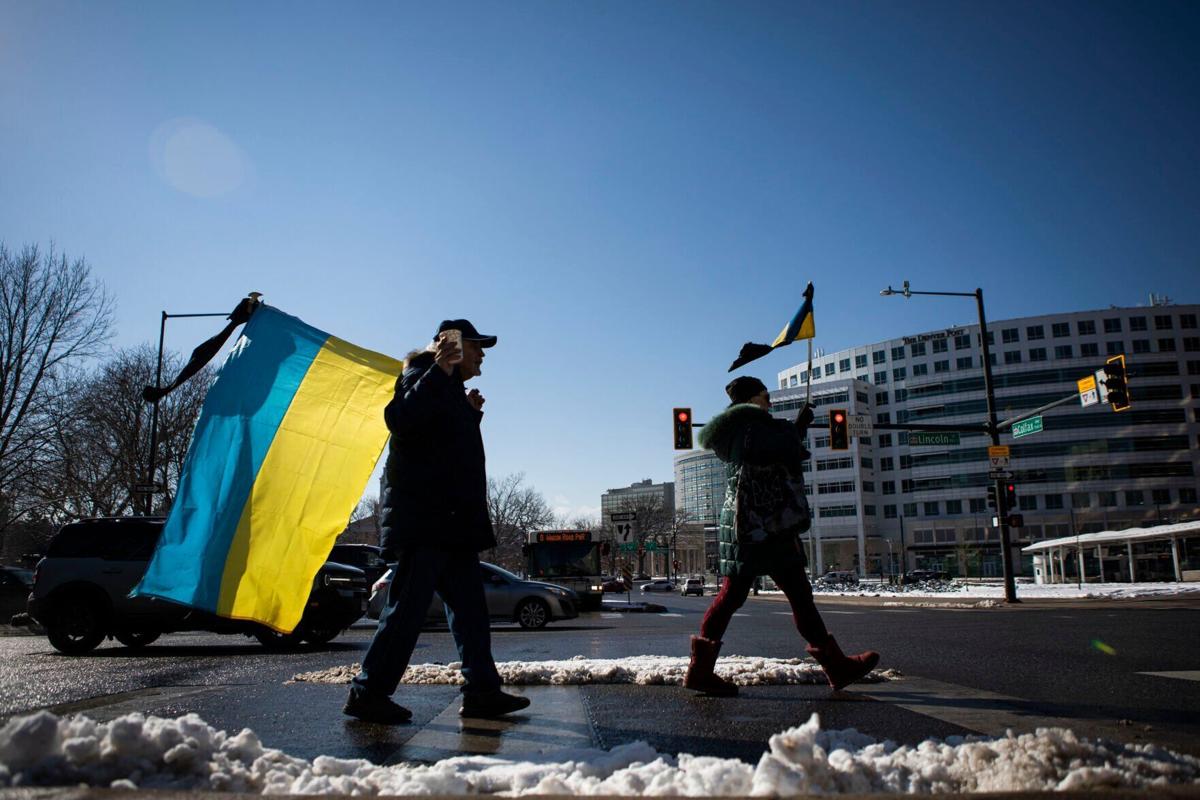
Dubrova, founder and president of Ukrainians of Colorado, a nonprofit social group, was among several hundred people protesting the incursion of Ukraine at the Denver Capitol on Thursday.
Supporters from Russia, Serbia, Jordan and other countries joined the opposition to Putin’s decision to attack key cities in Ukraine Wednesday night, and Thursday morning there, with air strikes.
At the rally Gov. Jared Polis declared his support for economic sanctions against Russia and solidarity with Ukrainians in the United States, including an estimated 11,000 who live in Colorado.
Colorado’s politicians join world leaders in condemning Russia’s invasion of Ukraine
“It was very productive and exciting to see all the support, which we appreciate,” said Dubrova, who was born in Ukraine and lived there for 32 years before immigrating to America in 1994.
Ukrainians are hard-working, responsible and peaceful people, she said.
Her relatives report that in declaring an emergency state, the government has enacted a curfew, banks have closed, supermarkets are open — but there is no bread, she said — and Ukrainians are waiting up to three hours in line at pharmacies to get medications.
Also in touch with friends who live in Ukraine is Christina Webb Thomas, a Colorado Springs resident who did community development work in Ukraine while serving in the Peace Corps from 2011 to 2013.
Her contacts say Russian forces are bombing airports, blowing up bridges and capturing small towns, with frequent loud gunfire echoing throughout the lands.
“They are scared and say that things are difficult, but so far they are OK,” Thomas said. “The overall sentiment is that they remain hopeful.”
People of Ukraine love their native land and will not give up easily, Thomas added.
“Ukraine is a wonderful country of incredibly generous, passionate, proud and brave people,” she said. “They will stand up and protect themselves, and I hope that the United States will stand with them.”
Russia presses invasion to outskirts of Ukrainian capital
But not all Ukrainians see the situation the same way.
Irina Primakova, operations manager at Appliance Works in Colorado Springs, who immigrated to the United States in 1991, said Russia did not start the war.
Rather, “We are observing Russia finishing this war,” she said.
She says the current regime, which she calls “Kiev Nazis” came to power unlawfully as the result of a coup and started bombing Donbas. That’s when the war started, she added.
“When Ukrainian Nazis burned 48 people alive during the infamous Odessa massacre of 2014 … when Ukrainian Nazis tortured and murdered civilians, including pregnant women and children in Donbas and other areas of Ukraine … the list can go on,” Primakova said.
She condemns the U.S. government for providing weapons for the conflict.
“It is a shame that our government has been supporting this bloody Kiev Nazi regime with weapons, enabling it to murder even more civilians,” she said.
But Primakova said she’s optimistic that the past eight years of suffering for Ukrainians will be over soon.
This is the most dangerous time in global security since the early 1960s, which saw the Cuban missile crisis and the construction of the Berlin Wall, said John O’Loughlin, professor geography at the University of Colorado in Boulder.
Biden hits Russia with sanctions, shifts troops to Germany
O’Loughlin has worked in Ukraine since the collapse of the Soviet Union in the early 1990s and conducts surveys of the political beliefs of Ukrainians.
He said was surprised about the wide geographic range of the Russian assaults.
“I thought that they would be confined to the Donbas region,” he said. “But it’s become clear that Putin wants to make Ukraine into a client state like Belarus currently is.”
O’Loughlin’s research determined there is some support for the Russian actions happening in south and east Ukraine, but it’s a small minority of the ethnic Russian population.
“The overwhelming majority will be opposed, frightened and try to work out how best to survive these attacks,” he said. “A small minority will fight back, but the military balance is overwhelmingly in Russia’s favor.”
He believes the war is “partly a result of Putin’s imagination that Ukraine is controlled by anti-Russian, pro-West elites who want to use NATO to attack Russia.”
The military invasion also is related to Putin’s demand that Ukraine never join NATO, O’Loughlin said, which has been “completely rejected by the Ukrainian government, NATO and the U.S. administration.”
Students studying the geography and politics of Ukraine asked O’Loughlin in mid-January to predict the odds of an attack. He predicted a 75% chance it would occur, and estimated it would start between Feb. 20-24.
“Sadly, I was spot-on,” he said.
Contact the writer: 719-476-1656.