




Colorado used to be home to ‘cheetahs’ – and their impact may still be seen today
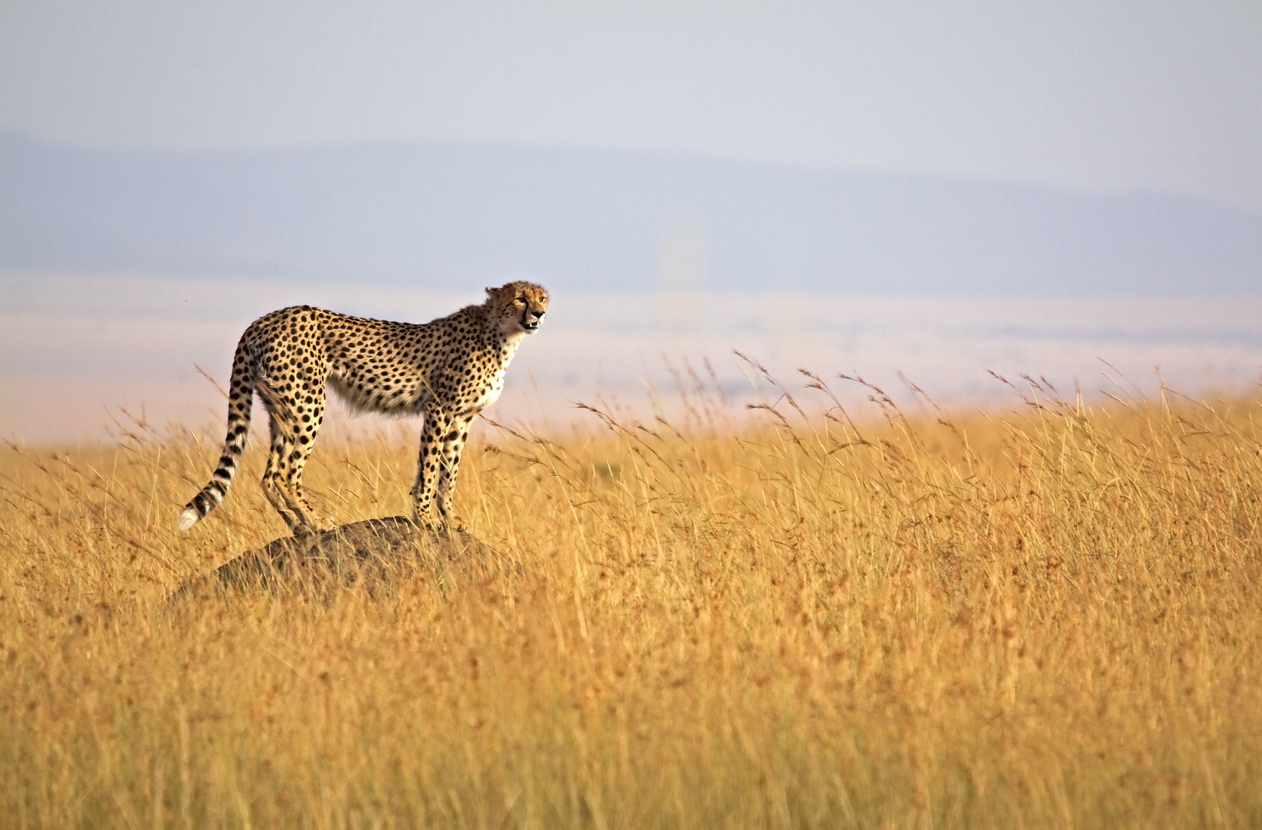
Ever wonder how Colorado ended up being home to the second-fastest land animal in the world? It probably has something to do with how a ‘relative’ to the world’s fastest land animal once called the region home.
Believe it or not, those pronghorns regularly spotted roadside can reach a top speed of 60 miles per hour, making them the second-fastest land animal on the planet. The only animal that’s faster than the pronghorn is the cheetah, capable of reaching speeds recorded at up to 61 miles per hour, according to the University of Wyoming. Many scientists now believe that the reason the pronghorn is so fast is because the species spent many years evading the now-extinct American cheetah – though this big cat wasn’t actually a ‘cheetah’ at all.
Before diving into this topic, it’s important to note that the American cheetah is actually a ‘false cheetah’ – in other words, it’s not actually directly related to the cheetah, but a specialized cat that’s genus evolved in North America about 3 million years ago, according to National Geographic. They just happen to be extremely similar in build and behavior and thus, there’s a bit of naming confusion at play.
While the American cheetah, or Miracinonyx (which is the extinct genus of two similar species), developed its traits specific to North America, it happened to have many similarities to cheetahs found in the wild today. This is despite being more closely related to the puma and likely due to either parallel or convergent evolution. In other words, a similar existence likely led to similar cats in two different parts of the world.
The American cheetah had build that was very similar to that of the modern cheetah, with long limbs, a short snout, and semi-retractable claws. While it’s not possible for someone to record the American cheetah’s top speed, given that the animal is extinct, it’s believed that this animal’s speed may be the reason pronghorns are so quick today. It’s likely the American cheetah had a speed in the same ballpark as the modern cheetah given other similarities.
The American cheetah weighed around 150 pounds with a head-to-tail length of about 103 inches – about eight and a half feet. This would be a little bit larger than the modern cheetah in terms of weight and length, but the difference in size wouldn’t be noticeable to most.
While evidence about the behavior of these animals can be difficult to piece together, near-full skeletal remains have been found in North American caves, with fossils found in parts of Colorado, as well as Florida, Texas, Georgia, Maryland, California, and other states.
It’s believed the American cheetah was around until about 12,000 years ago, during the Pleistocene epoch.
Next time you spot a pronghorn sprinting across Colorado’s plains, know that there’s a good chance it has the American cheetah to thank for all that speed.
STAY INFORMED: Sign-up for the daily OutThere Colorado newsletter here
Get OutThere
Signup today for free and be the first to get notified on new updates.
PREV
PREVIOUS

Florida Department of Health accuses CDC of altering state's COVID-19 deaths
The Florida Department of Health accused the Centers for Disease Control and Prevention on Friday of wrongly deleting roughly 20,000 Florida deaths from its nationwide COVID Data Tracker. The CDC removed 72,277 deaths last Wednesday from its nationwide tracker after discovering what it called a “coding logic error” that had mistakenly counted deaths from 26 […]

Celebrity chef admits he was a Mafia soldier in the 1980s and 1990s
A celebrity chef in New York City revealed Thursday that he was part of the New York City Mafia decades ago while still a successful chef on the restaurant scene. David Ruggerio, a famed chef at New York restaurants Maxim’s, Le Chantilly, and La Caravelle, admitted to being a member of the Gambino crime family […]