Colorado late-term abortion doctor: ‘I’m not going anywhere’
Parishioners leaving a noon Mass at Boulder’s Sacred Heart of Jesus church shook their heads as they walked by the damage done to an abortion memorial by a man with a hammer.
The vandalism took place the night news broke that the U.S. Supreme Court is poised to strike down Roe v. Wade based on a draft opinion leaked to Politico.
“There’s so much anger over the abortion issue. I wish we could channel it in a way that could bring understanding and peace,” said Brenda Luksch, past organizer of Forty Days for Life, a self-described “pro-life campaign.”
Despite several dents and cracks, the inscription on the sculpture was still readable: “Before I formed you in the womb, I knew you.” The way Luksch sees it, pregnancy is a gift from God, “where others consider it a parasite.”
The verse comes from the Bible, a passage familiar to Christians and that many in the anti-abortion movement point to when they raise theological arguments against abortion. They say this quote from God in the Book of Jeremiah affirms their view that life — at conception or before — is sacred.
Barely half a mile separates the Catholic church from a clinic known for performing late-term abortions and in cases involving the most difficult pregnancies. The church and the clinic illustrate the heated national debate over the future of Roe v. Wade.
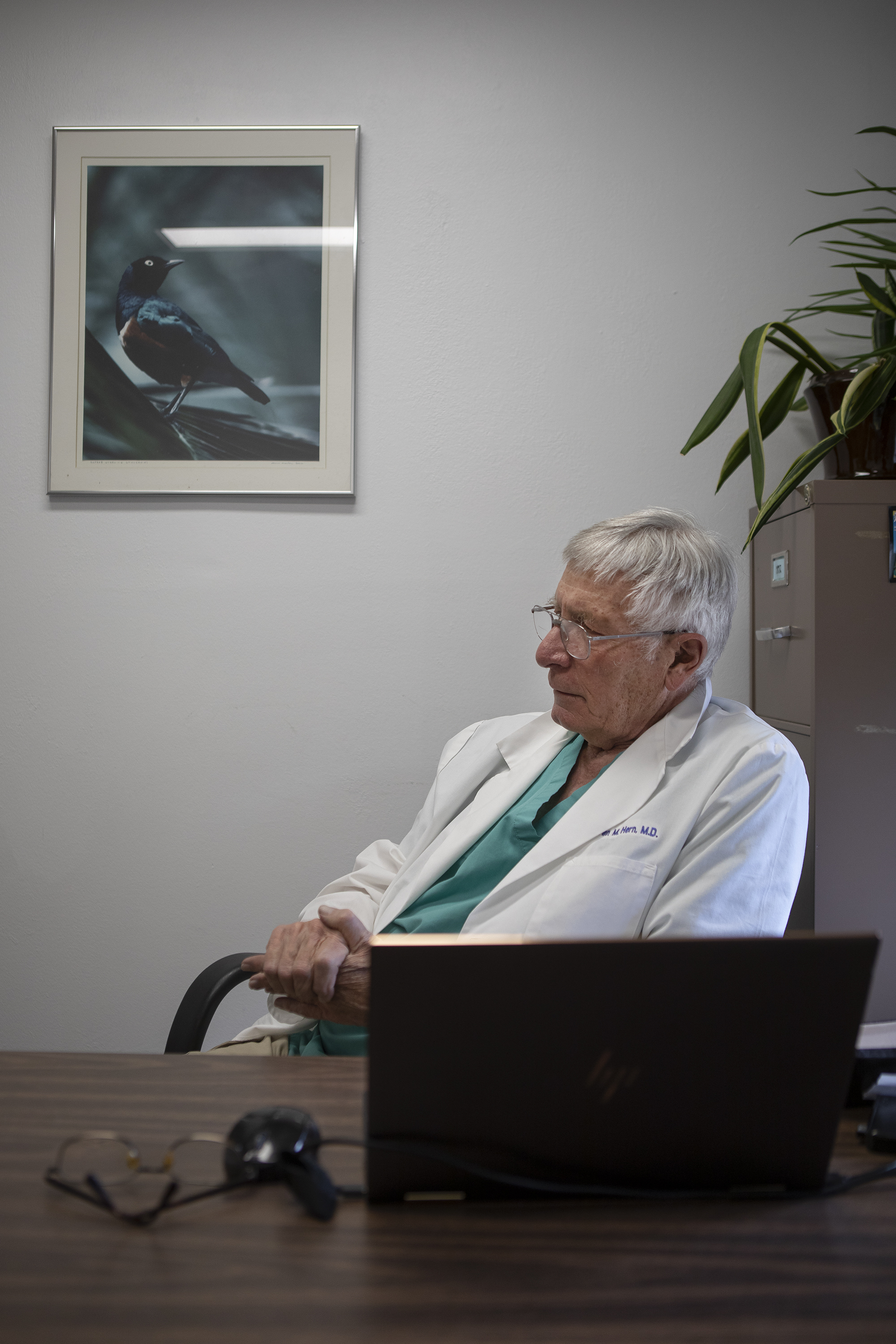
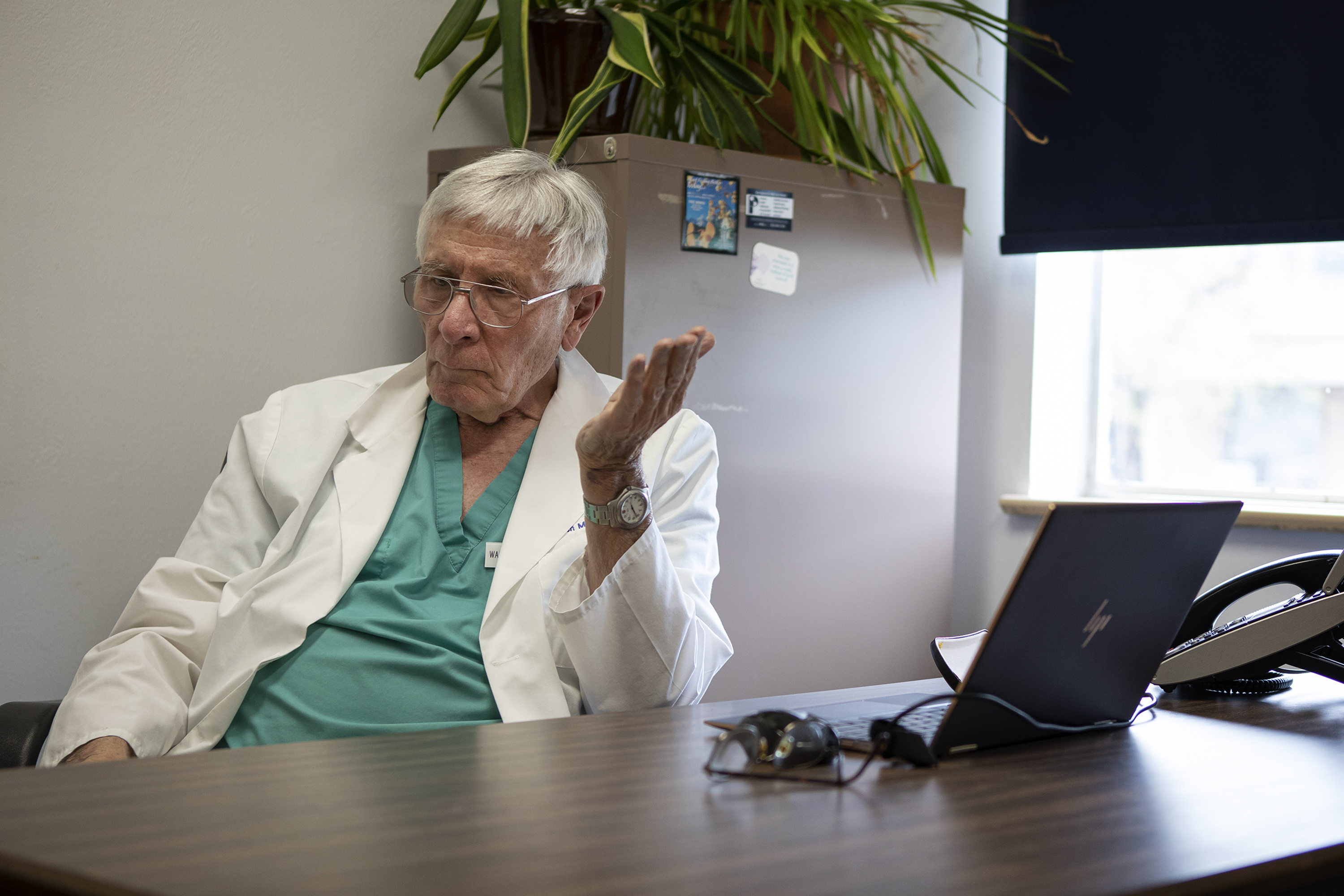
Dr. Warren Hern founded Boulder’s nonprofit intensive care abortion clinic in 1973, just three months after the Supreme Court issued its ruling in Roe v. Wade. He is preparing for the landmark decision to be overturned.
“It will be a cataclysmic decision, which is horrifying but completely predictable. The 2016 election sealed the fate of Roe v. Wade. This is what the anti-abortion people have been trying to do for 45 years and they have succeeded,” Hern told The Denver Gazette.
He was referring to former President Donald Trump’s election in 2016 and his series of appointments to the U.S. Supreme Court that many view as tilting the court to the right.
“My biggest concern about this as a physician is that women will die,” said Hern.
The outspoken 83-year-old started out in public health with no intention of performing abortions, but he said he welcomes the challenge of being an abortion doctor in today’s divided political climate. Hern is one of only a handful of doctors in the U.S. who will perform a late-pregnancy abortion. Since last summer, his clinic has only accepted patients who are at least 20 weeks pregnant.
Advocates on both sides of the debate expect a prolonged legislative fight if the court overturns Roe and shifts the issue of abortion access to the states.
Colorado is one of six states, plus Washington, D.C., that have no gestational limits on abortions. According to the Guttmacher Institute, an abortion-rights research organization, if Roe v. Wade is overturned or weakened, 26 states are expected to ban abortion, forcing women to travel to states where the procedure is legal.
If those states ban the procedure, Guttmacher predicts, the number of women whose nearest abortion provider is Colorado would increase by 504% because they’d be crossing state lines from Wyoming, Utah, Montana, Nebraska, South Dakota, Oklahoma, Idaho and Arizona. The number decreases to 482% if the ban applies at 15 weeks of gestation and then falls to 261% with a 20-week ban.
Gov. Jared Polis could be playing off of these kinds of predictions as he campaigns for reelection. On Thursday, he released a fundraising email pointing out Colorado’s stance on the right to choose and he promises that if he gets four more years, he will strengthen abortion rights here.

Earlier this month, he signed legislation affirming the right to an abortion in Colorado — regardless of what action the U.S. Supreme Court takes later this year. “This bill codifies a person’s right to make reproductive health care decisions free from government interference,” Polis said when he signed House Bill 1279 into law.

Known as the Reproductive Health Equity Act, HB 1279 establishes a fundamental right to continue a pregnancy and give birth, or to have an abortion. The bill also says fertilized eggs, embryos and fetuses do not have independent rights under the law, and it prohibits state and local public entities from denying or restricting an individual’s right to use or refuse contraception, or to either continue a pregnancy or have an abortion.
Hern said his practice is already seeing more women from out of state seeking abortions, perhaps reacting to so-called trigger laws. These measures are abortion bans designed to go into effect in 13 states if Roe v. Wade is overturned. In anticipation of an influx of women who are turned away in their own states, Hern has hired a new doctor and has plans to expand the clinic.
Already, women with more difficult cases who are referred by other doctors have to wait at least three weeks, and that agonizing wait, Hern said, creates a Catch-22.
“The longer women have to wait for an abortion, the more pregnant they get,” Hern said. “The more pregnant the patient, the more difficult the delivery.”
This week, 13 women were on the Boulder Abortion Clinic’s schedule.
That is heartbreaking news for Luksch, who calls Colorado an abortion sanctuary. It bothers her that Hern’s abortion clinic is just up the street from her church. And while she can’t choose her neighbors, she hasn’t been silent. She and a group from Sacred Heart of Jesus gather in front of Hern’s facility twice a year to “pray for the people inside and for the lies to stop.”

Anti-abortion advocates argue that abortion is unnecessary, given the array of options available to mothers, such as giving up a child for adoption. They point to support services available to women to carry their pregnancies through.
“The most important thing that the pro-life movement is doing currently and will be doing even more of in the future is to promote the amazing resources that exist to support those who would otherwise feel abortion is their only or best option,” said Lauren Castillo of Students for Life of America and Students for Life Action.
“We here in Colorado have incredibly experienced, professional, and robust pregnancy centers and resources,” she said, adding, “We will be expanding and promoting these resources to ensure that no woman stands alone in a post-Roe America.”
Luksch said her group of worshipers pray for Hern every day: “We pray for his conversion and that they can realize there’s something life-giving instead of life-taking.”
Luksch said she once favored abortion rights, but she changed her mind. She said that when it comes to a life, it’s OK to tell people what to do.
“We do it all of the time. People get up in arms when parents leave a baby in a car and go into a bar to get a drink,” she said.
Hern is used to people protesting along Alpine Avenue, a street dotted with medical buildings, including his own facility. When he decided on what to call it, he didn’t fret over politically correct or nonidentifiable phrases. Boldly painted across the outside of his facility are the words “Boulder Abortion Clinic.”
Women seeking abortion enter either from the street or from a secluded parking lot, down a gated walkway, into a receptionist’s cubicle using an old, 1980s on-call contraption. From there, they are buzzed in with a warning to wear a mask and to leave behind cellphones and cameras. Often women are dropped off by Uber and surrounded by protesters who implore them not to go inside, which Hern said only makes them more determined to go through with the abortion.
But one day last week, he said a pregnant Asian woman coming in for an abortion was so intimidated, she ran off and hid. He later brought her inside for treatment.
Hern said he has performed over 40,000 abortions since 1973 and none of his patients have died. The major complication rate for the more difficult advanced pregnancies is in the range of 0.5%. There have been virtually no major complications in the 20,000 early abortions.
Hern has seen many reasons for why women seek abortions later in pregnancy, including a missed diagnosis, a fetal anomaly or genetic disorder in a desired pregnancy, the fear that a relationship will collapse because of the impending birth, lack of money and/or transportation to get to an abortion clinic early, ignorance of signs and symptoms of pregnancy, especially in young women and fear, shame or guilt over the situation.
Hern is aware of the dangers of being an outspoken abortion-rights advocate and one of a handful of doctors who perform abortions late in pregnancy. He’s been shot at so many times, the clinic windows have a four-layer protection of bullet-proof glass, 24-hour surveillance and heavy-duty electronic steel gates.
Death threats are routine. “I’m on the hit list,” Hern said. “They’ve sent messages telling me, ‘Don’t bother wearing a bullet-proof vest. We’re gonna get a head shot.’”
Hern bought the building where he houses his practice in 1973 and later bought a building across the parking lot as insurance to keep anti-abortion groups from settling in there because, he said, “If I didn’t, they would have rifles pointed at me.”
In the 1980s, a rock thrown by a protester busted a clinic window. He put up a sign: “This window was broken by those who hate freedom.” In 1988, someone fired five shots, hitting a window of the clinic and nearly missing one of his staff.
Hern runs down a list of dedicated doctors who gave their lives for the cause of reproductive rights.
Five of his colleagues have been assassinated through the years including Dr. George Tiller, who was shot dead May 31, 2009, in the lobby of a Lutheran church in Wichita by a man who had been stalking him for years. Besides the obvious danger from people who want to take them out, Hern said doctors who perform abortions are stigmatized by other physicians.
Parishioners of Sacred Heart of Jesus said they don’t condone violence. But for them, the Boulder Abortion Clinic can’t shut down soon enough.
“I hope he retires,” said one woman who wished to go unnamed.
Nearly 50 years in, Hern does not intend to leave the work that he feels called to do.
“I’m not a factory worker. I’m a physician,” he said. “I’m not going anywhere.”