







Colorado wildlife officials will embark on quest to locate fish not seen since early 1900s
Courtesy of Colorado Parks and Wildlife
Colorado Parks and Wildlife officials will embark on a quest to discover a fish who hasn’t been found in Colorado’s waters in well over a century.
The wildlife team composed of CPW aquatic biologist Alex Townsend and CPW’s Southeast Region Senior Aquatic Biologist Paul Foutz and retired CPW aquatic biologist Greg Policky will search over 200 wetlands, streams, and ponds in the upper Arkansas River basin in search of the Yellowfin cutthroat.
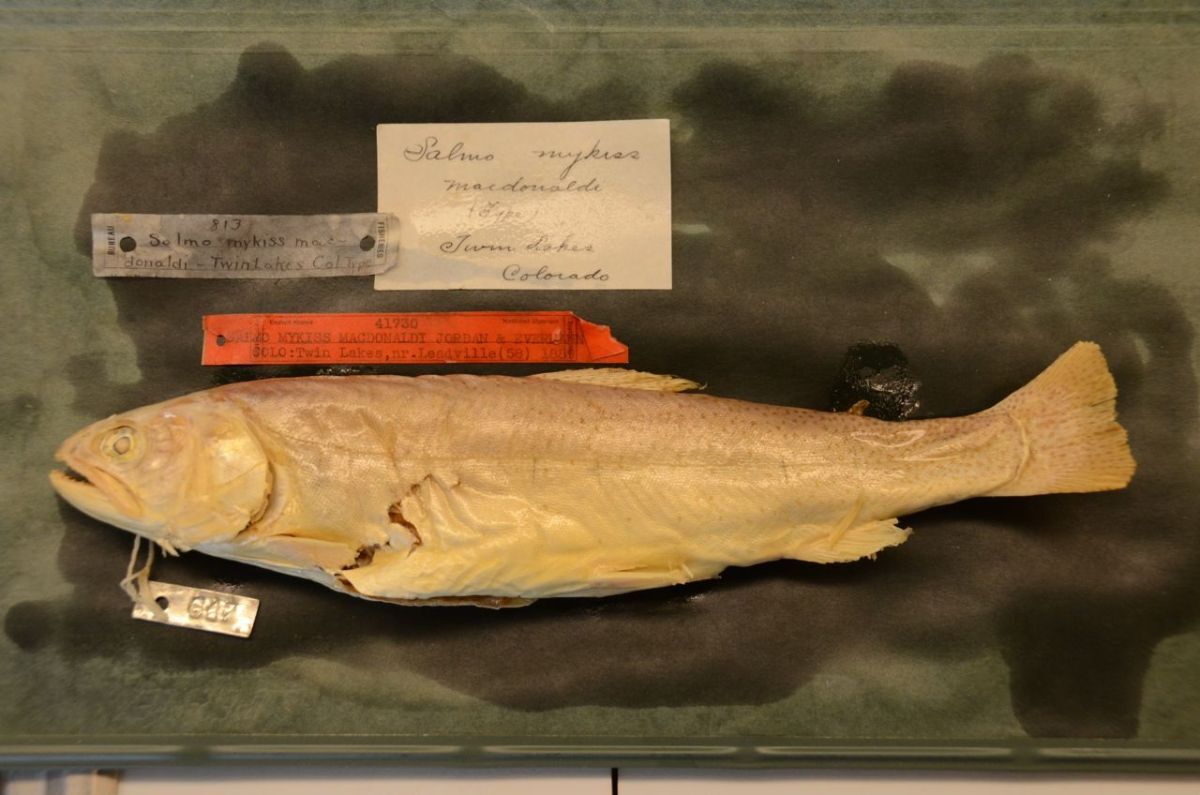
The Yellowfin — considered a giant compared to other cutthroat species — was last seen in the waters in Twin Lakes near Leadville in the early 1900s.
Officials believe the fish could be hiding somewhere in the waters bow that two other species, the Greenback cutthroat trout and San Juan River cutthroat trout, were discovered over the last decade after they were believed to be extinct.
However, the mission is a long shot.
“We are going into this search with our eyes wide open,” Foutz said. “We know the history of the Yellowfin and that it hasn’t been seen since before 1902. But millions of trout native and nonnative, have been back and forth across Colorado since before statehood. And if the history of the Greenback and San Juan River cutthroat teach us anything, it’s that we should never stop looking.”
The Yellowfin was first documented in July 1889 by David Starr Jordan and G.R. Fisher who published their discoveries in the 1891 Bulletin of the U.S. Fish Commission, according to CPW.
The pair collected seven Yellowfins during a visit to Twin Lakes. Those specimens are the only evidence of the species existence. Five of the fish are currently at the Smithsonian Museum of Natural History in Washington D.C.
Yellowfins are lake specialists and weigh between 10 and 12 pounds. The species was bred at the Leadville National Fish Hatchery from 1892 to 1905 and introduced to many lakes across the Centennial State.
But Yellowfins weren’t the only species spawned at the hatchery. In fact, Chris Kennedy, a U.S. Fish and Wildlife Service’s fisheries biologist gathered stocking records and found that more than 50 million cutthroat trout from the Gunnison and White River basins were stocked across Colorado between 1889 and 1925, according to CPW.
From 1914 through 1925, the state fish commission produced at least 26 million trout and stocked them in virtually every county in Colorado that could support the species.
However, surveys of Twin Lakes in 1902 and 1903 did not find any Yellowfin, according to CPW.
In 1979, Robert Behnke, a fisheries biologist and world authority on trout wrote in “Monograph of the native trout of the genus Salmo of western North America” that he believes the Yellowfins fell victim to nonnative trout introduced in Twin Lakes in the late 1800’s.
Surveys of those times showed nonnative rainbow trout were dominant in the waters. The survey also found hybrids of greenbacks and rainbow trout, but the greenbacks disappeared from the Twin Lakes shortly after 1903, according to CPW.
There were reports of Yellowfin being sighted in Island Lake, near Silverton, in the 1930s. However, these reports were found to be unsubstantiated, according to CPW.
Behnke wrote in 1979 that he was not optimistic of finding the Yellowfin in Colorado ever again.
“There is a remote possibility that the Yellowfin trout was once stocked into a barren lake where it was able to reproduce and no other trout was later stocked into that lake. Even if such a situation existed, there is no way a trout could be verified as the original Yellowfin trout of Twin Lakes,” he wrote.
“It is not likely that any more will ever be known concerning the Yellowfin trout.”
Despite his concerns, Foutz, Townsend and Policky are on a mission to find the “Zombie Fish.” Especially since modern genetic testing has made it simpler to identify a specific species.
The three-man team will begin sampling the watersheds in the Twin Lake region next June and a separate CPW team will continue their work in 2023, 2024 and 2025, according to CPW.
A survey in 2020 of the Upper Arkansas basin identified 236 waters that had no stocking and no survey records and only recently had stocking been well documented.
Townsend said poor record keeping was due to mining activity in the area.
“These waters may contain valuable populations of cutthroat trout of unknown genetic origin,” Townsend said. “Although these fish are no longer present in Twin Lakes, the possibility exists that a remnant population with pure genetics might be found in the high mountain lakes, tributaries and drainages to Twin Lakes.”
The project will persist until all 236 waters have been surveyed and documented. Sampling will occur throughout the summer months when there is no snow and impediments.
Crews will electro-fish, net and use hook-and-line methods as they make their way through all 236 waters, and will collect tissue samples that will be analyzed for genetic composition, according to CPW.
Although the mission is a long shot, Foutz said it is their duty to search for the fish that hasn’t been seen in 120 years.
“I know how exciting it was to discover that Greenback cutthroat trout still existed in our waters,” Foutz said. “Our world is diminished anytime a species goes extinct. Searching for the Yellowfin is the fulfillment of CPW’s basic mission of perpetuating the wildlife resources of the state. Based on our recent discoveries of the Greenback and San Luis cutthroats, we’d be remiss if we didn’t search for the Yellowfin.”