







Expulsion of Douglas County student who allegedly made ‘hitlist,’ allusions to shooting, upheld by court
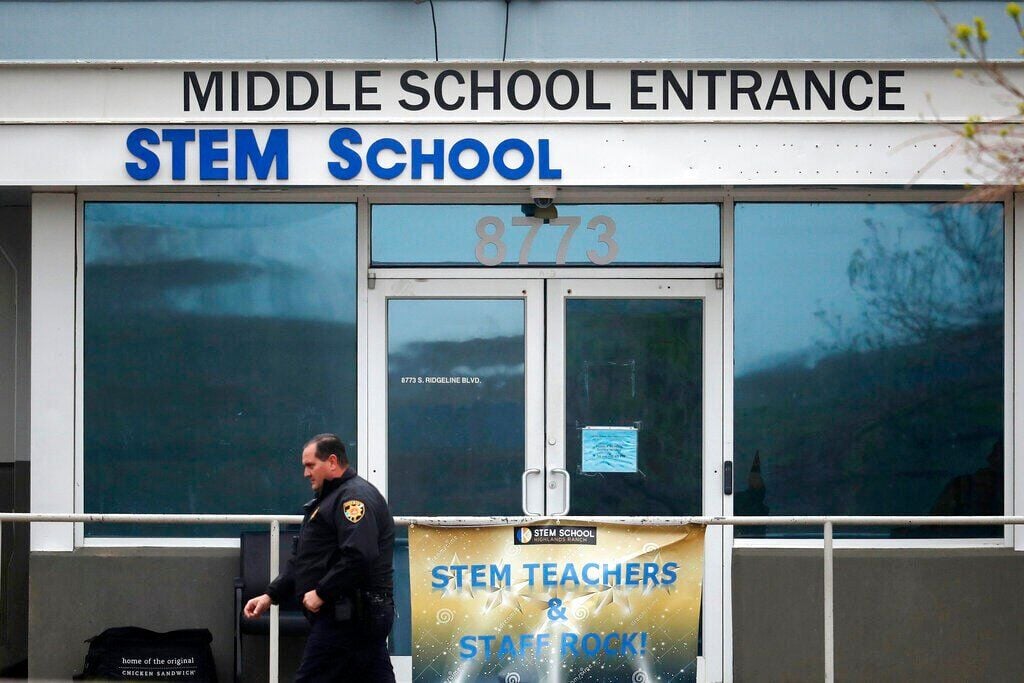
AP Photo/David Zalubowski
A trial judge correctly upheld the Douglas County School District’s expulsion of a student who allegedly created a “hitlist” and made other allusions to school shootings online, Colorado’s second-highest court determined last week.
At the time the student, identified as “John Doe,” made the comments over messaging platform Discord, it had been less than a year since two teenagers shot up a classroom and murdered 18-year-old Kendrick Castillo at STEM School Highlands Ranch — the same institution Doe attended.
“Plaintiff is a young man who was wrongfully expelled from STEM School for attempting to cope with trauma induced by being present at the May 7, 2019, STEM School shooting. Instead of attempting to help this student, STEM School punished him for doing nothing,” Doe’s lawyers argued in court.
Doe protested his discipline to the school district’s board of education and then to a judge in state court, arguing there was no documentation of a hitlist. But a three-judge panel of the Court of Appeals found sufficient evidence existed to justify the district’s concerns about Doe.
“Even if the actual hitlist was never presented to the Board, numerous student statements alleging its existence were,” wrote Judge W. Eric Kuhn in the Oct. 6 opinion. “And the other evidence before the Board — student statements, Discord screenshots, and Doe’s Discord transcript — support the Board’s conclusion that Doe posted school-shooter-themed profile pictures, usernames, memes, links, and jokes.”
In the school district’s narrative, Doe posted content in various Discord chatrooms in March 2020, including jokes about school shootings plus a picture of a guitar case and gun with the caption “school shooter starter kit.” Doe also changed his username to “the guitar case guy,” “showingmyguntoaguitarcase” and “Devon the Racist” — references to his school’s 2019 shooting, where the perpetrators brought a gun inside using a guitar case. Devon Erickson was later convicted of Castillo’s murder.
Doe also allegedly shared a file in a chatroom with a hitlist of STEM School students and staff, singling out “6th graders,” “blacks” and “homosexuals.” Simultaneously, he played the song “Pumped Up Kicks,” whose subject matter is school shootings. He deleted the document before he left the online chatroom.
Another student who witnessed the posts made an anonymous report to the Douglas County Sheriff’s Office. The school district interviewed other students who were present and they corroborated the allegations, including about the hitlist. The school found Doe’s actions merited expulsion under Colorado law, which authorizes such punishments for behavior on or off school property that “creates a threat of physical harm” to other children.
Doe’s parents requested a hearing, during which a hearing officer saw evidence of Doe’s allegedly threatening and racist posts. The hearing officer recommended a one-year expulsion and the district’s superintendent adopted the sanction.
The elected school board affirmed that decision in September 2020 and, when Doe’s parents filed a petition in court, Jefferson County District Court Judge Ann Gail Meinster found the evidence reasonably supported Doe’s expulsion.
“The district has an obligation,” Meinster wrote last year, “to maintain the safety of all students. The record presented shows adequate concerns for the school board to assert their responsibilities.”
Doe then appealed to the Court of Appeals. He argued that, in addition to his auditory processing disorder, he also had autism spectrum disorder that Douglas County School District refused to diagnose in a proper or timely fashion. Because state law prohibits expulsion for students when their actions are a manifestation of their disability, Doe believed the district wrongly denied him that opportunity.
“The statute does not require a student to have an identified disability, but just a disability. In this matter, John had autism spectrum disorder, diagnosed or otherwise, at the time of the alleged incident,” his lawyers wrote.
They also denied the existence of the hitlist.
The Court of Appeals panel believed the evidence was sufficient to expel Doe, and waved aside Doe’s claims about autism spectrum disorder. The school board had no evidence suggesting Doe had the condition. It even gave Doe the opportunity to present evidence that was unavailable during earlier proceedings, but Doe still did mention an autism diagnosis, Kuhn noted in the opinion.
The panel denied all of Doe’s claims, including his challenge to the constitutionality of the state law allowing for expulsion in response to a student’s off-campus speech. Because Doe raised the issue for the first time before the appellate court, the panel declined to consider it.
The case is Doe v. Douglas County School District.