







A Veterans Day tribute to Colorado’s ‘Home of Heroes’
The denver Gazette file
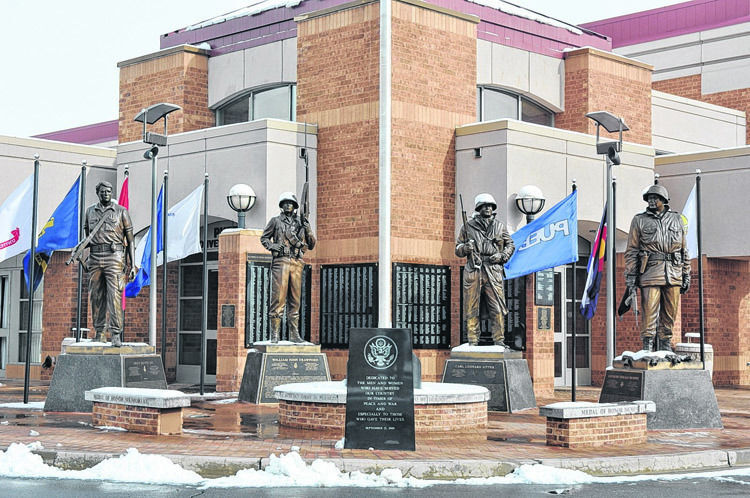
They call Pueblo, the Home of Heroes, and for good reason. This city in southern Colorado is tied with Holland, Michigan for having the most Congressional Medal of Honor winners (four) in the country since the turn of the 20th Century.
The four recipients of the Medal of Honor from Pueblo include: Pvt. William J. Crawford, Army, WWII — 1943; Capt. Carl L. Sitter, Marines, Korean War — 1953; Lt. Raymond G. “Jerry” Murphy, Marines, Korean War – 1953, and Sgt. Drew D. Dix, Army, Vietnam War — 1968.
The Medal of Honor is the highest military award for bravery that can be presented to a member of the US armed forces.
Since the inception of the award during the Civil War, only 3,511 individuals have received this honor. Its importance and meaning cannot be overstated.
In fact General George Patton, the famous WWII commander, said, “I’d sell my immortal soul for that Medal.”
One may wonder how a city like Pueblo in southern Colorado, whose population has never exceeded 120,000 residents, has more Medal of Honor winners than New York City with a population 70 times greater.
This question was surely on the mind of President Dwight Eisenhower when he presented the Medal of Honor to Raymond Murphy in 1953 for his acts of bravery in the Korean War. Eisenhower commented at that time, “What is it…something in the water out there in Pueblo? All you guys turn out to be heroes!” It’s that comment by Eisenhower that is said to have inspired the name, Home of Heroes.
The stories of each of the four men receiving the award represent true acts of courage that go far beyond the call of duty.
The case of Carl Sitter is representative of the four Pueblo recipients of the award. On the website of the Pueblo Home of Heroes Association, a group established to fund the Medal of Honor Memorial in Pueblo in honor its four recipients, there is a brief description of Sitter’s actions which led to him receiving the coveted award. Here is an abbreviated account from that site:
“On November 29th (1950) at the Chosin Reservoir in North Korea Captain Carl Sitter received his fateful orders to take East Hill. In unbearably frigid sixty below zero conditions Sitter and his men of George Company headed up East Hill. Outnumbered by at least twenty to one they were engaged by the ferocious Chinese troops for three nights – many times in hand to hand combat. During the brutal battle Sitter remembers feeling as though he was protected by an invisible shield. He gallantly executed his orders and today his heroic leadership is legendary in the annals of Marine Corps history.
He strategically maneuvered his men to successfully take and hold East Hill. A leader by example Sitter yelled words of inspiration and encouragement for his “boys” to perform. Wounded several times Sitter refused evacuation and determinedly led his men out of the Chosin Reservoir trap leaving no one behind.”
One can’t imagine what Captain Sitter must have been thinking on that freezing cold day. Only the day before (Nov. 28) the Associated Press had reported that General MacArthur, the commander of the Allied forces in Korea, had remarked to a fellow officer: “You tell the boys that when they get to the Yalu (River) they are going home. I want to make good on my statement that they are going to eat Christmas dinner at home.”
Only a day later, Sitter and his men would realize that not only would they not be home for Christmas but they may not make it home at all.
While Sitter was probably pondering whether he would survive, he also recognized his much greater responsibility of trying to ensure that those soldiers under him made it out alive. Many may have given up in conditions where soldiers’ feet froze into blocks of ice inside their boots and in the face of an enemy that was much greater in numbers.
Despite the odds, Sitter found the courage to inspire his men to continue to fight and lead them in a breakout back to Allied lines. Being a Marine, he also bore the special responsibility of all Marines that “no man be left behind” so all of the wounded and the dead, were carried out as they retreated.
Eisenhower may have been on to something about Pueblo being special. It probably isn’t the water but rather a city with strong family ties and bonds of loyalty that extend beyond their immediate loved ones. In the heat of battle, soldiers must depend upon their combat brothers and sisters to be willing to place their own lives at risk on their behalf.
The city also is deeply patriotic and over the years many have served in the armed forces and appreciate the sacrifices that must be made to preserve the freedoms that we have. Finally, it is a community that has long recognized the importance of family, country and freedom.
Greg Fulton is the president of the Colorado Motor Carriers Association, which represents more than 650 companies directly involved in or affiliated with trucking in Colorado today.