







Colorado’s egg supply strained; new law to allow cage-free eggs only
Colorado’s poultry and egg industry is facing challenges and changes — and shoppers are likely to notice.
Here’s a closer look at those changes and challenges and what shoppers should know as we enter the new year.
What will change in 2023 regarding egg production and sales?
Starting Sunday, Jan. 1, all eggs produced and sold in Colorado must follow a new standard that was set by state law in July that will shift all egg production and sales in Colorado to be fully cage-free by 2025.
The transition will require farms to have a ratio of 1 square foot per hen to become certified to sell eggs in Colorado, according to the Colorado Department of Agriculture.
All eggs must be labeled to indicate they meet that standard, the agency wrote on its website, and business owners cannot knowingly sell or transport eggs or egg products produced by a farmer that does not meet the state’s standard.
Farms with 3,000 or fewer egg-laying hens and business owners who sell fewer than 750 dozen eggs a week are exempt from the requirements, according to the Department of Agriculture.
While egg prices are changing on grocery store shelves, at least one Denver-area farmer has struggled for months not to raise prices. Paul Fleischer, founder and owner of Fleischer Family Farm, said the prices of poultry feed for their chickens and ducks have increased by about 20%, which has caused them to finally raise their prices from $6 for 12 eggs to $7. The farm’s customers are largely within a 10-15 mile radius of the Lakewood farm.
The requirements to move to cage-free is not something that Fleischer is worried about, he said. The term “cage-free” is meant to sound better than it seems, according to Fleisher, who uses organic and regenerative practices at his farm. They also got through the rise of avian flu without any issues or cases, he said.
Carton labels have specific meanings that are usually regulated by the USDA, according to its website usda.gov. Egg producers can request the services of USDA’s Agricultural Marketing Service (AMS) to validate marketing claims, but this is on a voluntary fee-for-service basis. Cartons with a USDA Grade Shield – like “USDA Grade AA” or “USDA Grade A” — have to meet certain standards.
Labels then have to be truthful and not misleading, including the way it was produced, as in the term “cage-free.” The on-site farm visits conducted by the USDA are done at least twice a year to try and ensure the production system. There is a difference between cage-free and free range, which ensures that hens are allowed access to the outdoors in addition to roaming.
Cage-free is still in an enclosed space, according to Fleischer, where there is a small area where they can push past each other and might see sunlight. What Fleisher says most consumers believe is that cage-free refers to free-ranging on farms, which is not what it is to regulatory agencies and producers.
“I think if people actually do some research and find out what the definition of cage-free really is, they’ll find out that it’s not that much different from where we are currently in Colorado in big-ag and factory farming,” Fleisher said. “There’s a lot of stipulations in the semantics of what goes on the labeling.”
How are shoppers handling the upcoming change with egg production?
Americans love their eggs. The U.S. Department of Agriculture’s Economic Research Service has been tracking egg consumption in America since 1909; the highest per capita egg consumption was in 1945 when each American ate 404 eggs per person, according to numbers on the USDA website. Egg consumption then went on a 46-year downward slide until the 1990s, when eggs became increasingly popular, according to the USDA. By 2031, the USDA expects an estimated 310 eggs will be consumed per person annually, up from 280 per capita today, according to a Minneapolis Star Tribune article.
For King Soopers shoppers like Diane Williams, the shift to cage-free will not affect her much as she already buys cage-free eggs. But for households like Megan and Erin Berson — who often buy whatever is available — the choice will be made for them, but they think the shift is a positive one.
“I think it’s important how we treat our animals,” Erin said.
Lonnie Day, who needs eggs every day in her diet due to a medical condition, said she does not mind the change so long as prices stay low. But lately, Day said buying eggs has been difficult, with prices reaching up to $10 for 18 eggs.
What is affecting the supply of eggs?
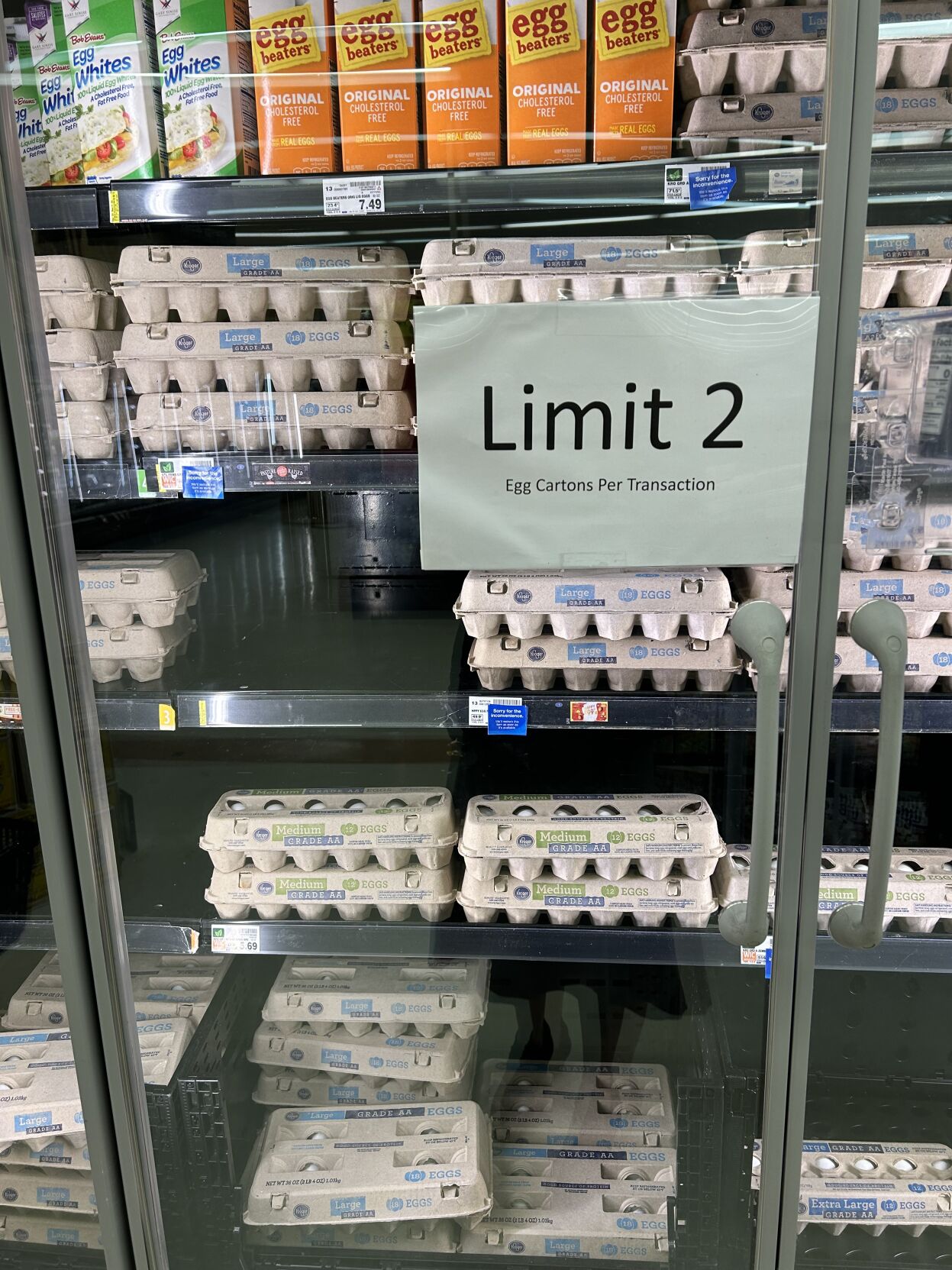
If shoppers noticed limits on egg purchases or a thin selection of eggs at stores, grocers said that’s because of a statewide outbreak of the Highly Pathogenic Avian Influenza (HPAI) that was detected in wild geese and chicken flocks in March.
Since then, more than 6 million chickens have been euthanized in Colorado because of the outbreak and that has shrunk egg supplies, grocers said.
Walmart officials said the holiday season’s demands compounded the limited supply of eggs.
That’s why stores such as King Soopers are limiting shoppers to two cartons of eggs per transaction, King Soopers officials said.
What is avian flu?
Avian flu is an infectious disease of birds. The highly pathogenic strain circulating among Colorado chickens can cause severe disease and potentially high death rate in domestic poultry, according to Colorado Parks and Wildlife.
Can humans be infected?
While rare, humans can be infected. The only case detected in the U.S. was reported in Colorado in April after a person with direct contact with the chickens involved in depopulating the infected chicken population experienced fatigue and since recovered, according to the Centers for Disease Control and Prevention.
Wild birds serve as a reservoir for the virus and can spread it to poultry. The U.S. Fish and Wildlife Service urges hunters to protect themselves from avian influenza by taking steps such as wearing rubber or disposable latex gloves while handling and cleaning game and to monitor their health for any signs of flu-like symptoms within a week of handling birds.