







Former Denver Police Chief Pazen joins Common Sense Institute as fellow

Timothy Hurst/Denver Gazette
Former Denver Police Chief Paul Pazen has joined Common Sense Institute as a public safety fellow, the group announced Friday.
In a statement, Pazen said he is excited to join the Common Sense Institute.
“I believe in utilizing research, innovation, data, and evidence-based methods to improve the quality of life, vibrancy and public safety for the people of Colorado and CSI strives to do exactly that,” he said.
Pazen, an outspoken critic of state policies he partly blames for the crime spike in his city, retired from the Denver police force Oct. 15. His 27 years with the Denver Police Department included four years as chief and a stint as the commander of patrol District One before that.
Common Sense Institute Executive Director Kelly Caufield noted how rising crime rates have driven public safety to the top of public policy discussions in the state.
“Our charge and the focus of this fellowship is to quantify the economic impact of public safety issues and spark thoughtful debate centered on policies that keep Coloradans safe and prosperous,” she said.
Caufield said Common Sense Institute will release a public safety study later this year on the economic benefits of increased law enforcement.
Pazen’s tenure as chief included helping launch the Support Team Assisted Response (STAR) program in 2020 in concert with community organizations. The program sends pairs of mental health clinicians and paramedics to low-level, non-violent calls that implicate behavioral health needs. And under his leadership, the agency was one of the first departments to adopt the Active Bystandership for Law Enforcement from Georgetown University Law Center, which trains officers on peer intervention to prevent situations from unnecessarily escalating.
Pazen also helped oversee the adoption of new use-of-force policies in 2018, which included prohibiting officers from watching footage from their body cameras before they are interviewed by investigators, creating a chart to train officers on making split-second decisions and prohibiting deadly force if a person only poses a danger to themselves.
Retiring Denver police chief, Paul Pazen, discusses police reform in the wake of George Floyd in a ‘Colorado Conversations’ session from Aug. 2022.
{
“@context”: “https://schema.org”,
“@type”: “VideoObject”,
“name”: “Retiring Denver police chief, Paul Pazen, discusses police reform in the wake of George Floyd in a ‘Colorado Conversations’ session from Aug. 2022.”,
“description”: “Retiring Denver police chief, Paul Pazen, discusses police reform in the wake of George Floyd in a ‘Colorado Conversations’ session from Aug. 2022.”,
“thumbnailUrl”: “https://bloximages.newyork1.vip.townnews.com/denvergazette.com/content/tncms/assets/v3/editorial/2/50/25061df3-7f9a-5f04-aa8c-7b36b5a07737/63487927f2584.image.jpg?resize=1396%2C785”,
“uploadDate”: “2022-10-13T14:46:00-06:00”,
“contentUrl”: “https://cdn.field59.com/GAZETTE/b295558d37b807b9060ca676bbbb00d62cd5635b_fl9-360p.mp4”
}
During his tenure, the police department began a “hot spot” policing strategy, which concentrated resources around five intersections police say made up a disproportionate number of the city’s shootings and homicides. The department has since expanded the strategy to include three more areas.
He led the department during a time of historic challenges: The agency has struggled with staffing shortages, an issue exacerbated by putting new recruit classes on hold in 2020 because of the pandemic; increased response times to calls for service; and, eroded public trust in policing. In addition, homicides began to increase in 2020, with 67 tallied this year as of Wednesday.
Last year, Pazen pointed to state policies that, he said, have made it difficult for law enforcement to go after criminals and keep them in jails.
“What’s often is missing at the legislative level is any concern for the victims of crimes,” he said. “Auto theft — we think it’s not that big of a deal, but it is a big deal. Think of our marginalized communities, communities of color. That might be the only vehicle a family has. That might be the only way to get the kids to school, to get to a job, to get to the grocery store and that vehicle is gone.”
CSI describes itself as a “non-partisan research organization dedicated to the protection and promotion of Colorado’s economy.”
Reporter Julia Cardi contributed in this report. Julia can be reached at julia.cardi@gazette.com.


Paul Pazen, a former police chief, launches bid for Denver City Council
Deborah Grigsby
deborah.smith@denvergazette.com
Updated 7 hours ago
Former Denver Police Chief Paul Pazen announced his bid for the District 2 City Council seat to be vacated by Kevin Flynn in 2027. Flynn is term-limited. Pazen, who began his law enforcement career in 1995 with the Denver Police...

Deborah Grigsby
Reporter

Denver advances face covering ban for law enforcement
Deborah Grigsby
deborah.smith@denvergazette.com
Updated 7 hours ago
A Denver City Council committee on Wednesday advanced a proposed ordinance banning law enforcement officers, including federal immigration agents, from covering their faces during an arrest or detainment or inside a city facility. The proposed ordinance also establishes a minimum...
Deborah Grigsby
Reporter

CU Boulder, state launch economic research in coal-transition areas
Scott Weiser
scott-weiser@denvergazette.com
Updated 9 hours ago
Communities in northwest Colorado built on coal mining and power plants are losing hundreds of high-paying jobs and a major share of their tax revenue as operations wind down. In a yearlong effort, the University of Colorado Boulder is teaming...

Scott Weiser
Reporter
Arvada councilmember under investigation for alleged ethics violation
Sage Kelley
sage.kelley@denvergazette.com
Updated 9 hours ago
A third-party investigator will look into potential ethics violations from Arvada City Councilmember Sharon Davis. Davis was excused from the dais during the council’s regular business meeting on Feb. 3. The rest of the council then approved the outside investigation...

Sage Kelley
Reporter
Aurora councilmembers discuss Regional Navigation Campus, ADA requirements
Kyla Pearce
kyla-pearce@denvergazette.com
Updated 14 hours ago
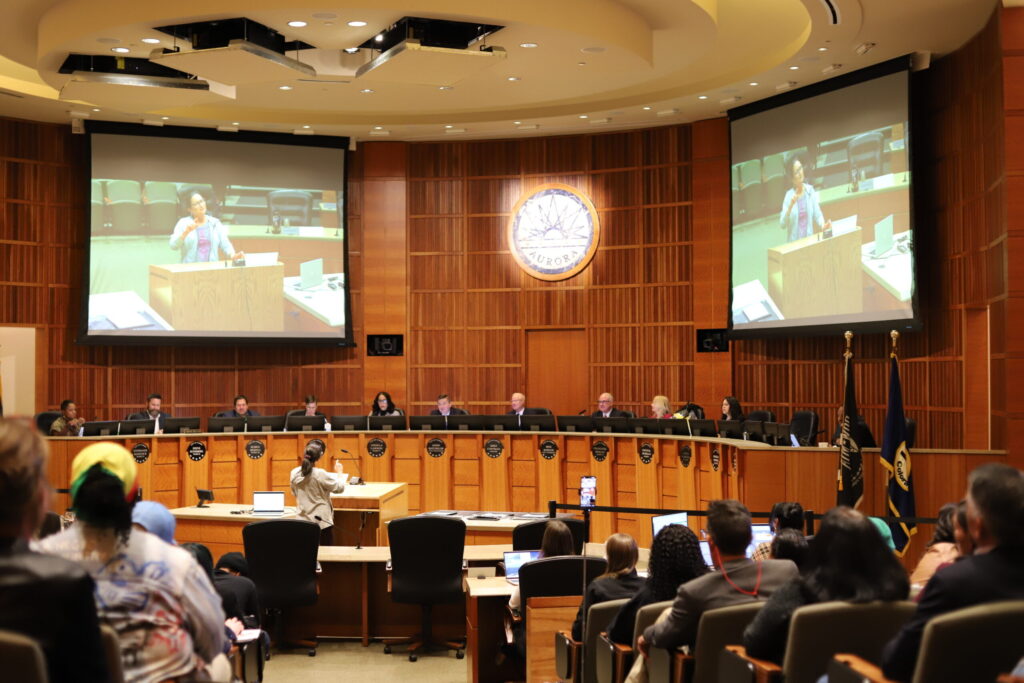
The Aurora City Council tackled several major city topics at a Saturday winter workshop, moving forward with ADA accessibility improvements for the council chambers, addressing concerns about the Regional Navigation Campus and debating a new impact fee for businesses. In...

Kyla Pearce
Reporter

Colorado lawmakers take aim at ‘imposter’ peaches, melons and chiles
Marissa Ventrelli
marissa-ventrelli@denvergazette.com
Updated 7 hours ago
Do you know where your Palisade peaches come from? What about your Rocky Ford melons? Your Pueblo chiles? You might think they were grown right here in the state, especially if they have the “Colorado Proud” logo — but that’s...

Marissa Ventrelli
Reporter

Denver moves to codify quarterly financial updates to the City Council
Deborah Grigsby
deborah.smith@denvergazette.com
Updated 14 hours ago
The Denver City Council unanimously advanced a proposed ordinance on Tuesday that aims to codify quarterly general fund reporting to the council from the city’s Department of Finance. The council currently does not receive regular budget updates, relying instead on...
Deborah Grigsby
Reporter

Colorado Title Board rejects challenges to graduated income tax ballot measure
Marianne Goodland
marianne-goodland@denvergazette.com
Updated 20 hours ago
The state body that determines whether a ballot measure contains a single subject has rejected challenges to eight versions of the push to change Colorado’s flat rate to a graduated income tax, thereby increasing the taxes on higher income earners....

Marianne Goodland
Reporter

Lakewood City Council urges residents to keep zoning changes
Sage Kelley
sage.kelley@denvergazette.com
Updated 14 hours ago
Lakewood’s long-running zoning fight is headed for a spring showdown at the ballot box, spearheaded by a new resolution from the City Council. The Lakewood City Council amended and confirmed a resolution on Monday expressing the councilmembers’ desire for residents...
Sage Kelley
Reporter

President Pro Tem Sen. Dafna Michaelson Jenet to resign from Colorado Senate
Marianne Goodland
marianne-goodland@denvergazette.com
Updated 1 day ago
A top Democrat in the Colorado General Assembly is resigning to take a new job. President Pro Tem Sen. Dafna Michaelson Jenet of Commerce City, who has served in the General Assembly since 2017, will become the director of the...
Marianne Goodland
Reporter
PREV
PREVIOUS

Bill to ban hospital facilities fees gets heated hearing, moves on
Facebook Twitter WhatsApp SMS Email Print Copy article link Save Hospital facility fees, according to those who oppose them, are hidden charges and unfair to consumers who get hit with those costs months after their outpatient medical treatments, and which can run into thousands of dollars. One witness likened the fees in a House committee […]

Colorado Republicans stage filibuster to delay gun bills
Facebook Twitter WhatsApp SMS Email Print Copy article link Save On a day when teachers and supporters of East High School came to the Capitol for a second day, a trio of Democratic-sponsored gun violence bills tied up the state House for hours on Friday. Friday’s actions also mean a Saturday session. Lawmakers are considering […]