







COLUMN: Denver’s school board must stop hiding | Jimmy Sengenberger

THE DENVER GAZETTE
From illegally holding meetings behind closed doors to deflecting from their culpability in school safety failures, Denver’s school board keeps hiding from the public. Unfortunately for the dysfunctional seven-member board, the public isn’t having it any longer — and the board’s breaches of transparency and trust are ever more apparent.
On Monday evening, the Denver Public Schools board rejected an effort by President Sochi Gaytán to discipline Tay Anderson, the board’s vice president, for what would have been his second censure. In part, Gaytán accused Anderson of publicly revealing contents of a confidential March 23 executive session that never should have been held privately in the first place.
When the item was removed from the agenda in a 6-1 vote, it was ostensibly because the internal squabble threatened to distract from the priority of school safety — a subject now front and center following school shootings at East High School and violence plaguing the district. “Anything happening amongst us is not even secondary,” Quattlebaum stated. “It shouldn’t even make the top 10. It shouldn’t matter at all. Because our babies don’t feel safe.”
Fair enough. But then, why did Quattlebaum and her colleagues spend just 20 minutes out of nearly three hours on school safety, including an impromptu 4-minute presentation by Superintendent Alex Marrero? Why wasn’t the issue important enough to get on the agenda? Any member could have requested it in advance. Why aren’t they openly discussing their ideas on school safety and hearing from experts?
Let’s be clear: When DPS removed school resources officers from schools in 2020, the board voted to do it. When DPS revamped its discipline matrix, limiting the circumstances in which schools may expel students or contact police concerning disruptive student conduct, the board voted to do it. Both decisions tied the hands of the superintendent, DPS Safety, school staff, and administrators. Only the current school board has the power to permanently undo such reckless decisions.
Yet, under the guise of something called “policy governance” — a widely used approach by school districts that delegates operational decisions to the district administration and lets a school board shape policy — the board members have absolved themselves of even taking public positions on school safety changes until Marrero offers his plan on June 30.
That’s a cop-out: Nothing prevents the board from, in the meantime, hearing testimony from safety and law enforcement experts, asking rigorous questions, and taking individual positions on big-picture policy matters that they have direct control over. After all, Denver voters elected the school board; they didn’t vote for Marrero.
After the board met behind closed doors in a marathon five-hour executive session on March 23, they unveiled a memorandum temporarily lifting the ban on SROs. Then, without any public discussion, they voted unanimously to approve the measure. If the board can develop a school safety policy change behind closed doors, why can’t they do so in public?
Moreover, had the effort to censure Anderson for breaking confidentiality moved forward, it would have deflected from the fact that the entire board met behind closed doors — illegally. “It is a clear-cut violation of the open meetings law,” Steve Zansberg, a First Amendment attorney in Denver and president of the Colorado Freedom of Information Coalition, told The Gazette. “They clearly adopted a position by agreeing in advance of a full public vote. They’re not allowed to make a decision behind closed doors.”
Why didn’t the board allow the public to see this debate? The answer may lie in the DPS board’s recent history of holding long executive sessions for dubious reasons.
For example, on Nov. 28, Anderson, Quattlebaum and Scott Esserman pushed for an executive session explicitly because they wanted to prevent the board’s well-earned reputation for dysfunction from getting even worse. They didn’t try to hide it: Quattlebaum argued public discussion would “create a narrative out there that doesn’t need to be created.” Anderson echoed her sentiments and asserted, “(W)e need to have the conversation privately, regardless of whatever the content is.” Except state law sets the standards for what justifies executive session — not the whims of the board.
They ultimately held off on going private until their subsequent Dec. 15 meeting. By then, the board finally generated their public reasons for the executive session, vaguely referencing the superintendent’s contract and legal questions regarding pending litigation. They met privately for four hours, wrapping at 11:30 p.m.
Let’s be real: The March 23 executive session was business as usual for the DPS board — the latest instance of a marathon meeting held behind closed doors to avoid public scrutiny. This time, unlike in December, they left the March meeting with a new policy — making it a flagrant breach of the law.
Denver’s school board exemplifies a persistent pattern of non-transparency and unaccountability. Board members claim to care about school safety, but when push comes to shove, they simply speak platitudes or take it private. In truth, the DPS board appears more interested in disposing of their own accountability than in proactively and openly addressing the grave crises before them.
Jimmy Sengenberger is an investigative journalist, public speaker, and host of “The Jimmy Sengenberger Show” Saturdays from 6 a.m. to 9 a.m. on News/Talk 710 KNUS. Reach Jimmy online at JimmySengenberger.com or on Twitter @SengCenter.
Jimmy Sengenberger is an investigative journalist, public speaker, and host of “The Jimmy Sengenberger Show” Saturdays from 6 a.m. to 9 a.m. on News/Talk 710 KNUS. Reach Jimmy online at JimmySengenberger.com or on Twitter @SengCenter.


Colorado’s Jason Crow misfires over Iran | Jimmy Sengenberger
Jimmy Sengenberger
jimmy-sengenberger@denvergazette.com
Updated 2 days ago
Over the weekend, President Donald Trump ordered Operation Epic Fury — a bold strike on Iran, conducted in tandem with the Israeli Defense Force. Some 40 members of Iran’s most senior political and military leadership were taken out in short order — including brutal...
Jimmy Sengenberger
Reporter

GUEST COLUMN: Another attempt at a fur ban? Still a ‘no’
Luke Wiedel
lwiedel@gmail.com
Updated 2 days ago
The Colorado Parks and Wildlife Commission (CPWC) will consider a petition to impose a statewide ban on the sale of fur at their March 4-5 or May 6-7 meetings. If you’re a Denver voter hearing about this petition for the...

Luke Wiedel
Reporter

Legislation on poison, poultry and prostitution dominate | Rachel Gabel
Rachel Gabel
rachel-gabel@denvergazette.com
Updated 2 days ago
Many weeks, my search history is odd but the past two weeks might worry our county sheriff if he didn’t know me as well as he does. This week has been the week of poison, poultry, and prostitution. Not to...

Rachel Gabel
Reporter
PERSPECTIVE: Jailbreak — Legislative Dems look to empty Colorado’s prisons
George Brauchler
george-brauchler@denvergazette.com
Updated 2 days ago
Colorado Democrats are working feverishly this legislative session to increase the rate at which convicted felons are released from our prisons back onto our streets. They claim they must, because of overcrowding and cost. Do not fall for that lie. ...

George Brauchler
Reporter
Are Colorado businesses leaving or evacuating? | Jon Caldara
Jon Caldara
jon-caldara@denvergazette.com
Updated 6 days ago
At this point, if you hear beeping downtown, it’s not a construction crew. It’s a company backing out. And look, I get it. Businesses relocate for all sorts of reasons: taxes, regulations, labor costs, office space, crime, commute times, the...

Jon Caldara
Reporter

GUEST OPINION: Generosity has defined Colorado for 150 years
Kyle Hybl
khybl1@gazette.com
Updated 5 days ago
What does it look like when a state takes care of its own? It looks like neighbors opening their homes to families displaced by wildfire. Volunteers standing shoulder to shoulder, offering food, clothing, and hope to people they have never...

Kyle Hybl
Reporter
Additional thoughts on State of the Union address/rally | Cronin and Loevy
Tom Cronin Bob Loevy
tom-cronin-bob-loevy@gazette.com
Updated 4 days ago
The U.S. Constitution’s Article II states that “He (the president) shall from time to time give to the Congress Information of the State of the Union, and recommend to their Consideration such Measures as he shall judge necessary and expedient...

Tom Cronin Bob Loevy
Reporter

What is the state legislature trying to hide?| Vince Bzdek
Vince Bzdek
vince-bzdek@denvergazette.com
Updated 4 days ago
What is it that the State Legislature is trying to hide? A bill that passed out of committee last week lets governments squirrel away important public notices on their own websites rather than publishing them in newspapers and other news...

Vince Bzdek
Reporter
Cute puppy overload and an audition of a different kind: Capitol M | Week of Feb. 28, 2026
Marianne Goodland
marianne-goodland@denvergazette.com
Updated 6 days ago
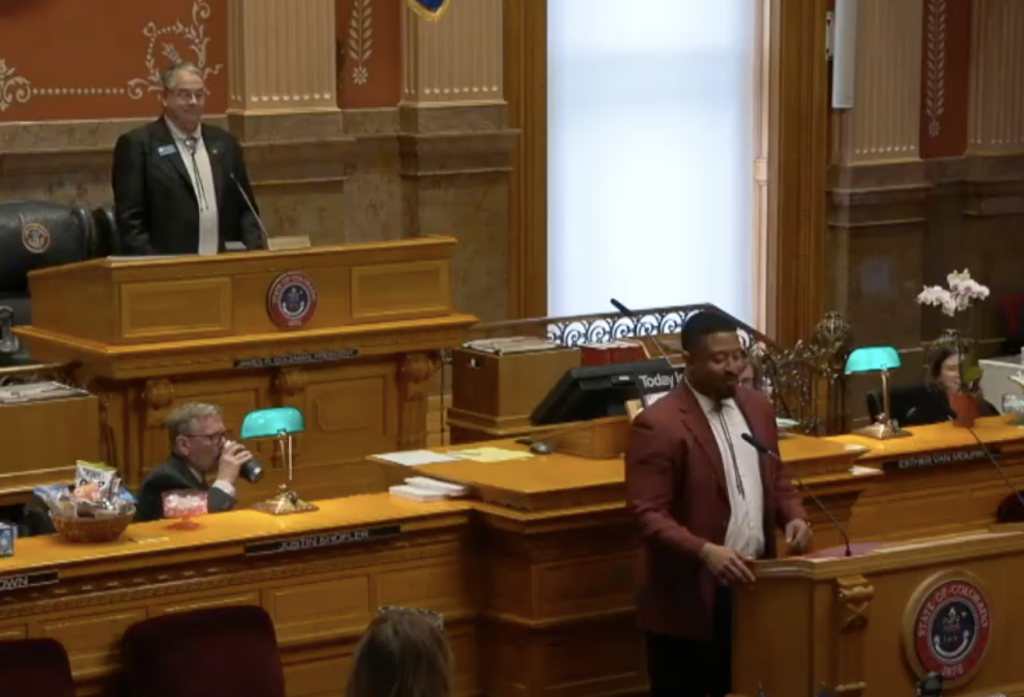
The lighter side of the Capitol, and most days, you ought to be really grateful for it. There’s a rumor (jk) floating around that an amendment is coming for the bill to legalize prostitution. The amendment would ban condoms made...

Marianne Goodland
Reporter

Union kills safeguards for Colorado schoolkids | Jimmy Sengenberger
Jimmy Sengenberger
jimmy-sengenberger@denvergazette.com
Updated 6 days ago
Without giving it a second thought, Democrats on the state Senate’s “kill committee” shot down a bill to keep dangerous public school employees from quietly moving between districts — even as supporters and critics alike urged amendments to make it work. Republican Sen. Mark Baisley, whose legislative...
Jimmy Sengenberger
Reporter
PREV
PREVIOUS

COLUMN: “Rhetorical advocacy” is license to lie | Mike Rosen
U.S. Senator John Kennedy (no relation to JFK) of Louisiana is a rare gem. His southern drawl, folksy demeanor, and keen wit — he’s said that judicial nominees don’t belong on the bench just because they watched “My Cousin Vinny” — are disarming, but he’s no rube. Kennedy is sharp as a tack and well […]

PERSPECTIVE: Colorado after legalized marijuana
On November 7, 2000, Coloradans approved Amendment 20, which legalized the use of marijuana. In 2012, recreational use of marijuana in Colorado was approved. Colorado has been at the forefront of the effort to legalize the use of cannabis in the U.S.; however, one has to ask: Have we become a better state because of […]