







Iconic Denver Folklore Center sold to employee
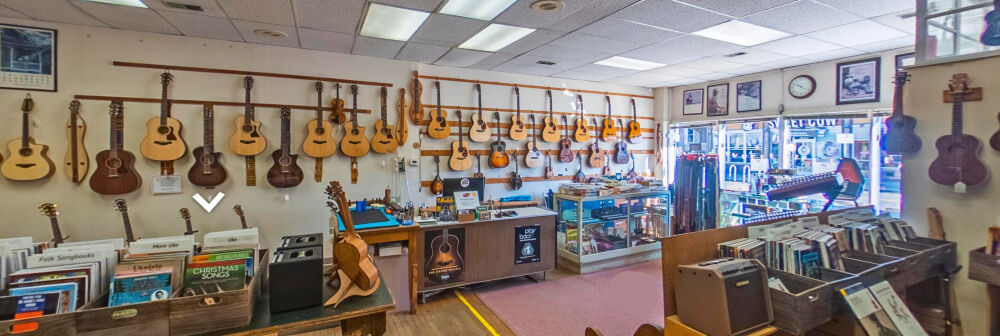
Courtesy Denver Folklore Center
The iconic Denver Folklore Center, which has sold instruments to and nurtured the local acoustic music community since 1962, was sold Thursday to 38-year-old Ian Dehmel of Aurora.
That’s according to seller Saul Rosenthal, who purchased the Folklore Center in 2016 with business partner Claude Brachfeld upon the retirement of the legendary founder Harry Tuft – who, at age 86, is still an active performer and member of the Colorado Music Hall of Fame.
Dehmel, who grew up on Colorado’s Western Slope, has been an employee of the Denver Folklore Center for more than three years and plans to keep the business open at 1893 S. Pearl St., its home base for 40 years, Rosenthal said. The purchase price was not disclosed.
“Ian is a very bright and energetic young man who started out working in a music store in Grand Junction,” Rosenthal said.
After a stint in the city of Denver’s Office of Economic Development, he wanted to get back to his love of music, so he took a job as a sales associate at the Folklore Center. He worked his way up and was named manager a year ago.
“His primary instrument is the claw hammer banjo, he’s great with customers and he has all kinds of ideas to take the Folklore Center into the next decade – while still maintaining its essence,” Rosenthal said.

The Denver Folklore Center has been operating at 1893 South Pearl St for 40 years.
Courtesy Denver Folklore Center


The Denver Folklore Center has been operating at 1893 South Pearl St for 40 years.
The Denver Folklore Center is the premier acoustic musical instrument business in Colorado.
Over the years, it has hosted some of the biggest names in folk and rock music, including Joan Baez, Judy Collins, Bob Dylan, Pete Seeger, Arlo Guthrie, Muddy Waters, the Mammas and the Papas, Jim Morrison and Frank Zappa. Its primary mission is to sell (and repair) top-quality musical instruments – and all things acoustic music.
Change can be hard for longtime patrons whenever there is an ownership change, but Rosenthal likened today’s sale to recent ownership changes at the similarly independent-minded Tattered Cover book store and Twist & Shout record store, both now owned by returning or longtime employees.
“This has always been a place where you can buy the things you need and a place where you can feel part of a larger community of acoustic musicians – and that will not change,” Rosenthal said.
Tuft was an itinerant six-string player from Philadelphia who came to Colorado for skiing and took a bussing job at the Holy Cat in Georgetown. He later decided to open a folklore center in Denver that would combine merchandising, classes and performances. In December 1961, so the legend goes, Tuft loaded his 1951 Dodge truck and headed to Denver with his life savings of $900.
The Denver Folklore Center opened on March 12, 1962, at 608 E. 17th Ave., in Denver’s Swallow Hill district. In 1979, Tuft spun off the Swallow Hill Music Association into a fully independent nonprofit school that also presents hundreds of concerts annually, including the popular summer music series at the Denver Botanic Gardens.
In 1980, Tuft lost the lease on his original location when the property was sold to developers. Tuft sold the store’s name and stock to employee Rick Kerby but reacquired the business in 1983 and reopened it on South Pearl Street.
With Tuft approaching 80, Rosenthal and Brachfeld took ownership in 2016.
“After more than 50 magnificent years of running the Folklore Center, Harry was ready to turn it over to someone else who might be able to breathe some additional life in it,” Rosenthal said.
He emphasized that the Denver Folklore Center is in perhaps surprisingly strong financial shape – a fact he attributes, in part, to the pandemic shutdown, which was not devastating to every business.
“In fact, certain kinds of businesses that provided goods and services that people could make use of in isolation actually grew,” he said. Like the Denver Folklore Center.
“There was a real hunger from people looking for creative things they could do with their time,” he said. “People couldn’t travel or go to restaurants or concerts, but they had money in their pockets and could buy instruments. So, to be candid … our business boomed.”
While, admittedly many others suffered – including Swallow Hill Music.
“At a time when many longtime Denver businesses are disappearing, the Denver Folklore Center has not only survived but thrived,” Rosenthal said. “And now, with new ownership, it appears the store will be around for quite some time to come.”
John Moore is the Denver Gazette’s Senior Arts Journalist. Email him at [email protected]