







‘A large bear that can do ballet:’ Why Nikola Jokic inspires us all | Vince Bzdek

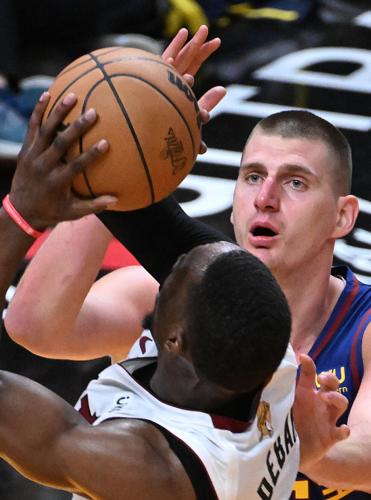
Denver Nuggets center Nikola Jokic (15))warms up in front of the red seats at the Kaseya Center in Miami before Game 3 of the NBA Finals on Wednesday, June 7, 2023. (Photo by Jerilee Bennett, The Gazette)
What do Nikola Jokic and Ted Lasso have in common?
They are both, I would argue, fitting heroes for our times. They both believe it’s more important to bring out the best in the players that surround them than to elevate themselves.
They just might be the best evidence we’ve seen in a long time that nice guys sometimes finish first.
Not only is Jokic a better player than anyone else in the NBA right now, he may be a better person than any other player.
When Jokic was named the Western Conference finals’ Most Valuable Player, ESPN’s Lisa Salters asked him what the trophy meant to him.
“For me to be honest, nothing,” Jokic replied.
“This trophy is supposed to go to my teammates and coaches,” Jokic said. “They put me in this situation. I’m just first among the equals, and I’m just happy that we are collectively getting wins and getting to make something.”
First among equals, indeed.
Jokic comes to this championship moment after being picked 41st in the 2014 NBA draft. You wouldn’t have seen him picked on TV, though, because a Taco Bell commercial was running when the Nuggets selected him. Nobody drafted that low ever won two MVP awards. Jokic has.
For most of his life, in Serbia, Jokic shared a two-bedroom apartment with six people.
An early scout reported that Jokic was “meek and lousy” as well as being overweight. The scout also said Jokic seemed to love basketball more than anyone else on earth.
He has gone on to lose 40 pounds and become the best player in professional basketball in America at the tender age of 28, redefining how the game is played.
And even at his pinnacle, he still refuses to act like a star, refuses to join social media platforms. Keeps to himself. He stays dedicated to basketball and his teammates and won’t be distracted by fame. He’s a team player in a superstar age.
Jokic may be more potent in his selflessness as a playmaker than as an incredibly talented point scorer. His team usually wins when he is not scoring a huge amount of points, even though he can score almost at will. The team does better when he’s making sure the other players score lots of points while he performs Globetrotter-esque passes, rebounds, play-makes, and passes some more.
Here’s a guy demonstrating unselfishness and collaboration as leadership techniques.
Meanwhile, “Ted Lasso” has been the surprise television hit of the past couple years because of the very same kinds of qualities. Lasso — a clueless coach recruited to take charge of fictional English football team Richmond ACF — has caught the imagination of viewers on both sides of the pond. He’s done so by being an ever-upbeat leader who motivates others to become their best selves, his approach being that the better you are as a person, the better a player you’ll be.
So he spends most of his time inspiring players to be kinder and more compassionate to one another rather than plotting grand soccer strategies. He puts a premium on the value of relationships, trust and respect more than individual achievement or even winning games. In our age of selfie self-promotion, toxic divisiveness and tribal cultural warfare, it’s a little shocking, really.
In both Lasso’s and Jokic’s worlds, the best leader is the leader who can turn a group of people into a cohesive unit that works together to achieve a common goal.
Creator Jason Sudeikis once told an interviewer his show is based on one overarching thing: kindness. He was motivated to create the benevolent coach character, and the show itself, by the coarseness he saw unleashed in the country by Donald Trump.
Sudeikis told The Guardian: “I’m not terribly active online and it even affected me. Then you have Donald Trump coming down the escalator. I was like, ‘OK, this is silly,’ and then what he unlocked in people … I hated how people weren’t listening to one another. Things became very binary, and I don’t think that’s the way the world works.”
Sudeikis was trying to create an antidote to Trump.
The result was the warm, uncynical character of Lasso who pastes a “Believe” sign above the door of the locker room. Sudeikis was trying to create an experience that enriches and spreads joy, he said. And, some observers have noted, in a time of hyper-focus on toxic masculinity, Lasso’s characters allowed viewers to feel better about men.
Jokic could care less about politics or “Ted Lasso,” or much of anything that goes on in American pop culture. In the off-season, he goes back to Serbia to take care of his horses. But I would argue he’s the on-court equivalent of Lasso’s antidote for our toxic, troubled times. A role model of unselfishness, humility and hard work, showing us the heights being a decent person can take you to.
“I think it’s a really nice brand of basketball that we have, and everybody buys in,’’ Jokic said to our reporter Chris Tomasson.
I like to think Jokic reflects a Colorado kind of approach, and that’s why we’ve embraced him so deeply: down to earth. Unpretentious. Practical. Humble. “The kind of talent that he is, you know, a modest talent, not somebody who is searching out the spotlight, a team player, somebody who’s down to earth,” U.S. Sen. Michael Bennet said recently to The New York Times. “I think Denver and Colorado, we view ourselves as down to earth.”
Gov. Jared Polis, in the same story, called Jokic “a rarity in the modern sports age.” He said people in Colorado “admire him all the more for not being an off-court distraction like other so-called stars are, you know, too often in both basketball and other sports.”
U.S. Sen. John Hickenlooper told the Times that Jokic was like a “large bear that can do ballet.”
It finally occurred to me why Jokic’s approach resonated powerfully with me personally the other day, when I heard someone talk about the importance of servant leadership.
Some of Jokic’s personal appeal — I’m not going to lie to you — is the bond us Big Men who once played basketball feel. I was a big man who couldn’t really shoot, alas, and had one, maybe two stuttering moves under the hoop. To see Jokic spin and dance and toss off soft skyhooks left and right and do what I only dreamed and wished I could do in the paint — and then shoot fadeaway 3-pointers with one hand while balancing on one foot, to boot — well, that kind of wish fulfillment is not to be taken lightly, my friends.
But the thing that really resonates with me, I finally realized, was how he reminds me of one of those lessons you learn in catechism class as a kid and then forget when you grow up to be a cynical old adult focused on your own, little insular world.
“Whoever would be first among you must be servant of all,” Mark wrote (Chapter 10, verse 42.) “For even the Son of Man came not to be served but to serve others and to give his life as a ransom for many.”
It’s been a long time since we let that kind of grace and goodwill seep deeply into our popular culture. Who would have thunk a 6-foot, 11-inch Serbian with a 5-inch vertical would be the messenger our better angels sent?