







Denver’s Jesse Aaronson rides his rocket ship to Tonytown tonight | John Moore
Until there is not a reason to tell the Holocaust story, 'it will always be relevant,' says Cherry Creek High grad featured in Best Play favorite 'Leopoldstadt'


Jesse Aaronson has set a pretty high Broadway bar for himself.
The affable 2014 Cherry Creek High School graduate will be at the Tony Awards tonight in New York City, 10 months after making his Broadway debut, as a cast member of the narrow favorite to win the award for Best Play – Tom Stoppard’s “Leopoldstadt” – even in a field sporting a record three Pulitzer Prize-winning plays.
Press the “Cast” link on the show’s website, and Aaronson has top billing. (Now, full disclosure: The actors are listed in alphabetical order. “Ahh, yes,” Aaronson said with a laugh, “the double-A has served me well for a very long time.”)
Aaronson, who shares something crazy in common with “The Office” actor Phyllis Smith, was first cast as (Double-A) Aaron, a minor figure in Stoppard’s celebrated, 38-actor ensemble epic. In March, he was given the additional role of Leo, a key character in the play’s final scene. Leo is a loose stand-in for Stoppard himself, the 85-year-old British knight considered by many (including Aaronson) to be the world’s greatest living playwright.
“It does feel like I kind of tripped into playing Tom Stoppard on Broadway,” Aaronson said this week from New York. That’s because he kind of tripped into being in the play at all.
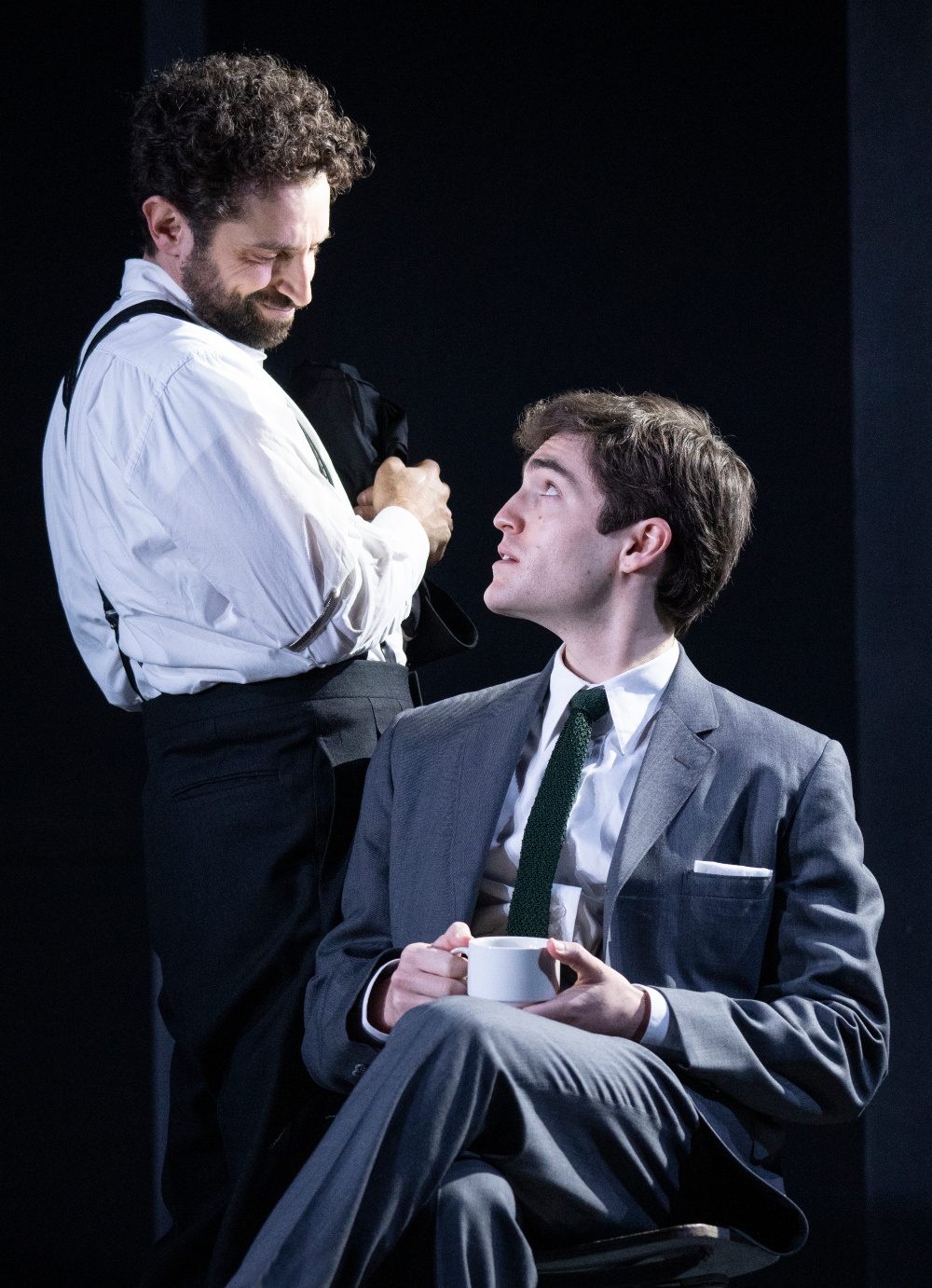
In April 2022, a casting director asked Aaronson to serve as the thankless “audition reader.” That means when the dozens of actual hopefuls entered the scariest room in show biz to perform a scene and possibly land a part in the play, Aaronson read all of the other characters’ lines, over and over again, with no expectation of being considered for a part himself.
“I was later told that, at the end of the first day, our director, Patrick Marber, asked about me and inquired if I was available to audition – and they said yes,” Aaronson said.
(Reporter’s interjection: This almost never happens.)
“And so, a few days later, I went in for a proper audition, which was kind of funny because I had spent three full days in the same room with the same creative team to do this very formal audition that I had seen 60 or 70 people do over the previous few days. A couple of weeks later, I found out I was going to be playing a small role and also covering for three larger roles – and I was absolutely thrilled about that.”
I say this “almost” never happens because this is pretty much the same, near-mythical story of how Smith was cast on “The Office” for a role the writers then named after her.
Aaronson had only arrived in New York in 2019, quickly landing a role in the Off-Broadway comedy hit “The Play That Goes Wrong.” Then there was that whole pandemic thing. When that relaxed, he landed in “Leopoldstadt,” the zeitgeist play of the Broadway season, which has had an uncommonly long 10-month run for a Broadway play but must close on July 2. And essentially playing Stoppard, who is up for his fifth Tony Award for Best Play tonight.
Literally, the only thing that has been able to slow Aaronson’s roll was a global shutdown.
It’s a fun story, the equivalent of the American (Theater) Dream. But what makes it so special to Aaronson is how deeply special the play is – not only to him, but to theatergoers in general, and especially to the international Jewish community as a whole.
“Leopoldstadt” follows multiple generations of a Jewish family in Vienna from 1899 through 1955. The play shows how the increasing threat of a Nazi invasion fractures the family and makes everyone face their Jewish heritage. In the final act, the last remaining family members come together from across the world to reconcile both their painful and fond memories.
“The story of the Holocaust and the Jews of Europe in the 20th century has been told many, many times. But until there is not a reason to tell that story, it will always be relevant. It certainly hasn’t proved irrelevant yet,” said Aaronson, noting that hate crimes “and prejudice of all kinds” have been on the rise since 2016.
Each of the play’s five acts takes place in a separate year: 1899, 1900, 1924, 1938 and 1955. You might notice the telling leap from ’38 to ’55. Stoppard makes a point to omit the actual Holocaust years, moving from Kristallnacht (or, “The Night of Broken Glass,” the start of the Nazi terror campaign against Jewish-owned businesses, synagogues and homes), to a full decade after the war ended.
“I think by jumping over those years and picking up with three disparate people who had three disparate experiences of the Holocaust provides a new context that hasn’t really ever been seen or told,” Aaronson said. “And I think that’s what makes Tom Stoppard’s writing so resonant and astonishing.”
This is all such a far cry from when Aaronson, 27, started doing summer-camp shows at the Jewish Community Center when he was 4. He took classes as a teen through the Denver Center’s Education Department, and he says he got lucky when his successive theater teachers at Cherry Creek High School turned out to be local stage veterans Mark Devine and, for his senior year, Jimmy Miller.
Devine cast Aaronson for the first and almost last time as a freshman in “Cyrano de Bergerac” because the youngster showed up for his sophomore “Beauty and the Beast” audition wearing “this stupid lime green and yellow beanie, with some ugly green flannel that didn’t match,” as Aaronson describes it. “I vividly remember my mother telling me, ‘You know, you really shouldn’t wear that to the audition.’” But the 14-year-old didn’t listen, and it landed him in Devine’s office for some real talk.
“Mr. Devine taught me to take auditions seriously – and to never wear an ugly lime green and yellow beanie to an audition,” Aaronson said. (This anecdote should be particularly amusing to any fans who now know Mr. Devine by his long-haired rock-band alter ego, “Mr. Majestyk.”)
Aaronson was a different kid by the time Miller took over. By his senior year, Miller said, Aaronson was laser-focused on advancing to the University of Michigan and, eventually, a New York acting career. “From the very beginning,” Miller said, “he just knew what he wanted, and he did it.”
Miller remembers seeing Aaronson for the first time in August of the 2013-14 school year. “He came bouncing in like Tigger asking what show we would be doing that fall,” said Miller. “When I said, ‘Dracula,’ he just said, ‘Great, that’s my part.’ I kind of thought, ‘Well, good luck with that,’ but a month later, Jesse came in and just nailed it.”
At the end of that school year, Aaronson was invited to the second-ever Bobby G Awards, which is the Denver Center’s annual celebration of Colorado high-school theater. He was nominated for his supporting performance as the Elvis-like Pharaoh in Cherry Creek’s “Joseph and the Amazing Technicolor Dreamcoat,” which won that year for Outstanding Musical. It was a night he will never forget. He did not wear a green beanie. In fact, he wore next to nothing.

“I remember Mr. Miller made us all dress in costume for the Bobby G Awards, because he has a flair for the dramatic – in the best possible way,” Aaronson said. “Everyone else was wearing their nice suits and dresses, and we were in full Egyptian garb.” Miller staged a procession with his cast all walking together under the massive Denver Performing Arts Complex arch and into the Buell Theatre.
“I mean, it was the best idea ever,” Aaronson said. “I was shirtless at the Bobby G Awards for 2½ hours.”
Aaronson reels off lots other names who helped him along his young way, including Kelly McAllister, Ashlee Temple. Allison Watrous, Steve Wilson, Amy Board, Ronni Stark and Piper Arpan – all recognizable names to the local theater community. “I was always surrounded by professional people who instilled such confidence in me as a performer at a young age,” he said. But he also cites his Cherry Creek choir leaders, Adam Cave and Sarah Branton Harrison, as well as his speech-and-debate coach, Marti Benham – each of whom tucked another ace up his performing sleeve.
”I was so lucky to have had such an incredible line of teachers who fostered me,” he said.
Aaronson now considers it “a complete gift” that he nightly gets to utter the muscular, intellectual words that Stoppard has written into what might turn out to be his final play.
“I think Tom Stoppard is the greatest living playwright because he is able to boil down these massive ideas into completely streamlined, articulate, concise thoughts,” he said. Take, for example, when a character named Ludvig says, “I don’t observe Jewish customs except as a souvenir of family ties.” That hit Aaronson very close to home.
“I grew up Jewish,” he said. “I went to Temple Emanuel in Denver. I was Bar Mitzvahed. But really, over the past 13 or so years, I fell out of touch with my Judaism, even though I have always maintained a sort of cultural connection to it. So this idea of ‘observing Jewish customs only as a souvenir of family ties’ is exactly how I have gone about my Judaism as an adult.
“But being a part of this show, which is a predominantly Jewish company, has made me feel completely reconnected to the greater Jewish community. Hearing all the stories of people who have come to this show has really reinvigorated my ties to this culture that I come from.”
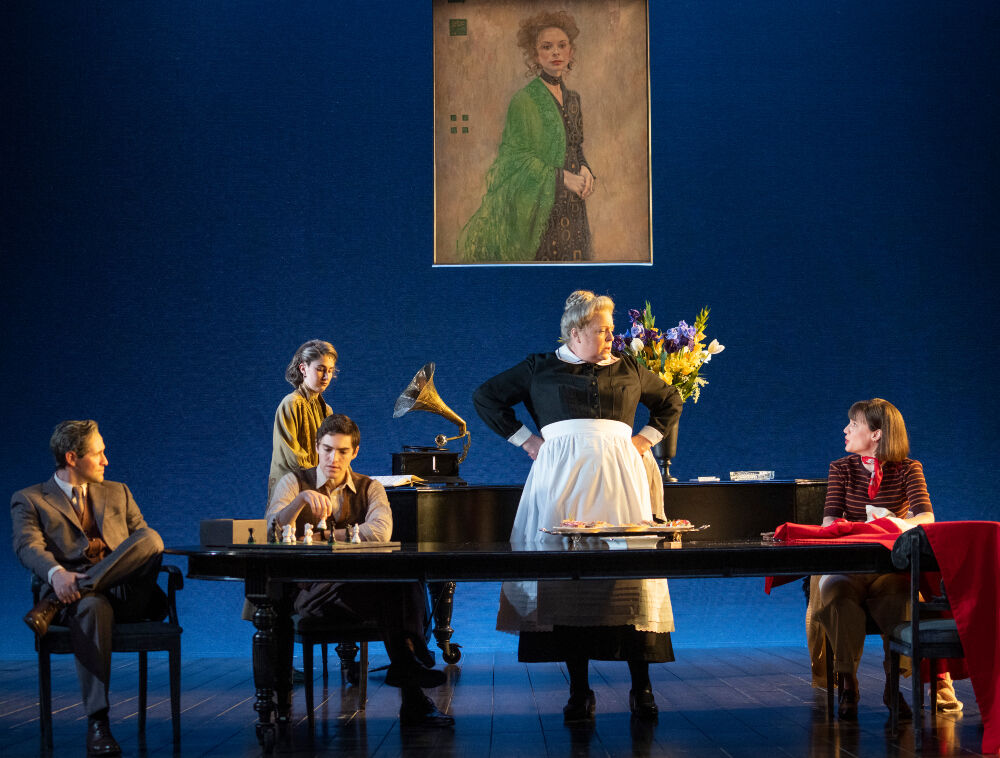
In the play’s final scene, set in 1955, Aaronson, as Leo, is at odds with his cousin, Nathan, who survived Auschwitz. Leo (aka Stoppard) is an Englishman who didn’t learn about his Jewish ancestry for decades. In the scene, Nathan tells Leo: “Antisemitism is a political fact. It’s a bit soon for it to be a party platform – but when it is, there will be Austrians to vote for it.” When Leo responds: “It can’t happen again, Nathan,” his cousin retorts, with a scornful chuckle, “I bow to your experience.”
“And, I mean, wow, what a roller-coaster,” Aaronson said. “Every night, when I say, ‘It can’t happen again,’ there is a disdainful moan from the audience. Because by this time, there are only three family members left. Everyone else has been extinguished in some way.”
If “Leopoldstadt” were to win the Tony Award tonight, Aaronson said, “that would be a wonderful affirmation that this play is important, that the message is important, that the message has been received – and that people are listening.”
But where does that leave Aaronson when the play closes?
“As of July 2, I might be a nanny again,” he said with a laugh. “These things are never linear. I’m here right now, and I’m enjoying every second of the end of this run. But yeah, my first Broadway show winning Best Play would maybe be a Catch-22.
“It might have been better to start in a flop that only ran for a month.”
