







Marijuana-related crime, sales decreased last year in Denver, according to study
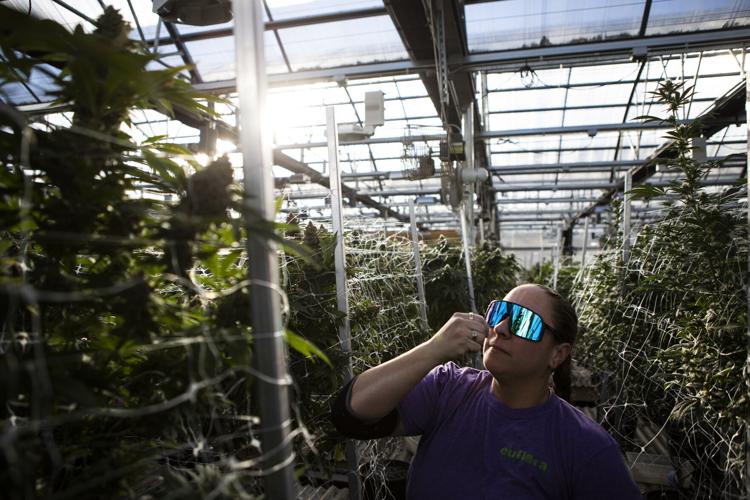
FILE PHOTO: Director of cultivation Jess Cordova smells for resins on her fingers while inspecting a row of Apex strain plants at the Euflora cannabis greenhouse on Monday, Feb 28, 2022, in Denver, Colo. (Timothy Hurst/The Denver Gazette)
Timothy Hurst/The Denver Gazette
The 2023 annual report from the Denver Department of Excise and Licenses showed marijuana sales decreasing in 2022 and criminal offenses related to marijuana remaining a small portion of the city’s overall crime.
On Jan. 1, 2014, Denver became the first U.S. city allowing regulated retail marijuana sales.
In years since, Denver has developed ordinances to regulate, license and tax medical and retail marijuana, making the city “the gold standard for cannabis regulation and a worldwide leader,” according to a letter from Mayor Michael B. Hancock included in the report.
According to the annual report, crime related to marijuana decreased in the past year and makes up a small percentage of overall crime in Denver.
Sales in marijuana, both medical and retail, have also decreased.
The Office of Marijuana Policy within the Department of Excise and Licenses compiled the report to give a transparent picture of the first municipality with legalized and regulated recreational cannabis sales in America.
In 2023, 877 licenses operated in 443 locations in Denver, with 492 being retail and 385 being medical.
Medical cannabis store licenses have been steadily going down since 2016, with 152 in 2022 and 144 in 2023. Retail cannabis store licenses have steadily increased since 2015, with 178 in 2022 and 188 in 2023.
Marijuana sales, both retail and medical, decreased 28% in Denver in 2022, with $497 million in marijuana revenue in 2022 as compared to $689 million in 2021, according to the report.
Prior to 2022, sales had been steadily increasing.
Gross sales in Denver for medical marijuana decreased 44%, from $189 million in 2021 to $106.4 million in 2022.
Gross retail sales decreased 22%, from $500.6 million in 2021 to $390.2 million in 2022.
Marijuana Industry Group officials highlighted that April had the lowest level of cannabis sales since 2018, as reported by the Colorado Department of Revenue.
“Colorado cannabis small business owners count on the weeks leading up to the 4/20 holiday to be some of the strongest sales of the year,” said Truman Bradley, executive director, in a news release. “As an industry, we are struggling–we are in dire need of a regulatory overhaul to prevent more cannabis small business owners from closing their doors and laying off their workers. We earnestly hope that Colorado’s policymakers will start taking a new approach to marijuana policy, one that will protect small business owners and the public programs funded by cannabis.”
Numbers showed $131 million in marijuana sales for April 2023, according to the department, down from more than $153 million in sales in April of 2022.
“This decline also impacts state tax collection,” according to the MIG news release. “Colorado collected 18.2% less in cannabis tax revenue in May 2023 versus May 2022, putting at risk critical public state and local programs that marijuana businesses help fund including housing, mental health, public safety, and education.”
According to the Vangst 2023 Jobs Report, Colorado lost 10,481 cannabis jobs last year.
Some critics applauded the drop in cannabis sales numbers.
Luke Niforatos, executive vice president of the anti-marijuana group Smart Approaches to Marijuana, said the decline in sales should be “celebrated.”
“Big Marijuana profited off of increased addiction and use throughout COVID-19 lockdowns and the isolation that so many Coloradans felt during those years,” he told The Denver Gazette in prior interview. “What we are seeing now is likely a return to the pre-pandemic average use. This decrease should be celebrated, but we need to do more to educate the public on the harms of marijuana use and hopefully we will continue to see these numbers decline.”
When it comes to crime, marijuana-related offenses make up a small portion of Denver’s overall crime and decreased over the past year.
Total marijuana offenses make up 1% of overall reported offenses in Denver, according to the report.
In 2022, there were a total of 263 offenses reported to the Denver Police Department that had a clear connection or relation to marijuana out of 87,791 total criminal offenses in Denver.
Marijuana-related offenses where licensed marijuana businesses were the victims or perpetrators of a crime represented 0.19% of overall crime in Denver, with 162 total offenses.
Ninety-six percent of the industry-related offenses were burglary or attempted burglary, with 156 offenses. Theft made up the other 4%, or six offenses.
Violent offenses related to the licensed marijuana industry are “rare” and include homicide, rape, robbery and aggravated assault, according to the report.
In 2022, there were 14 violent offenses related to the marijuana industry, which is one per every 564 overall offenses.
Citations and bookings for violations of marijuana laws have decreased overall from 2021 to 2022. In 2021, there were 290 total arrests or citations for marijuana violations compared to 121 in 2022.
Over the years, overall impaired driving arrests have been on the decline in Denver, which can be attributed to factors such as public education campaigns and the rising popularity of ride-sharing services.
“When Amendment 64 to legalize marijuana was put to Colorado voters, many feared that youth marijuana use and crime would skyrocket,” Hancock wrote in the letter. “To date, none of the extreme negative predictions about about legalization have come to pass in the Mile High City.”
Denver still has work to do, however, according to Hancock. The city is continuously improving and evolving, particularly when it comes to social equity in the cannabis industry.
“Denver has developed a multipronged approach to remove barriers and implement changes through its social equity program so there is more equitable access to the cannabis industry and the city can achieve the full promise of legalization,” Hancock wrote.
In 2021, Denver began a partnership to give free entrepreneurial assistance programs for aspiring cannabis business owners disproportionately impacted by marijuana prohibition, according to Hancock.
“I am proud of the foundation my Administration has built over the past decade and their dedicated efforts to ensure a bright future for this industry,” Hancock wrote.