







Larimer County deputy won’t face charges over I-25 death of man hit by SUV
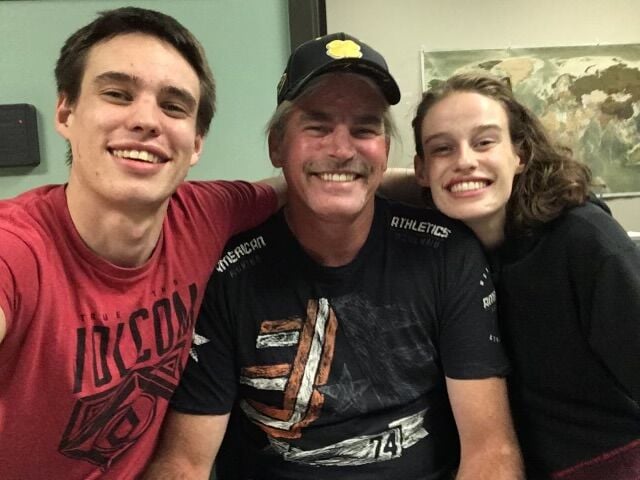
Brent Thompson (left) with his father, David, and his sister, Adrianne, in this undated photo. Thompson, 28, was killed by an oncoming SUV the night of Feb. 18, when a Larimer County sheriff's deputy tased him as he ran onto Interstate 25 after the deputy pulled him over because the car Thompson drove had expired plates.
Photo provided by Brent Thompson's family.

A Larimer County sheriff’s deputy will not face charges for tasing a man on Interstate 25, who was then hit and killed a few seconds later by an SUV, after the man ran from arrest, according to a decision by the 8th Judicial District Attorney’s Office.
Meanwhile, the man’s family called for the deputy to be fired and for the district attorney to resign.
Deputy Lorenzo Lujan pulled over Brent Thompson, 28, on the night of Feb. 18 after he saw the car Thompson drove had expired plates. Thompson then gave Lujan a fake name, according to a decision letter from District Attorney Gordon McLaughlin’s office.
The decision letter outlined what happened that day. Lujan pulled Thompson over on the off-ramp for exit 271 after he saw the Ford Fusion Thompson drove in a hotel parking lot on East Mulberry Street in Fort Collins. Lujan thought the driver was behaving strangely and learned the car had an expired registration when he ran the license plate. Thompson gave Lujan the name “Jacob Jones,” which Lujan learned was an alias when he ran the name and Thompson’s birth date. Lujan also learned that Thompson’s driver’s license had been revoked because the latter was a “habitual traffic offender.”
Thompson got out of the car when Lujan asked, but he denied using a fake name. When Lujan told him he was under arrest, Thompson ran down an embankment toward the highway. He tried to jump over the guardrail but caught his foot and fell onto the shoulder of the north lanes of I-25, according to the decision letter.
Lujan then tased Thompson. Seconds later, an SUV hit Thompson, killing him.
In an interview with investigators, Lujan said he issued verbal commands that Thompson ignored, and that he thought the only less lethal option was a Taser, as he believed using his firearm would not have been justified.
The family said they are dismayed at what they view as the portrayal of their son and brother as a troubled person.
“I’m just heartbroken to think about how he was killed. As a mom, it just rips your heart right out,” said Thompson’s mother, Karen.
Thompson’s autopsy report showed a blood alcohol level of 0.012 and fentanyl levels that the coroner and a toxicologist said were “very high.”
While McLaughlin decided against pursuing charges, he said Lujan used “poor, and ultimately tragic, judgment” when he deployed his Taser after Thompson was already in the traffic lanes of I-25. But, McLaughlin concluded, the deputy had no “evil intent.”
A lawyer for Thompson’s family questioned why Lujan chose to start a chase at all over a traffic stop, especially since he knew Thompson’s name by then. Civil rights attorney Siddhartha Rathod also said he believes even if Lujan wasn’t specifically trained to not tase someone on a highway, his training to look at all the circumstances of a situation when deciding to use his Taser should have made the danger to Thompson obvious.
The Larimer County Sheriff’s Office policy, referenced in McLaughlin’s letter, includes “individuals whose position or activity may result in collateral injury” as one situation in which Taser use should generally be avoided, unless the need to control the person outweighs the risk of deploying the Taser.
“The district attorney says, ‘We can’t find anybody else who has tased anyone on a highway, so this officer couldn’t have known.’ Why? Because no one is insane enough to tase someone on a highway,” Rathod said.
A spokesperson for the Larimer County Sheriff’s Office said nobody wanted the outcome, but maintained that its training and policy “(provide) a strong framework for deputies to continually assess the safety priorities and risks in any situation.” The office added that it grieves the loss of life in any situation.
“Deputies are routinely faced with making split-second decisions in rapidly changing environments, and they don’t have the comfortable luxury of hindsight in those moments,” spokesperson Kate Kimble told The Denver Gazette. “In this case, the suspect’s decisions created a potentially hazardous situation for motorists and the deputy was forced to make a choice: take action and try to prevent harm to the public, or stand back passively and hope no innocent people got hurt.”
Kimble added: “We train our deputies to take decisive action with the information they have available in the moment. Unfortunately, in some cases, this results in unintended consequences. This incident is no exception, and multiple lives have been changed forever. Nobody wanted this outcome.”
The district attorney’s decision letter said another officer who came to the scene, Cpl. Matthew Bordewick, saw it unfold and tried to stop the SUV before the driver hit Thompson.
The decision letter said Bordewick forgot to bring his body-worn camera with him when he responded. Bordewick said he had left it in the office to recharge, as its battery was running low.
The driver of the SUV, whose name has not been released, said he believed he was driving 65 to 70 miles per hour. He described seeing two green lights flicker and “something laying” in the road, as well as two men to the side. He swerved and tried to brake but did not have enough time to avoid hitting Thompson, according to the decision letter. The driver has not been criminally charged for the accident.
In his letter, McLaughlin said the possibility of getting re-arrested might have played a role in Thompson’s actions that night. A warrant had been issued against Thompson in January for failing to comply with a pretrial release terms in a case in which he was charged with misdemeanor and petty drug offenses. He had been arrested on that warrant in February. He had posted bond, and was released.
In addition, McLaughlin said Thompson had a felony conviction, which would mean he illegally possessed the gun found in his car.
His mother, Karen, said when they met with McLaughlin’s office this week to learn about the charging decision, she felt like her son was characterized as a troubled nuisance. She is troubled, she said, with how she feels the district attorney has portrayed her son.
“I just felt like they were judging him for his past behaviors or whatever he was involved in, like his life meant nothing,” she said.
Thompson’s family remembers him as charismatic, creative and adventurous. They lit up as they talked about memories of him Friday morning: His ability to make friends with strangers, family vacations in the Caribbean, and his love for drawing and Star Wars.
“Even if you didn’t like him, you kind of liked him. He just had a goofy, fun, adventurous attitude,” said Thompson’s father, David.
McLaughlin’s letter clarified Lujan’s use of his Taser was not deadly force, and that deadly force would not likely have been justified. Lujan said during the investigation he felt his Taser was the only less-lethal force he could use to try to stop Thompson from continuing to run toward the highway, according to the letter. He said Thompson did not respond to verbal commands, pepper spray would not have worked given the distance between them and deadly force wasn’t justified.
McLaughlin determined Lujan didn’t properly appreciate the risk to Thompson’s life when he used his Taser, and that, in hindsight, allowing him to run onto the highway likely could have avoided him being killed. However, the letter also said Lujan looked for traffic coming south on the highway during the chase and did not believe there was immediate oncoming traffic in the north lanes.
“While it is clear he used poor, and ultimately tragic, judgment in deploying his Taser after Mr. Thompson was already in the traffic lanes of I-25, the split-second decisions here were not formed with evil intent and were made after a quick assessment of the possible dangers” to Thompson and other drivers, McLaughlin’s letter said.
McLaughlin’s office plans to hold a virtual town hall about Thompson’s death on July 31. The Denver Gazette has also reached out to the Larimer County Sheriff’s Office to ask when it plans to release body-worn camera footage of the incident.
McLaughlin’s office oversaw the prosecution of Austin Hopp and Daria Jalali, two former Loveland police officers, who, in 2020, violently subdued Karen Garner, an elderly woman with dementia, who had mistakenly left a Walmart store without paying for less than $15 worth of items. When one of the officers received a five-year prison sentence last year, McLaughlin said he hoped it would send a message that excessive force and inhumane treatment by law enforcement officers wouldn’t be tolerated.
“Those in a position of power that use that power to violate the trust of this community will absolutely be held accountable,” McLaughlin said.
Thompson’s parents said they received very little information about his death when it happened. Karen Thompson, who lives in Loveland, said two detectives from the Loveland Police Department came to her house around 1:30 a.m. and told her her son died in a traffic accident after he was pulled over for having expired tags.
David Thompson, who lives in Windsor, said he also struggled to get information the next morning, and learned few details until he saw the body-camera footage a few months ago because his son’s death was still under investigation.
“I sat on that for five months and two days, up until yesterday, to get an answer I’ve been waiting for,” David Thompson said.