Rare mountain tornado hits Pikes Peak, downs trees during Thursday storm
While portions of the Colorado Springs area were experiencing heavy rain, hail and flooding on Thursday, the slopes of Pikes Peak experienced extreme weather of their own: a tornado.
The National Weather Service in Pueblo announced Friday afternoon via Twitter that the agency’s survey team completed assessment of damage on America’s Mountain and confirmed it was caused by a tornado.
Gazette media partner KKTV’s weather service reported its Doppler radar picked up rotating weather movement passing over the Pikes Peak Highway, south of the Crystal Creek Reservoir, around 2 p.m.
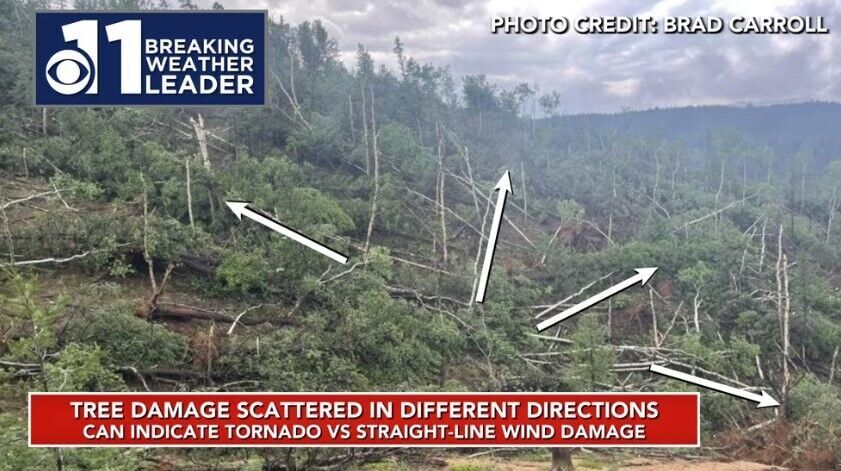
A KKTV viewer also provided photos from the area, showing a scattering of fallen trees.
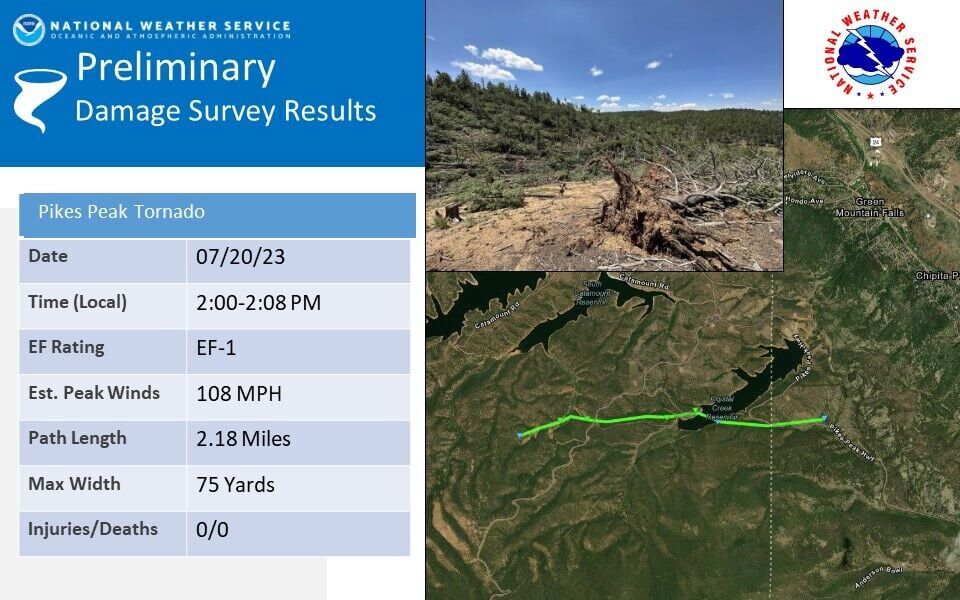
Pikes Peak America’s Mountain reported on Twitter just before 3:30 p.m. Friday the twister ran for 2 miles, beginning northwest of Pikes Peak Highway’s Mile Marker 8 and ending just below Mile 5 on the east side of the highway, crossing it in two sections.
The Crystal Reservoir Visitor Center near Mile 6 of Pikes Peak Highway is 9,160 feet in elevation, according to an official map of the mountain.
Fox 21 reported that in 2012 the highest-elevation tornado on record was identified on the southeast side of Mount Evans near Idaho Springs, at around 12,500 feet.
“Damage resulted in uprooted and snapped trees, two snapped power poles and multiple power line snaps,” Pikes Peak America’s Mountain said of Thursday’s tornado.
Power will be restored by Friday evening, the city enterprise tweeted.
The National Weather Service said via social media the tornado’s preliminary rating, according to the Enhanced Fujita Scale that assigns tornado ratings “based on estimated wind speeds and related damage,” was an EF1.
This means a 3-second gust at the point of damage was estimated to blow 86-110 mph.
Pikes Peak America’s Mountain reported winds reached 108 mph. There were no injuries or fatalities, the city enterprise said.
“It’s fairly seldom that Pikes Peak gets hit with a tornado, but it does happen,” Kathleen Torgerson, lead forecaster for the National Weather Service in Pueblo, told The Gazette’s sister news outlet Out There Colorado.
High-pressure systems have been pushed farther west in the United States than is typically expected this time of year, Torgerson said. As a result, Colorado is experiencing northwesterly flow aloft — a pattern favorable for significant severe weather and tornadoes, she said.
Although tornadoes are recorded in Colorado each year, this year has been “very active.”
Torgerson said several signs indicate the damage was caused by a tornado.
First, a tornado was radar-indicated in the area. Torgerson also said downed trees are laid out in all different directions, caused by the spinning force of a tornado. If the damage was caused by straight-line winds, then the trees would be lying in all the same direction.