







COLUMN: Let’s train more minority teachers | Pius Kamau
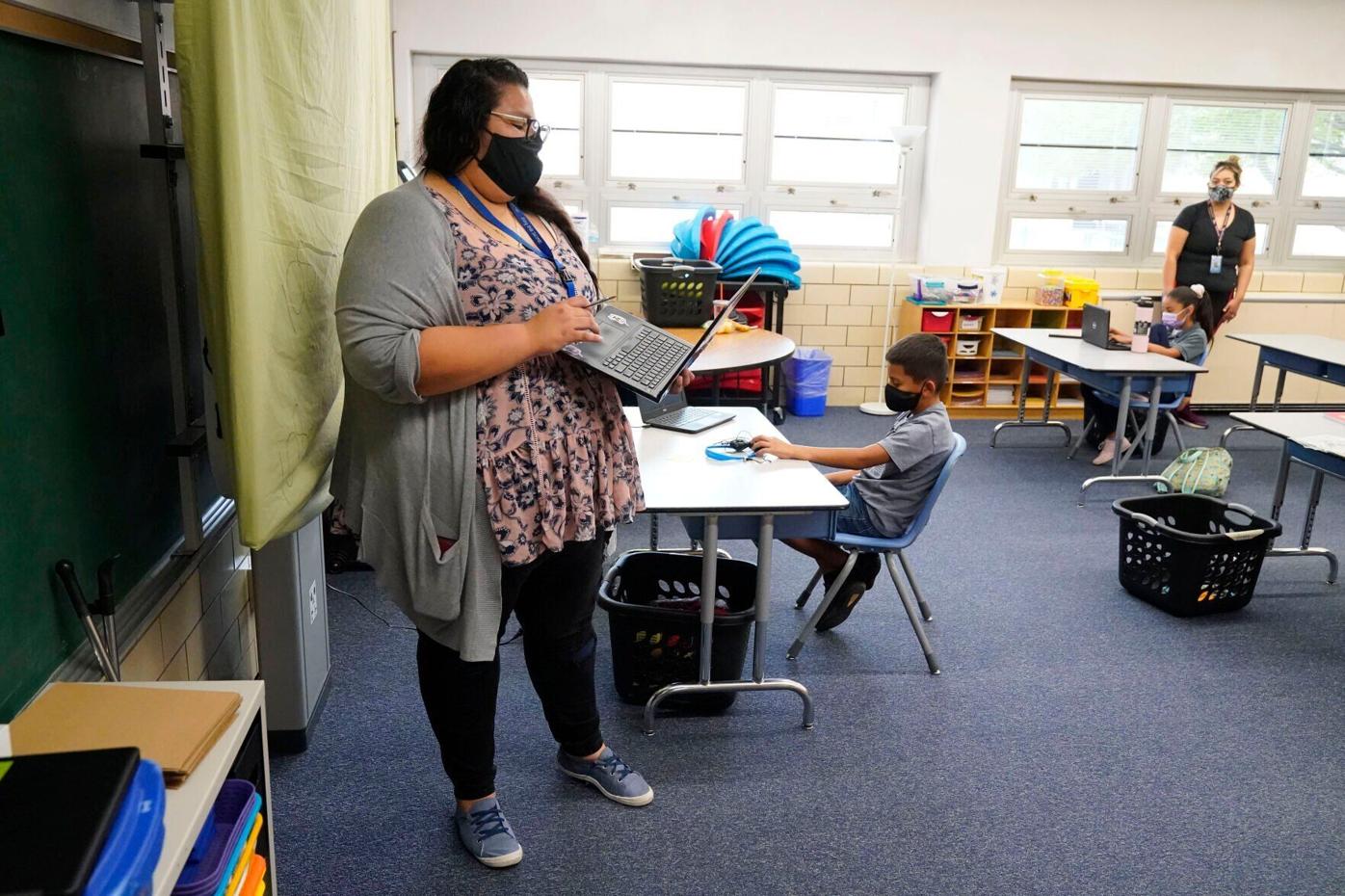
the associated press file
In a recent column, I advocated coupling students’ education to that of their parents. And since where this matters most, a large percentage of fathers are in jail or just AWOL, the onus of raising children falls mainly on mothers. It is these women — especially those dependent on welfare — I feel we should encourage to participate in a variety of educational efforts: completing their GEDs; learning different trades — plumbing, trainee electrician, car mechanics.
My hypothesis is: A child whose caretaker values books and learning will thirst for that greatest women’s and children’s liberator — education.
I’m cognizant of the bottleneck that poor testing in mathematics presents to Black students. That, and my overriding concern on how to train more minority physicians and scientists, make me believe that concerned communities should grow their teachers. In fact, each one of us can and should teach those willing to learn.
Without teachers there is simply no learning or education. And yet our good teachers work under trying conditions.
We denigrate them for perceived shortcomings of the American education system, which is in great disrepair.
We must therefore work within the confines of a broken system by addressing how to better train BIPOC — Black, Indigenous and people of color — teachers and doctors.
Current teaching staff should get the help they need, even as we rededicate ourselves to training new BIPOC science teachers — particularly Black male teachers — to fill the gaps that exist in the profession for teaching minority children. There are obstacles standing on the way, but they are surmountable.
In Michigan, among undergraduate students taking a teaching education course, 30% of the White and only 7% of the Black students become student teachers. Many minority students find licensure tests forbidding.
Invariably many of them are unaware of the universal American solution — at every level, White and Asian students engage in intensive test-taking practice and classes. Most cost money that many minority candidates lack. If we want to see more Black science teachers in our classrooms, we should underwrite their intensive test-taking training.
My wish list would be: promote the merits of the teaching profession; raise teachers’ pay; and proselytize young sharp minorities to join the profession and give more scholarships to attend teacher training. Assist prospective minority teachers with test prep to enter teacher training schools as well as licensure exams. And just as important, mentorship of new teachers by “qualified” older teachers to illumine the way of their progress.
In addition, STEM teacher-to-teacher dialogues across Colorado; paying for current math and science teachers’ continuing education. Establishing districtwide math clubs as well as ACT and SAT prep classes. Teacher-training schools should continue being part of the intellectual and academic lives of their BIPOC alumni.
Because the greatest difficulty for BIPOC students and teachers is mathematics and physics, colleges and universities should offer them regular seminars and continuing education.
Additionally, existing national science and mathematics organizations should invite and include corresponding BIPOC students and teachers, in an effort to build a mathematics culture in minority schools. All high school students should be offered membership in a math club in their school district.
Like all other professional groups teachers steadfastly hold onto practices no matter how faulty, arcane, or strange they might appear to an unbiased observer. The desire to maintain what a profession has gained over decades, mitigates against accepting outside criticism or even suggestion to change.
Over time, I have made overtures to teachers and school principals to learn about their concerns, and to express my views and criticism. I have failed miserably.
For instance, in 2010 I invited three Denver school principals and Tim Marquez — founder of the Denver Scholarship Foundation — to dinner at Strings restaurant; we had a wide-ranging discussion that resulted in an agreement on a to-do list and next steps. Many emails later elicited no response.
I only hope they effected some of the steps we agreed upon.
Many schools’ neighborhoods are replete with brilliant minds that lie fallow, unutilized and uncalled upon. Schools and the teaching profession should endeavor to seek those parts of their communities that can help advance their students’ learning. The wise woman or man learns that it pays to invite advice, as well as accepts criticism and accolades.
This is the Socratic way of being — a way the scientific mind should aspire to. We can’t be good teachers if we are closed-minded.
Pius Kamau, M.D., a retired general surgeon, is president of the Aurora-based Africa America Higher Education Partnerships (AAHEP); co-founder of the Africa Enterprise Group and an activist for minority students’ STEM education. He is a National Public Radio commentator, Huffington Post blogger, and past columnist for Denver dailies. He has authored a memoir and a novel recounting Kenya’s bloody colonial history.