







Aurora city, project leaders break ground on I-70 Picadilly Interchange project
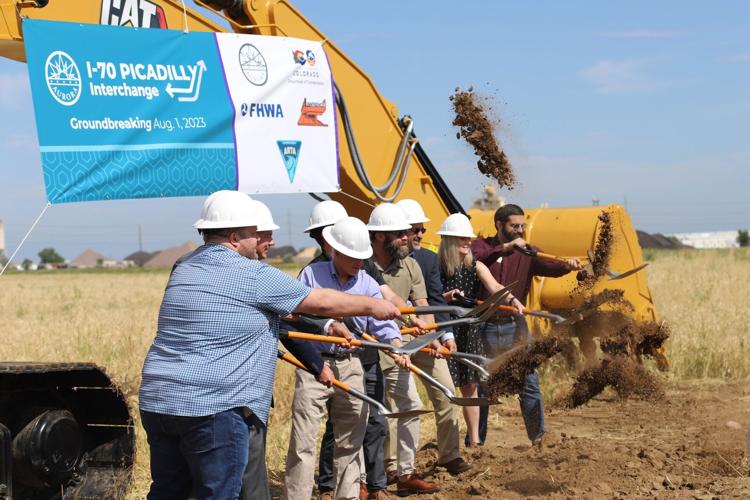
Aurora leaders celebrate the groundbreaking of the I-70 Picadilly Interchange Project on Aug. 1, 2023.
Kyla Pearce/The Denver Gazette
Aurora city leaders and project officials broke ground on the I-70 Picadilly Interchange Project Tuesday, celebrating the beginning of the two-year project that will connect the “aerotropolis” region near Denver International Airport — a booming commercial and residential area — with the rest of the state, boost the economy and create an estimated 74,000 new jobs.
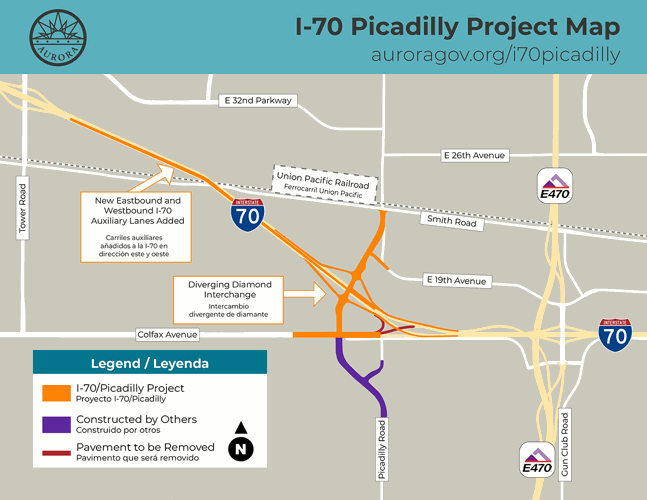
Mayor Mike Coffman, several city councilmembers and representatives from organizations including the Federal Highway Administration (FHWA), Colorado Department of Transportation (CDOT) and the Aerotropolis Regional Transportation Authority (ARTA) talked about the benefits of the interchange project, which will extend Picadilly Road between Colfax Avenue and Smith Road.
The project will link eight new miles of roadway with an interchange onto I-70 in Aurora.
City and project leaders, including Coffman, picked up shovels and dug them into the dirt to symbolize the project’s start around 10:30 a.m. Tuesday, grinning for cameras as they tossed dirt into the air in front of a crowd of community members and other area representatives.
Residents mingled with city and project leaders after the ceremony, taking the chance to ask questions and learn more about the project while enjoying shaved ice from a food truck.
“I-70 is a vital route supporting the regional economy and the local economy, but it’s also a national route and I think the significant part about this is that it’s not just for the Front Range,” FHWA Colorado Division Administrator John Cater said. “This is going to help everybody going from Kansas City to Vegas or Salt Lake.”
Within the aerotropolis region surrounding DIA an ARTA study found that more than 21,000 acres were prime for development, with potential for new jobs and innovation, but transportation connectivity created a barrier for that development, ARTA Board Chairman Matt Hopper said.
“This is not just ‘here’s an interchange and I can get off and it makes things a little easier’,” Hopper said. “This has a financial impact not only in Aurora and Adams County, but this entire region, the state of Colorado and the nation.”
By 2040, the project’s connection between DIA and the aerotropolis region is expected to create 74,000 jobs in the area, according to the city of Aurora website.
Part of the project’s funding comes from a $25 million federal grant, the BUILD multimodal surface transportation grant, from the U.S. Department of Transportation. The project is one of six in the country to get the maximum grant amount.
“That’s a sign of the importance of this project,” Cater said. “It competed nationally against hundreds of projects and it came out on top.”
The interchange will include safety measures including wider lanes and improved lighting. It is a diverging diamond interchange, a type of interchange that gives vehicles direct access to freeway ramps without waiting for a signal and eliminates left turns against oncoming traffic, according to CODOT, making it safer for drivers because there are fewer potential conflict points.
“We’re really struggling with increased fatalities, injuries and so forth on our highway system, so anything we can do to improve safety is always a good thing,” Cater said. “It’s great to see that innovation (diverging diamond interchange) being used on this project.”
In January, the city made Lawrence Construction Co. the prime design-build contractor for the project, which is expected to be complete by late 2025.
More information about the project and its progress can be found on Aurora’s website.