







A call to arms — the kind that can embrace an at-risk kid | Vince Bzdek
Our Denver editor, Luige Del Puerto, was telling me a story the other day about an ecologist in South Africa who had a problem on his hands. A band of adolescent male elephants in Pilanesberg National Park had started attacking rhinos in the park. More than 50 badly mutilated rhino carcasses were eventually discovered, and the ecologist, Gus Van Dyk, needed to find way to make the attacks stop.
He identified the probable cause as a lack of adult male bull elephants in the herd. The park had been seeded with elephants from other national parks, but the big bulls were much more difficult to transport, so all the elephants in Pilanesberg were between 15 and 18 years old. Eight-foot-tall, 6-ton teenagers, in other words.
Van Dyk got six large bulls introduced to the herd from Kruger National Park, according to a BBC Earth Podcast report, and literally within hours, the teen elephant thugs were under control. No more rhinos have been killed since by rampaging youngsters.
The story was used in an academic paper recently as an example of the importance of a stable society and a father figure to provide boundaries and accountability for teen males. “The young males that were getting into these elephant gangs had no template of good social behavior and were at the mercy of their rampaging hormones, which was putting them at as much risk as those around them,” the study found.
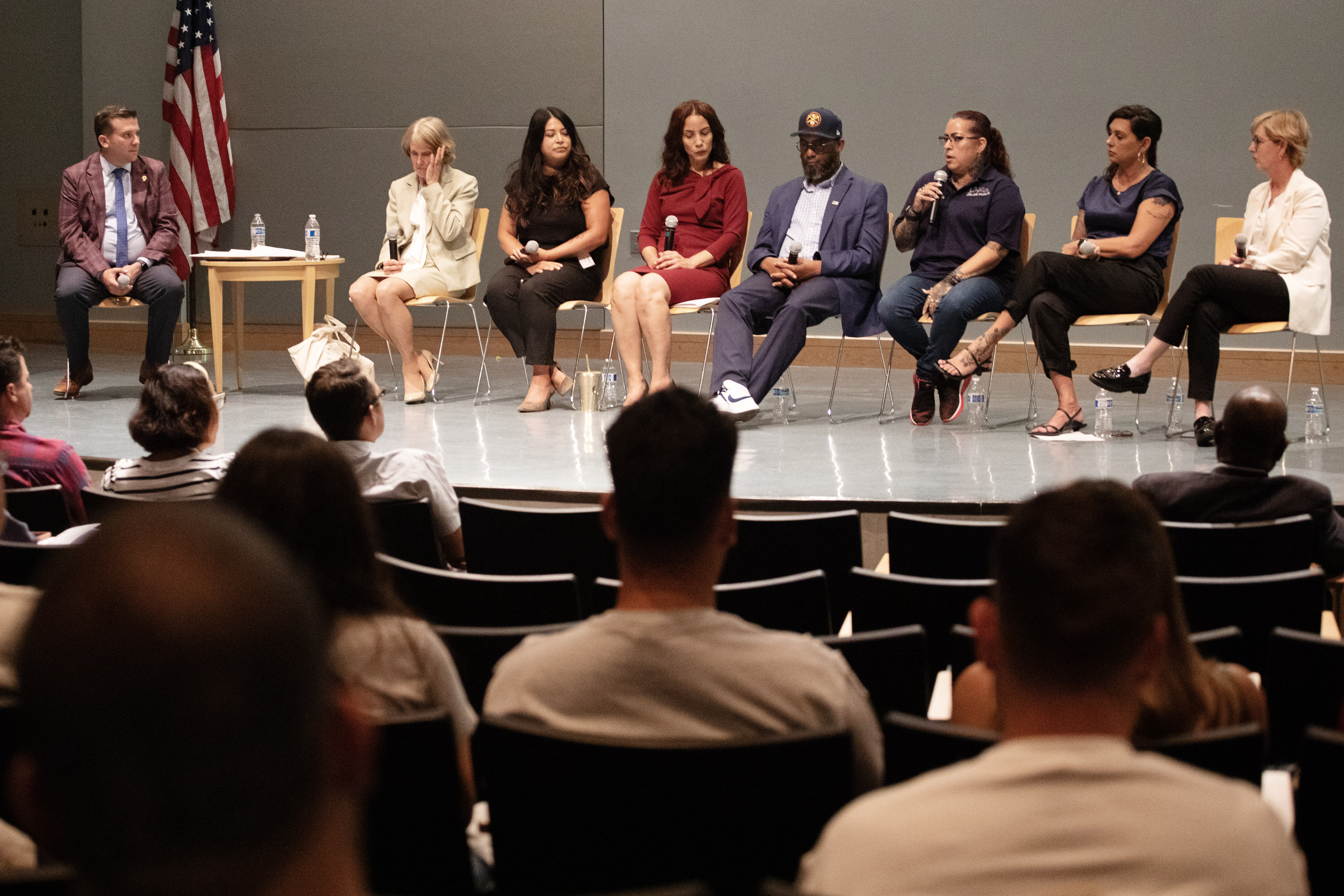
We heard a very similar thing from seven experts convened for a Denver Gazette/9News town hall last week to talk about Denver’s raging epidemic of teen violence.
All the programs, research, volunteers, therapy, addiction services, law enforcement efforts and wrangling over tougher laws boil down to one thing, the experts agreed.
“A caring, trusted adult consistently in a young person’s life, from cradle to grave” is crucial in steering a child away from a violent path, said Jonathan McMillan, director of the Office of Gun Violence Prevention at the Colorado Department of Public Health and Education. “Having that person who a young person can go to to learn from, who they can confide in.
“It’s hard to legislate being concerned and involved in someone else’s life,” McMillan said.
McMillan knows of what he speaks.
At age 25, he was incarcerated by the state of Colorado.
Part of what drove him to prison, he said, “was this normalization of this narrative that because I was a young Black man in the late ’80s, early ’90s that I was more likely to go to prison than college, more likely to drop out of high school, more likely to die before the age of 25. And that created a vacuum that sucked all of the hope out of me and I would say hundreds of thousands of young Black men like me at that time.”
But McMillan changed his own narrative, redirecting it to help others in the same boat he was once in. “And I celebrated my 50th birthday this year,” he told us all last Tuesday.
He is concerned that normalization of the violent deaths of 12- to 18-year-olds suddenly seems to be happening again this spring and summer. A fusillade of violent crimes involving teenagers and children, both as perpetrators and victims, prompted us editors and reporters at The Denver Gazette a few months ago to launch a series of stories called “ Kids in the Crossfire.”
We wanted to explore why gunfire with young people pulling the trigger has become so constant that, at times, it has seemed omnipresent in parts of the city.
“That narrative hasn’t gone away,” McMillan remarked. “And that hopelessness leads to recklessness. So when we have gang members whether they’re OGs or the Tiny Dancers, Young Dancers, they don’t care about criminal consequences, they are just looking to get the most out of what they think is going to be a short life anyway.”
What’s going to best redirect that behavior?
“Guess what I’m going to say? It’s a caring, trusted adult,” McMillan repeated. “It doesn’t have to be a parent. It doesn’t have to be a mentor. It actually can be law enforcement. Oftentimes, law enforcement people are the consistent adults in those lives so they need to know how to connect with young people and build those bridges to services and bridges to safety and bridges to justice.”
We’re talking cops with mental health training, emotional intelligence training, not just guns.
That town hall Tuesday transcended just talk. It ended up being a clarion call to arms for our communities, the kind of arms that wrap around the shoulders of at-risk kids who could use someone to believe in them.
“These are very complicated problems. These are not law enforcement problems. They are not social services problems. They are community problems, and it takes all of these different agencies and institutions working together in partnership,” said Sarah Goodrum, a research professor with the Center for the Study and Prevention of Violence at the University of Colorado Boulder.
And it starts with us.
Goodrum suggested that everybody should learn and practice “skills for being a good upstander.”
“It really does take people like us, seeing someone going down the wrong path, a pathway toward violence, and ask, ‘What is going on here?’ Practice those skills with your friends, with your children, so when the time comes, you know what to say, and you know what to do,” she said.
I was stuck by how solvable all the folks who dedicate their lives to at-risk youths believe this surge in violence is. Solvable, but the solution requires something from everyone.
McMillan said during his time as director of gun violence prevention, he came to want every single person in the city “to really recognize that they play a role in making sure that we all are safe, and happy, healthy and hopeful.” And that may just be asking a colleague, “Steve, are you Ok?” “It may be, ‘You need someone to talk to?’ And then following up on that.” It also means our government leaders have to make sure there is a framework that supports the support other people are offering.
“We all ought to be cognitive of the fact that not every young person is going to be in a gang, or not every gang member is going to pick up a firearm, and not every kid who picks up a firearm is actually going to be a shooter, so when we start to break down the reality of the situation of how very few youth are the ones that are at the highest risk and maybe have the highest need for services, it becomes a much more manageable issue, where each of us in the room, literally, if each of us in the room really wanted to reach out to one of those gang members or one of those young people who are most at risk of picking up a firearm, we would probably have more than enough people in this room right now for the city and county of Denver and probably Aurora.”
So consider this column a Help Wanted ad for Caring, Trusted Adults. Social media and the pandemic have sapped our sense of community and voluntary civic engagement around the country — what Alexis de Tocqueville called the “science of association” that he saw as our country’s greatest strength. What I heard Tuesday was a loud plea for its return.
Is there anyone in your orbit, locally, within reach with the aid of your cellphone, that could use a parental arm around their shoulder, someone you believe in, someone you want to believe in? Pick one. Make a difference.
Do you have those precious parenting skills that are so in demand by our at-risk kids but maybe you no longer employ regularly every day because you now have an empty nest? Or do you live in a retirement home and have some time on your hands? Or just looking for some extra meaning in your life?
Parenting is zone defense. When one parent is out of commission, the rest of us parents need to step up. Together, we need to be the Distant Early Warning Line that lets the many organizations that are doing really good work on teen violence know who needs extra help. We need to be the program for the kids all the other programs don’t reach.
Especially us male parents. We need not underestimate how important our presence is, how vital our particular parenting skills are — even if we don’t see our caring reciprocated, even if mom gets all the hugs and attention. Those kids need male role models to set limits, set examples, hold them accountable, calm the herd. Just like those bull elephants.
We are all of us, after all, involved in the family of man.