Disability-affirmative Phamaly Theater Company comes home to Denver Center
A look back at five signature stage moments that only Phamaly, which next tackles Shakespeare, could ever deliver


You never forget your first time seeing the Phamaly Theatre Company.
Your first opportunity to take in a production by Denver’s renowned disability-affirmative theater in action is your first opportunity to have your mind – and your preconceptions – expanded. Make that “blown.” Because when Phamaly tells a story, no matter the story, they tell it in a way you have never seen before.
Take 2002, when Phamaly was staging a trifle of a musical called “Once Upon a Mattress.” There had been a moment when a queen, played by an actor performing in a wheelchair, demonstrated an elaborate dance for her subjects. Her able-bodied minions quickly followed her instructions, while those in wheelchairs merely moved their arms. But when the admonishing queen screamed, “No! Do it like me!” the able-bodied characters got the drift. They ran off stage and returned in wheelchairs. They then joined in on an intricate, joyous dance on wheels, sending the audience into prolonged cheers.
That glorious Phamaly moment, and dozens more like them, have almost always played out on one of the Denver Center’s grand stages. For most every summer since 1991, Phamaly has staged a big Broadway musical at the Denver Performing Arts Complex, with technical assistance from the DCPA Theatre Company. It has been a happy creative marriage, but Phamaly’s last production at the arts complex was “Chicago” back in 2019.
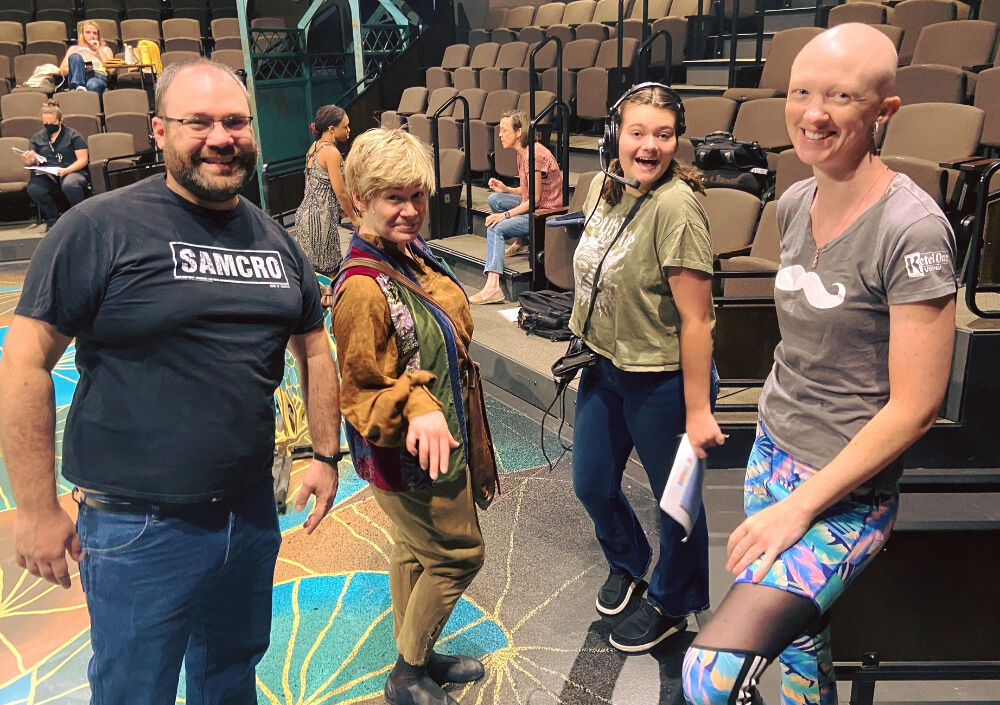
This week, Phamaly is coming home to the Denver Center’s newly rechristened Kilstrom Theatre (formerly The Space). And, for the first time, Phamaly will not be performing a summer musical, but rather Shakespeare’s magical fairy tale, “A Midsummer Night’s Dream.”
“When people think of Denver theater, the first thing they’re going to go see is something by the Denver Center Performing Arts – as well they should,” said Ben Raanan, who was named Phamaly’s artistic director in 2021. “They’re an institution, and it means something really special when you have a company like that make an active choice to welcome a population that is largely ignored by the wider American theatrical community.
“Phamaly and the Denver Center have been a summer tradition for decades. And I can’t wait to make that tradition part of my tradition.”
Phamaly’s core artistic tenet is not to ignore its actors’ disabilities, but rather to incorporate them into the characters they play. The point is to highlight the fact that the world we inhabit is a world full of disabilities, both seen and unseen. That has resulted in dozens of seminal moments that only could have happened through a Phamaly creative lens. Here are five:

5. “Chicago”: We both reached for the gun
One of the many crowd-pleasing moments in any staging of the cynical 1920s musical “Chicago” is the climactic courtroom song “We Both Reached for the Gun.” Lawyer Billy Flynn and YouTube personality, er, I mean, aspiring showgirl Roxie Hart, are putting on a show to dazzle jurors into believing she somehow was innocent of killing her husband in cold blood. In 2019, Director Regan Linton turned Roxie’s testimony into a full-blooded vaudevillian comic spectacle. Given that actor Megan McGuire was born without a left hand, you can bet Linton made maximum physical comedy out of the moment when Roxie, perched on her lawyer’s lap and performing like a marionette, tried to demonstrate those most dubious of lyrics – “We Both Reached for the Gun” – without a left hand. Rather than delicately avoid the reality of the actor’s congenital limb loss, Linton and Maguire turned it into a knockout visual joke that would not have been funny in any other context.
4. “Urinetown”: The blind leading the blind
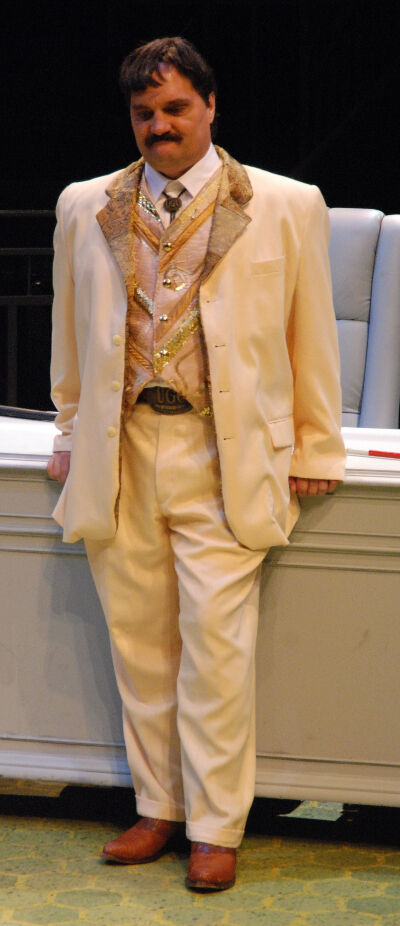
During a rehearsal for “The Wiz,” Don Mauck, playing the anything-but-cowardly Lion, sang with such a roar that one of his prosthetic eyes just jumped right out – and rolled across the stage floor. “What can I say? … It was an eye-popping performance,” said Mauck, who ought to come with his own rim shot.
For 2007’s “Urinetown,” the cleverly dark satire that imagines a world where the citizenry must pay to pee, Director Steve Wilson had the vision to cast all his rich characters – the ones profiting off the suffering of the poor – with visually impaired actors. Call it a case of the blind leading the backed-up. The point was crystal clear 20:20. Corporate ethics are sometimes blind. And all the more delicious considering the way disabled people are often treated in the corporate world. This was unapologetic stunt casting, but a brilliant way to turn actors’ disabilities into artistic inspirations.
3. “Side Show”: Come look at the freaks
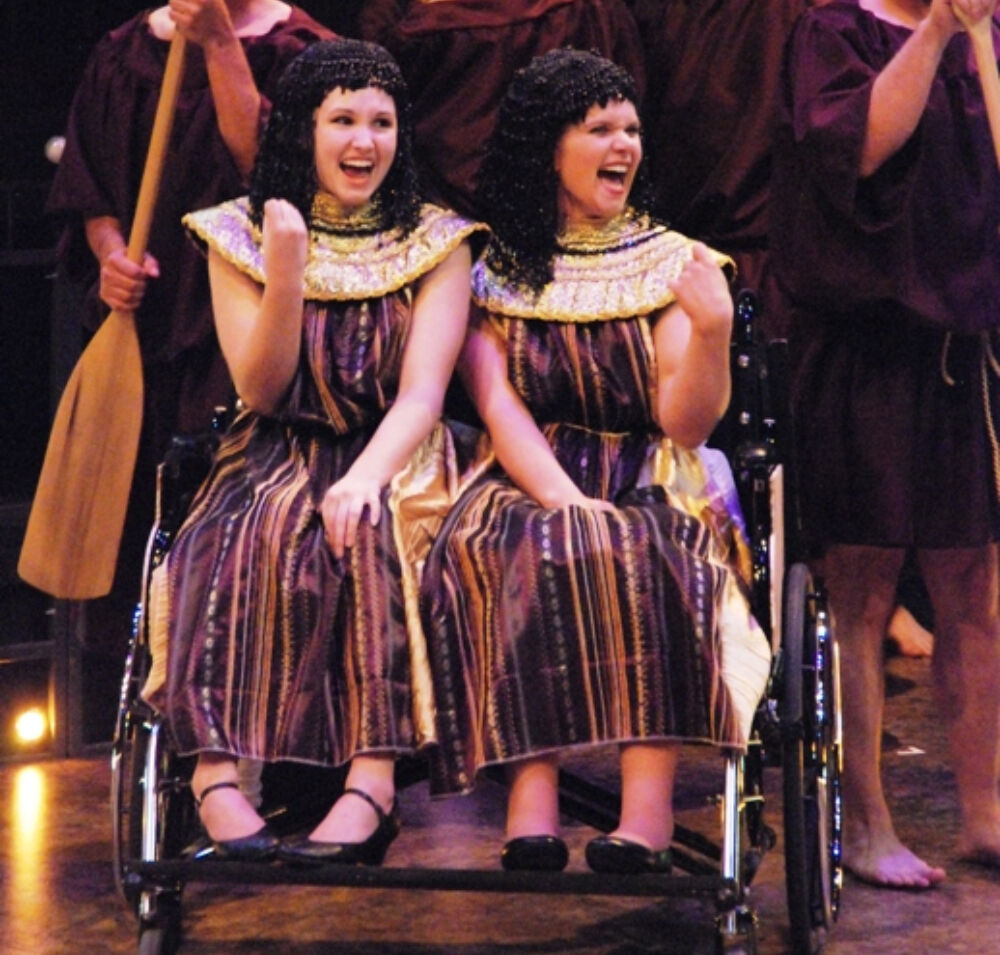
The first Phamaly performance I ever attended was the carnival musical “Side Show” in 1999 – and it was like a mind eraser. Nothing past the opening number survived in my memory bank. And in a 2008 remount, Phamaly got back to what it does best: Shock and (leave you in) awe. There may not be a more shocking opener than an entire company of snarling actors with wheelchairs, shuffling gaits and malformed limbs getting all up in your grill, challenging you to “Come Look at the Freaks.” Rather than mask your whispers and avert your stares, their characters dared you to openly gape at their aberrations, malformations and grotesque physiques. Because deep down, the show posits, everyone loves a freak show – the freakier, the better. As a theatergoing moment, it was feral, it was ferocious … and it was awesome. And you just knew that in the simple act of performing that song, the actors were experiencing a catharsis like nothing ever before.
2. “Beauty and the Beast”: To be human again
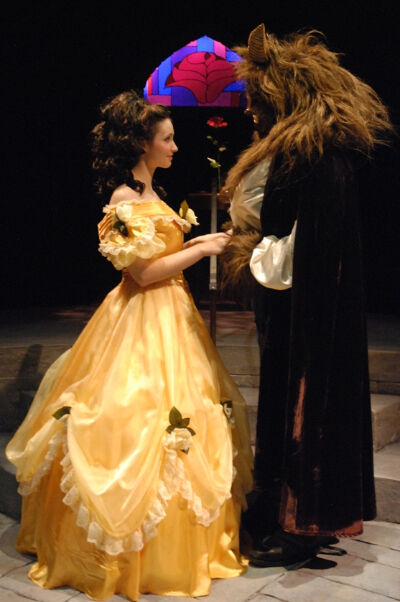
To be seen as human is all anyone who has ever walked, wheeled or been led onto a Phamaly stage has ever really wanted. In 2010, Wilson dared to cast the lovely Jenna Bainbridge as his quintessentially perfect heroine, Belle. She looked the part, sang like an angel and did not miss a dance step. But Disney never would have had the courage to imagine what Wilson could see: A Belle who walks with a noticeable limp – the result of a spinal-cord injury when Bainbridge was a baby. “I’m not going to cover up what they are,” Wilson said at the time, “because I love who they are.”
From the start, Bainbridge radiated like the light from Lumiere’s candlestick. She made the Beast truly earn her heart in a brave performance that embodied the courage of her character. When the Beast is redeemed, the story culminates with Belle imploring the Beast to dance with her. Their waltz is meant to be the perfect stage moment. And, with Bainbridge dancing with her disability in full view – it was.
Side note: Wilson cast acclaimed actor Leonard Barrett, who happens to be Black, as the Beast, and 8-year-old Jaylen Dionta James – who happens to be Black, blind and beautiful … as the younger version of the prince. Which required some dramaturgical clarification. In Wilson’s world, this particular prince’s blindness is the reason his parents banished him at birth. His crime? Being imperfect. Here, it was the absence of parental love that turned the boy into the brat who notoriously picks on the wrong old woman – the one whose curse turns him as ugly on the outside as he is on the inside. Of course, then, you would expect the adult Beast to be blind as well. Instead, in an act of sublime piling-on, as the witch transforms the bratty boy into a hideous monster, Wilson had her also … wait for it … restore the young monster’s sight. Not out of benevolence – she wanted him to see just how hideous-looking her curse has made him. Wicked cruel. Signature Phamaly. But that’s why, when we meet the adult Beast, he, like Barrett, has the gift of sight.
1. “Man of La Mancha”: The rape scene
You can’t open “Man of La Mancha” in a 16th-century Spanish dungeon prison populated exclusively by disabled people and miss the intended visual commentary on how that same community is often cast aside in 21st century America. You knew from the start that, once again, this show was personal for Phamaly.
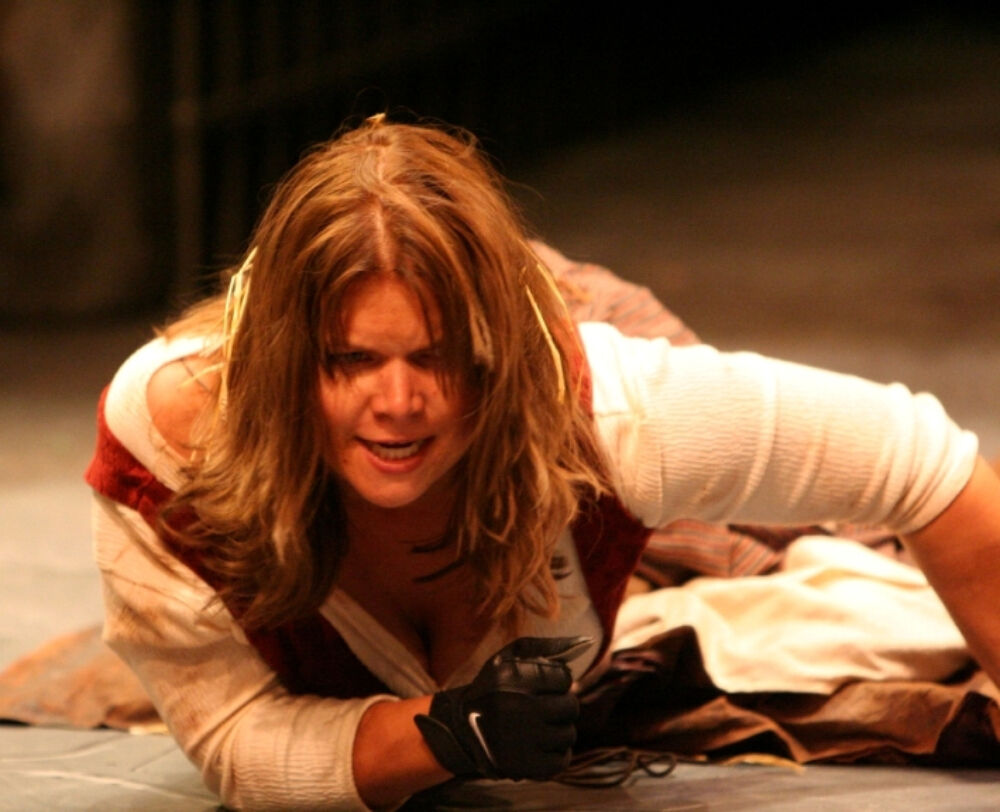
And talk about leaving it all on the floor. Regan Linton, playing the medieval whore Aldonza, was made to crawl back onto the stage after having been ravaged by a gang of brutes. Raging with spite and vulnerability, she berated the delusional old fool Don Quixote for filling her head with the fantasy of possible civility in the real world.
That’s all in the script. But over the past 58 years, no one has seen this scene quite like Phamaly audiences saw it in 2009. Because Linton is paralyzed below the chest. Her character’s wheelchair having been stolen during the staged assault, Linton had to writhe the full length of the stage floor in the only way the actor physically could. As she sang the bitter lament “Aldonza,” it took every ounce of restraint not to leap from your seat to help her up. That was a moment no other “La Mancha” could ever possibly deliver.
Can’t wait to see what epiphanies “A Midsummer Night’s Dream,” directed by Shelly Gaza, brings when it opens on Aug. 19.
“I think there were four or five productions of ‘Midsummer’ by local theater companies last year,” Raanan said. “I guarantee you none of them are going to be like ours. I guarantee you.”