








Kaiser Permanente workers launch strike, signaling failure to reach agreement
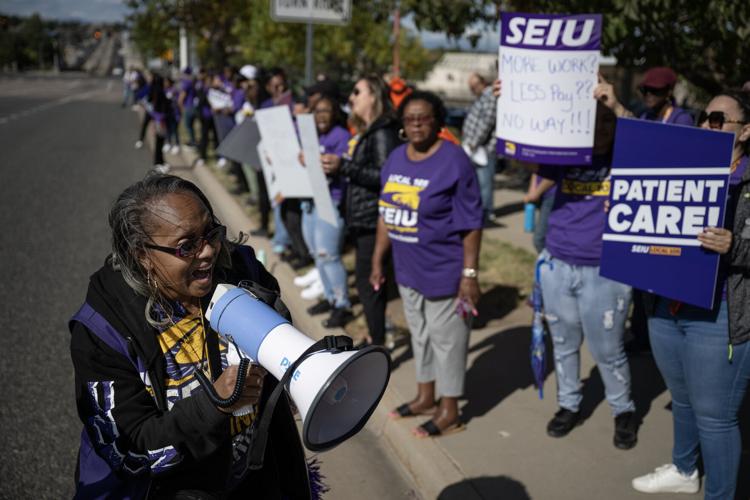
Kimberly Williamson, a union steward who works in Kaiser Permanente’s claims department, uses a bullhorn to lead chants with employees during a strike outside the Kaiser Permanente Aurora Centrepoint Medical Offices on Wednesday, Oct. 4, 2023, in Aurora, Colo. (Timothy Hurst/Denver Gazette)
Timothy Hurst/Denver Gazette
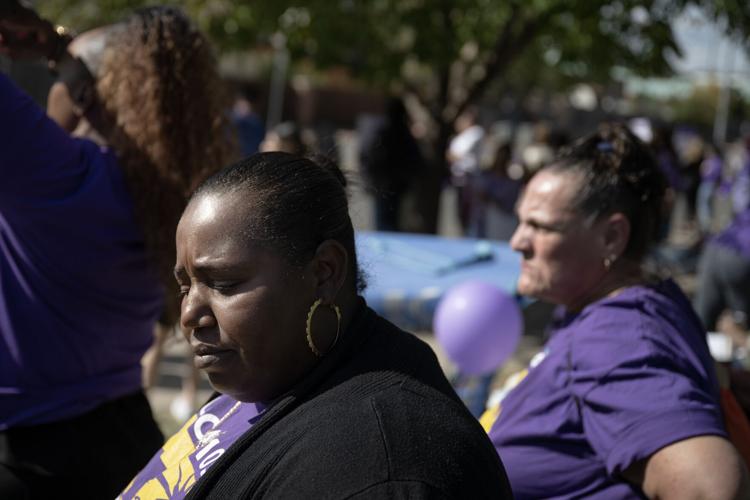




About 100 Kaiser Permanente workers in Aurora picketed on Wednesday morning, joining more than 70,000 Kaiser employees striking across the country in the largest health care work stoppage in American history.
The strike — expected to last three days — signaled that Kaiser and the union have failed to reach an agreement. Kaiser’s contract with the Service Employees International Union (SEIU) expired Saturday.
Short of an agreement, union employees said they could walk off the job again.
Some 3,000 union members joined in the strike, representing roughly half of the 6,800 employees Kaiser in Colorado.
Among those on the picket line Wednesday was Elizabeth Dixon, who has worked for Kaiser for 25 years first as a transporter and then in imaging.
“They need to step up to the plate for us,” said Dixon, 52.
Dixon is not just an employee. She’s also a Kaiser Permanente patient. Diagnosed with T-cell lymphoma, Dixon forwent her treatment Wednesday to join the picket line.
Andrew Sorensen, a Kaiser spokesperson in Colorado, has said — without elaborating — that the health system would remain open during the strike.
“Both Kaiser Permanente management and Coalition union representatives are still at the bargaining table, having worked through the night in an effort to reach an agreement,” Sorensen said in statement. “There has been a lot of progress, with agreements reached on several specific proposals late Tuesday.”
Kaiser employees in Colorado have characterized the need for a strike over what they called “unfair labor practices” and a staffing crisis that union members have said has led to months-long waits and delayed care.
The sticking point in the negotiations appears to be pay.
The union originally asked for an across-the-board 7% increase, but have countered with a 6.5% proposal, according to the SEIU Local 105 website.
Kaiser offered a 3.5% increase for Colorado workers.
“We’re saying that’s not enough,” said Jeannetta McCain, a licensed practical nurse (LPN) who serves on the national bargaining team for the union.
McCain added: “A couple of years ago what I make now could be considered a lot of money, but now, with inflation, we’re living paycheck-to-paycheck.”
Sorensen said Kaiser pays above market and offered a $21 minimum wage for employees next year.
Many of the frontline workers on strike in Aurora earn less than $25 an hour.
Several of those on strike Wednesday have spent their career with Kaiser.
Not Allison Maez.
The 26-year-old followed in her mother’s footsteps and started as an LPN with the nonprofit organization on Monday in the oncology department at the Franklin Medical Offices in Denver.
“I know that Kaiser is a great company and I know what Kaiser is capable of,” Maez said.
‘It’s never happened’
With 75,000 workers in five states and Washington D.C. on the picket line Wednesday, this work stoppage has the distinction of being the largest in the nation, according to the U.S. Department of Labor.
The previous record was set in 2018 when 53,000 workers with the University of California Medical Centers in California had a two-day strike, federal data shows.
SEIU last authorized — but did not employ — a strike in 2019.
“This has been threatened a few times, but it’s never happened,” said Michelle Polizzo, a pharmacy technician for Kaiser.
In fact, Kaiser has reached agreements with the union the past 26 years without a labor strike.
In July, about 1,000 union members in Aurora protested what they described as “unsafe staffing” that has led to what they describe as a patient-care crisis.
McCain echoed these concerns again on Wednesday.
The staffing shortage, McCain said, means appointments can take months and test results — usually provided within days — can now take weeks.
The staffing crisis is not unique to Kaiser.
Over the next three years, Colorado is expected to face a shortage of 54,000 lower wage health care workers and more than 10,000 registered nurses.
In light of this, Kaiser has committed to hiring 10,000 union-represented jobs nationally. It is unknown — because officials have declined to say — how many will be Colorado positions.
Kaiser Permanente operates 30 medical offices along the Front Range, including three in Colorado Springs, that serve more than 500,000 patients annually.
The Denver Gazette reached out to a number of officials with advocacy organizations to better understand the effect of the strike on patients. These officials either did not respond or, as did the Colorado Consumer Health Initiative, declined to comment.
Neither State Sen. Rhonda Fields, chair of the Health and Human Services Committee, nor Rep. Lindsey Daugherty, chair of the Health and Insurance Committee, responded to emails seeking comment.
Colorado Division of Insurance has communicated with Kaiser about the organization’s contingency plans for the strike and is monitoring the strike’s impact on consumers, spokesperson Vincent Plymell said.


Mayo Clinic Q&A: Can holiday stress trigger a heart attack?
Mayo Clinic News Network
mayo-clinic-news-network@gazette.com
Updated 8 hours ago
Dear Mayo Clinic: I’ve heard that all the stress of the holidays can lead to a heart attack. What’s the link, and what can I do to reduce my risk? Answer: It’s easy to get caught up in the stress...

Mayo Clinic News Network
Reporter

Tips and tools for adapting to vision loss
Miller Jim Miller, Special to The Gazette
jim-miller@gazette.com
Updated 3 weeks ago
Dear Savvy Senior, Can you recommend some good resources or products that can help seniors with severe vision loss? My wife has diabetic retinopathy, and it’s gotten worse over the past year. — Need Help Dear Need, I’m very sorry...

How a rare drug made from scientists’ blood saves babies from botulism
The Associated Press
the-associated-press@denvergazette.com
Updated 1 week ago
When Alessandro Barbera was rushed to a California hospital with infant botulism in October, his father had barely heard of the disease, never mind the rare and costly treatment that likely saved the newborn’s life. Now, however, Tony Barbera is...

The Associated Press
Reporter
How to prepare your online accounts before you die
Miller Jim Miller, Special to The Gazette
jim-miller@gazette.com
Updated 3 weeks ago
Dear Savvy Senior, I recently had an estate plan drafted, including a will, power of attorney and advance directive, but I’m not sure what to do about all my online accounts – email, banking, and social media. What can I do...

Clash of the titans: Democratic race for governor pits two candidates similar in focus, but very different in style | Vince Bzdek
Vince Bzdek
vince-bzdek@denvergazette.com
Updated 1 week ago
By Vince Bzdek The race for governor is shaping up to be a clash of Democratic titans, U.S. Sen. Michael Bennet and Attorney General Phil Weiser. They are two of Colorado’s highest profile politicians with deep track records who...

Vince Bzdek
Reporter
US vaccine advisers say not all babies need a hepatitis B shot at birth
Mike Stobbe
mike.stobbe@associatedpress.com
Updated 2 weeks ago
NEW YORK (AP) — A federal vaccine advisory committee voted on Friday to end the longstanding recommendation that all U.S. babies get the hepatitis B vaccine on the day they’re born. A loud chorus of medical and public health leaders...

Mike Stobbe
Reporter
Plaintiffs win $10M settlement against CU Anschutz School of Medicine over COVID-19 vaccine exemption denials
Michael Braithwaite
michael.braithwaite@gazette.com
Updated 2 weeks ago
Eighteen plaintiffs will receive more than $10 million in damages after settling with the University of Colorado Anschutz School of Medicine on Monday over claims the school denied religious exemptions from the COVID-19 vaccination mandate. The $10.3 million settlement ended...

Michael Braithwaite
Reporter

Mayo Clinic scientists create tool to predict Alzheimer’s risk years before symptoms begin
Mayo Clinic News Network
mayo-clinic-news-network@gazette.com
Updated 2 weeks ago
ROCHESTER, Minn. — Mayo Clinic researchers have developed a new tool that can estimate a person’s risk of developing memory and thinking problems associated with Alzheimer’s disease years before symptoms appear. The research, published in The Lancet Neurology, builds on...
Mayo Clinic News Network
Reporter
Savvy Senior: How to locate an age-friendly doctor
Miller Jim Miller, Special to The Gazette
jim-miller@gazette.com
Updated 3 weeks ago
Dear Savvy Senior, My husband and I are relocating to a nearby state to be closer to our daughter and will need to find a new primary care physician when we arrive. We are both in our late 70s and...

New FDA-approved glasses can slow nearsightedness in kids
The Associated Press
the-associated-press@denvergazette.com
Updated 2 weeks ago
WASHINGTON — For many children, the experience of getting their first pair of glasses is an inevitable milestone, the first in a lifetime of visits to the eye doctor. But what if those lenses could actually help preserve the child’s...
The Associated Press
Reporter
PREV
PREVIOUS

The TikTok influencer who is making newspapers cool again | Vince Bzdek
It could be the defining principle of our times. It’s called Brandolini’s Law, coined by Italian programmer Alberto Brandolini. “The amount of energy needed to refute a false statement is an order of magnitude bigger than the amount needed to produce it.” Social media has turbocharged this principle, spreading information at the speed of light […]
Here's the list of open and closed Kaiser Permanente labs, pharmacies
Tom Hellauer tom.hellauer@denvergazette.com Kaiser Permanente reiterated on Thursday morning that its urgent care departments and medical offices remain open during the strike, although some of its labs have been forced to close and services elsewhere have been affected. Here are the labs that are closed In Denver and Boulder: Arapahoe (Centennial), Baseline (Boulder), Brighton, Castle […]