







Lylaus Keyes who brought Denver schools segregation lawsuit 50 years ago, has died
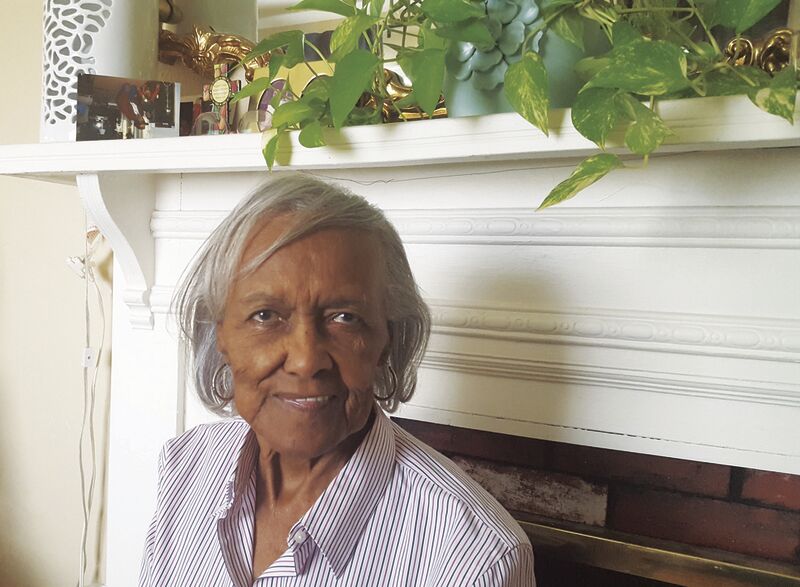
Courtesy: Charles Emmons/Denver Urban Spectrum
Lylaus Keyes — whose name is forever attached to a pivotal 1973 Supreme Court decision involving segregation in Denver — has died.
Keyes died on Oct. 1.
She was 97.
Keyes and her late husband, Wilfred Keyes, a chiropractor turned insurance salesman, were the lead plaintiffs in a lawsuit five decades ago in which the U.S. Supreme Court ruled that the actions of Denver Public Schools had led to segregated schools in the Park Hill neighborhood.
The case also led to a federal consent decree, still in force today, that requires Denver to improve the education for Spanish-speaking students.
“Mrs. Keyes was a legend and remains a light for us, illuminating the pathway forward to a reality where equity and the equality of our humanity are sure,” Vernon Jones Jr., said in a text message to The Denver Gazette.
Jones is the father of two DPS students and executive partner of FaithBridge.
“We are here today because she and her family chose to stand, speak up and sacrifice because they refused to live in and under a system that would deny their children equity,” Jones said.
“We are stewards of the baton that has been passed.”
The youngest of six children, she was born on a farm in south central Kansas, said Keyes’ daughter, Christi Romero. Keyes, Romero said, grew up the only Black student in segregated St. John before moving to Denver in 1952.
A lifelong educator, Keyes was an undergraduate of Metropolitan State University of Denver and graduate of University of Northern Colorado, Romero said.
After 30 years teaching, she retired with Denver Public Schools.
“She’s the last one of her generation,” Romero said.
Board Vice President Auon’tai M. Anderson said Monday that the Keyes’ contributions “changed the landscape” for the state and the nation.
“I just believe that this is a sad day for Denver Public Schools,” Anderson said. “We’ve lost a giant in our community.”
Keyes is not as well-known as Brown v. Board of Education of Topeka, the landmark civil rights case delivered 19 years earlier by the U.S. Supreme Court, which found state-sanctioned segregation in Kansas public schools violated the 14th Amendment.
But the Keyes case was history-making in its own right — as a “tri-ethnic case” — because it marked the first time Hispanics students were given the same rights Brown v. Board of Education extended to Black students in 1954.
The decision was also significant because it was the first desegregation ruling outside the South, post-Brown.
In the Keyes case, the court held that when a school system is segregated a “prima facie case of unlawful [systematic] segregative design” becomes apparent.
“What they (the Keyes) did was epic,” said Craig Peña, who along with his sister, Theresa Peña, was among the plaintiffs in the original Keyes case.
“For 25 years, DPS was desegregated. And it wasn’t just Denver Public Schools.”
Peña added: “In many people’s eyes it was the landmark case because it refined Brown. It brought in ethnicity, not just race. It changes the course of Denver, in my mind.”
The issue of “de facto segregation” came to the forefront again this year when a study by the Latino Education Coalition and at the University of Colorado Boulder in July found Denver Public Schools had resegregated by ethnicity shortly after mandated busing ended in 1995.
Peña co-authored the report.
De facto segregation is a term used during the 1960s integration effort to describe conditions in which legislation did not overtly separate students by race, but where segregation nevertheless continued.
Having prevailed in court, one of the lead attorneys for the group of Denver Public Schools’ families who brought the lawsuit, argued the Keyes decision provided a “detailed precedent and blueprint” for dealing with segregation.
“Taken as a whole, Keyes provides the constitutional basis for cases beyond Brown, whose facts, based on legally mandated separation and inherent inequality, are no longer relevant throughout most of the nation,” Robert T. Connery, wrote for the Denver Law Review in 2013.
“The legacy of the Supreme Court’s 1973 decision in Keyes continues to be written by courts and scholars that are addressing not only separation and isolation of minorities but also the many forms that deprivation of equal educational opportunity may take under the Constitution’s promise of equal protection in this broad and diverse country of ours.”
Neither Denver Public Schools Superintendent Alex Marrero, nor Board President Xóchitl Gaytán responded to The Denver Gazette seeking comment.
A celebration of Keyes’ life will be held at 1 p.m. Oct. 19 at Shorter AME Church, according to Taylor Funeral and Cremation Services. Keyes is expected to be laid to rest at the Fort Logan National Cemetery in Denver.
“The work is not finished,” Jones said. “We have not yet arrived. But we will. Mrs. Keyes reminded us with her life that we who believe in freedom cannot rest until it comes.”