







Colorado has 2 new national historic landmarks in vision for ‘inclusive conservation’

Gazette file
Two buildings in Colorado have attained a top recognition for their historic significance.
Among 16 entries nationwide, Interior Secretary Deb Haaland on Wednesday announced Trinidad’s Temple Aaron and Wink’s Panorama, a lodge in the mountains west of Denver, as national historic landmarks.

Inside the sanctuary of historic Temple Aaron in Trinidad. Temple Aaron is one of the oldest synagogues in the western U.S.
Gazette file


Inside the sanctuary of historic Temple Aaron in Trinidad. Temple Aaron is one of the oldest synagogues in the western U.S.
That’s a designation reserved “for some of the nation’s most historically significant buildings, sites, structures, objects and districts,” according to a news release — indeed, marking “the highest federal recognition of a property’s historical, architectural and archaeological significance.”
Temple Aaron and Wink’s Panorama bring Colorado’s list of national historic landmarks to 28. The National Park Service recognizes more than 2,600 across America.
The additions announced Wednesday “further the Interior Department’s vision for inclusive and collaborative conservation,” Haaland said in a statement.
That kind of conservation has been long ignored, advocates around Lincoln Hills have said. Since 1928, Wink’s Panorama has stood at the center of the resort that comforted and entertained Black travelers amid hate in towns and cities beyond the scenic forest of Gilpin County.
In a Gazette interview early this year, Dexter Nelson II, History Colorado’s associate curator of Black history, counted himself among hopefuls waiting for Wink’s Panorama to achieve status above its long place in the National Register of Historic Places.
“This history is really important,” Nelson said, “and we need to make sure we can preserve it while we can.”
Funding, technical support and greater outside attention are among benefits of national historic landmark designations, as outlined by the National Park Service.
The benefits have been sought by a volunteer team around Temple Aaron since 2016, when one of the West’s oldest operating synagogues was feared to be lost. The hilltop place of worship was put up for sale before Jewish people from afar rallied to raise funds and maintain a virtual congregation.
One of these was Neal Paul. In a previous Gazette interview, he cited his teenage parents’ imprisonment during the Holocaust and a life facing antisemitism as motivators for getting involved.
“Because we have lost so much,” he said, “and if I can have some control in saving one thing into the future … yeah, I think I’d be pleased about that.”
Along with the national historic landmark achievement, Colorado Preservation Inc. is awarding the Temple Aaron team with its Endangered Places Progress Award.
“We are thrilled to have achieved these important milestones,” Paul said in a statement, adding the team was “excited to work with our growing community of supporters to build on the rich historic legacy of the founders and families who established the congregation nearly 140 years ago.”
The legacy stretches back to Sam Jaffa, who in 1876 became Trinidad’s first mayor. He was among several Jews who followed a pioneer path and proved influential to the mining town that boomed on the state’s southern edge.

Winks Lodge was said to have hosted some of the great Black luminaries of the day.
JERILEE BENNETT, GAZETTE file


Winks Lodge was said to have hosted some of the great Black luminaries of the day.
Jaffa saw Temple Aaron built in 1889 — a colorful, soaring edifice of brick, stone and stained glass of Eclectic Revival style. The architecture is also noted in the detailed nomination form that convinced the Department of the Interior.
“More than 130 years after the synagogue’s construction … this small congregation — because of its dedicated stewardship of Temple Aaron — sustains the story of the Jewish people in the American West into the 21st century,” the form reads.
Meanwhile, Lincoln Hills sustains the story of “a safe haven, an oasis for Black people to enjoy and recreate,” retired Denver Judge Gary Jackson is quoted for saying in the nomination form for Wink’s Panorama.
Jackson’s family has continued to sojourn in the scenic, stream-fed forest where Obrey Wendell “Wink” Hamlet opened his lodge in 1928.
He would welcome fellow Black people who built their own cabins or overnighted at the retreat established amid a hostile backdrop. In 1924, The Denver Post declared the Ku Klux Klan the “largest and most efficiently organized political force in the state of Colorado.”
This was around the time automobiles boomed in America, a time that would inspire the Negro Motorist Green Book, directing Black people to safe places. At Wink’s Panorama, visitors would find food and drinks and reportedly some of the top Black performers of the day.
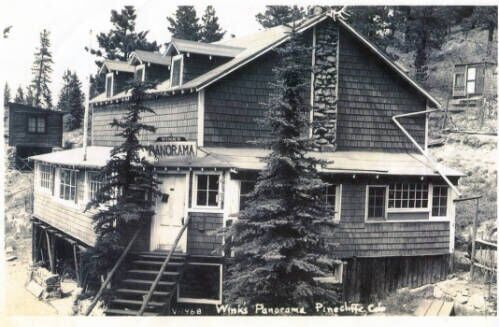
Winks Lodge, a gathering place for the resort community of Lincoln Hills.
Courtesy of Denver Public Library Special Collections


Winks Lodge, a gathering place for the resort community of Lincoln Hills.
According to the nomination form, “Wink’s permitted African Americans to enjoy themselves in a peaceful setting free of potential discrimination, with access to hiking, trout fishing, wildlife viewing, horseback riding and relaxation.”
Along with two new national historic landmarks, Colorado also has a pair of new national natural landmarks, both in Glenwood Springs.
Wednesday’s announcement added Glenwood Caverns and Iron Mountain Hot Springs to a list of 602 other sites “that contain outstanding biological and geological resources, bringing illustrative character, rarity, diversity and value to science and education.”
Interior recognized Glenwood Caverns and Iron Mountain Hot Springs for “beautiful cave formations” and “habitat for a variety of species, including eight native and fully cave-adapted animals.”