







Aurora sign specialist takes pride in resident navigation, making people happy

City of Aurora sign marking specialist Kebede Haile carefully cleans and lays the face of a sign down onto its aluminum blank before taking it to a rolling press on Tuesday, Jan. 9, 2024, at the Aurora Streets Department building in Aurora, Colo.(Timothy Hurst/Denver Gazette)
Timothy Hurst/Denver Gazette
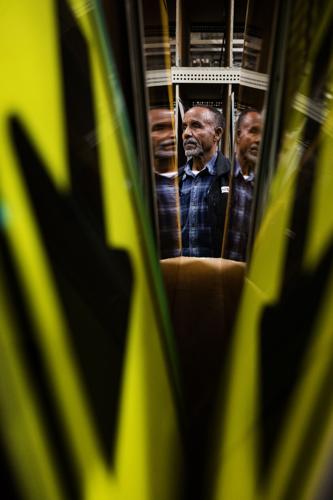
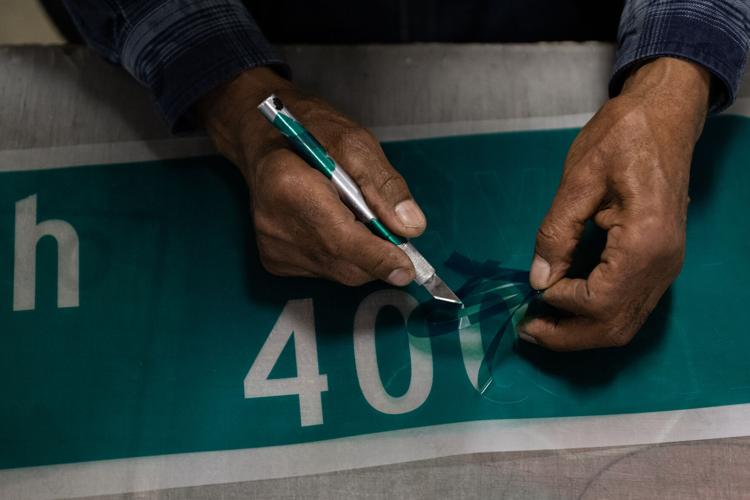
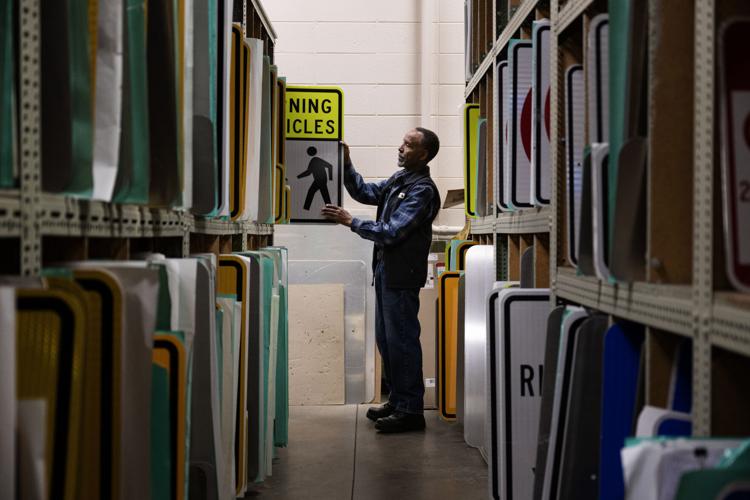

Kebede Haile knows the location of pretty much every street sign in the city of Aurora. All 2,756 of them.
The Ethiopian immigrant is one of five people who make and fix about 90% of the city’s street signs.
While most drivers pay attention to what street signs say for the sake of navigation, Haile pays attention to letter spacing, size and readability of the signs.
When Haile drives in other jurisdictions outside the city of Aurora, he can be pretty judgmental of sign design, he said. Haile is passionate about his job and ensuring signs create a safe driving environment, so he keys into signage that doesn’t comply with best practices.
Haile works in Aurora’s sign shop, where he spends his work time creating the signs that tell drivers speed limits, road names, road conditions and a variety of other things.
When he isn’t in the workshop making signs, he’s out responding to calls about sign damage.
When Aurora’s signs are knocked down, broken or graffitied, Haile and his team are immediately out fixing them, he said, pointing to the 2,000 completed signs stacked on shelves in the sign shop ready to go up to replace damaged ones.
“I change a lot of signs because Aurora has a good appreciation for (sign quality),” Haile said. “Not to exaggerate ourselves, but we do a really good job in the city.”
Haile takes pride in the quality of his signs and maintaining them. As soon as he gets a call, he goes out to fix it the same day. He works for the people of Aurora and prides himself on ensuring they know where to go.
“If you work for the people, you have to make good things for the people,” Haile said.
His work ethic and pride in his work comes partially from his grandfather, he said.
“I take advice from my grandpa, who always told me ‘Don’t save work,'” Haile said. “If you save work, you’re making work more difficult for you tomorrow. Once you start doing something, try to finish up.”
Aurora has 2,756 street name signs, Haile said. In a day on his own, Haile said he can make about 60 to 70 signs.
Before coming to Aurora, Haile was born in Ethiopia and lived in several other countries, including Italy, Ukraine, Russia, Israel and Kuwait.
Throughout his life, he’s done architecture, house planning, road construction and a variety of other jobs.
He landed in the United States in 1999 and started working for the city in 2001.
Part of what Haile loves about his job is the free workout, he said. Instead of paying for a gym, he gets paid to go all over the city and move his body every day.
Haile follows guidelines from the U.S. Department of Transportation and the Federal Highway Administration in making signs, ensuring the lettering is spaced correctly so drivers can read it. The faster the speed limit, the larger and more spaced out the lettering has to be, he explained.
They also have to think about sign size compared to wind pressure and other factors, deciding where to put holes in the signs and how many poles they need to mount the signs to lessen environmental impacts.
A well-made sign will generally last about 12 to 15 years before needing replacement, he said.
Even though Haile has worked on signs for years and knows the process like the back of his hand, he still can’t go into autopilot while making them, he said.
“I have to focus on what I’m doing and double check before I put them up because I can’t make a spelling mistake,” Haile said, mentioning signs he’s seen in other places on which ‘STOP’ was spelled ‘S-O-T-P’ and mountain was spelled ‘m-a-u-t-i-n.’
Jon Purnell, the traffic signs and markings supervisor, has worked for the city for 17 years and with Haile that entire time.
In his time with the sign shop, Purnell and Haile have seen sign technology change as traffic has.
“People’s mentality is changing, accidents are rising … people are too busy doing everything but driving,” Purnell said.
With traffic changes come signage changes, such as the creation of flashing stop signs and other technology designed to capture peoples’ attention, he said.
The hardest part of Purnell’s job is working with the public, he said. But it’s also his favorite part. As a people person, Purnell loves the part of the job that allows him to interact with residents. He still gets his fair share of complaints and disgruntled people.
“It’s been interesting and it’s been challenging,” Purnell said. “We’re just trying to make it safe for people, that’s all. Patience is all we ask.”
While some people do complain, there are also a lot of people who show appreciation for their work, Haile said. Hearing people say thank you for replacing a broken sign makes him happy.
“We work for the public and when we serve them, we have to do a good job,” Haile said. “It makes me feel happy to get appreciation. If they like it, that makes me happy.”