







Report shows 30,000 in metro Denver accessed homeless services in 2023 | ANALYSIS

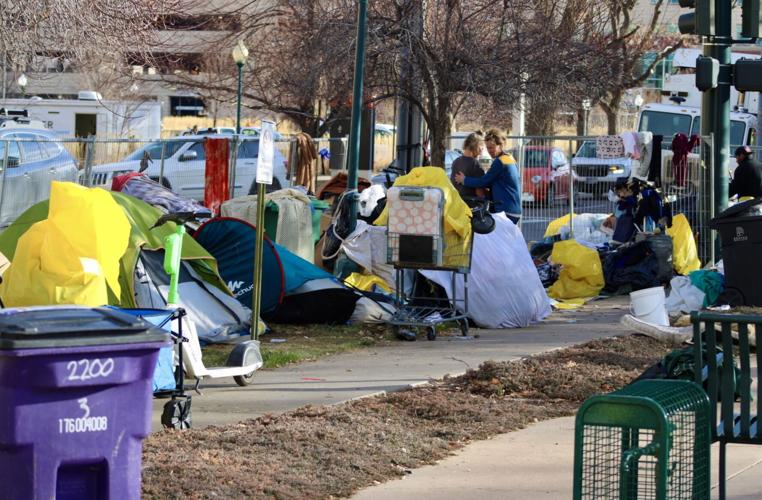
FILE PHOTO: A homeless people encampment located at Champa and 20th streets in downtown Denver.
Noah Festenstein/Denver Gazette


A new, wide-ranging report painted a complicated, incessant and sorrowful picture of homelessness in metro Denver, a crisis that has soared in recent years and which is costing taxpayers hundreds of millions of dollars each year.
The report suggested that tens of thousands more homeless people resided in metro Denver than an annual count showed and the self-reported causes of the crisis point to deeper problems that a having a shelter per se won’t necessarily resolve.
Despite the dispiriting numbers, the report offered some nuggets of good news — notably a 16% reduction in homelessness among veterans — and its authors remain optimistic, noting the work by a network of groups and individuals to try and help homeless people get back up on their feet.
The 2023 report from the Metro Denver Homelessness Initiative also described a homeless population that is struggling with mental and chronic health and, more notably, substance abuse challenges that, at least in Denver, aren’t necessarily the primary focus of the Johnston administration. The Denver mayor has embraced a “housing first” approach, which emanates from the belief that an individual’s most acute need is housing and, therefore, the solution is to get the person off the streets first and offer other services, such as mental health treatment, later.
The results of this year’s annual point-in-time count — conducted last week, with the data released in the summer — will help establish the extent of Johnston’s success in curbing homelessness in his city, which has earmarked roughly $250 million year in 2023 and 2024 to homelessness and housing initiatives.
30,409
The Metro Denver Homelessness Initiative report — which synthesized four data sources and thereby offered the most comprehensive look at the crisis — showed that while last year’s annual point in time survey counted 9,065 homeless people, 30,409 actually accessed services or housing with partner agencies.
“The number in our report is a unique count of individuals who were served during the period and all those individuals met the definition of homelessness during that time period,” said Kyla Moe, the deputy director of the MDHI, which is the regional body that coordinates housing and services funding for homeless people.
Indeed, the report noted that homelessness is not limited to the “visibly” homeless and an “entire subset” — of children, families, young people, others — remained “invisible.” In fact, the authors said three in four people who were homeless were in emergency shelters, transitional housing or other indoor situations and they were, therefore, “unseen.”
Moe told The Denver Gazette the services they get from a homeless provider generally refers to employment, treatment, housing referrals, food pantries and overnight housing.
Who are the homeless people?
The MDHI report provided a demographic breakdown of the region’s homeless population.
Not surprisingly, the vast majority are male (64%) and between the ages of 25 and 54.
Only a third are “chronically” homeless. Most (45%) became homeless for the first time.
The MDHI report drew data from several places, including the point in time (PIT) count, an annual survey conducted nationwide to provide a single night’s snapshot of homelessness in America.
Last year’s PIT count yielded several insights into the conditions homeless people face, which the MDHI report outlined.
Notably, they faced chronic health conditions (24%), mental health concerns (31%), domestic violence (11%) and substance abuse (24%).
That a quarter of homeless people suffer from drug addiction is tragically illuminating in light of the fatal overdose report for 2023. The overdose crisis has, in particular, hammered Denver’s homeless population, who made up 38% of the overdose deaths last year.
One key information out of Denver’s homeless dashboard last year revealed how wide the gulf is that local governments and providers must bridge: Out of roughly 600 homeless people who moved into temporary shelters upon the urging of Denver officials following encampment sweeps, only one left for an outside treatment program.
Causes
The MDHI report’s authors noted that homelessness has many causes and insisted that “continuing to blame the individual rather than the system will not solve homelessness in its current state nor prevent it in the future.”
“People are not choosing to become homeless,” the authors said.
The authors also maintained that housing is “the solution to homelessness.”
Two sets of data that the MDHI report analyzed showed that among the biggest factors that contributed to homelessness is “relationship problems or family breakup.”
“When coupled with rising rents and low wages, it becomes increasingly difficult for people to secure stable housing in one of the most expensive metro areas in the country,” the report said.
Under the PIT data, homeless people cited alcohol or substance abuse problems as another major contributor, along with losing job or failing to find work, being asked to leave or evicted or being unable to pay rent or mortgage.
Other advocates argued that drug addition is so interwoven into the homeless crisis that, unless local governments and providers make solving it the big priority, all other strategies are bound to fail. Indeed, they also said that so long as local governments and homeless providers do not require some level of personal responsibility and accountability in their strategies, the hundreds of millions of dollars in spending won’t solve the crisis.
“Johnston is going to be scratching his head as to why homelessness isn’t gone in four years,” Tom Wolf, who roamed the streets of San Francisco for five years as a homeless person struggling with heroin and fentanyl addiction, said last year. Wolf had visited Denver and appeared at a virtual town hall hosted by The Denver Gazette and Colorado Politics.
Today, Wolf, who serves as director of West Coast initiatives for the Foundation For Drug Policy Solutions, said he prefers an all-of-the-above strategy to tackling homelessness, but Denver and other cities in Colorado must deliberately move away from a strategy with a heavy — and often sole emphasis — on treating homelessness as primarily an economic issue, in which the underlying cause is the lack of housing and the solution, thereby, is more housing.
“On paper, ‘housing first’ sounds like a great idea. And if implemented to perfection, it could work. And I mean perfection — it has to be the perfect scenario,” he said, adding the problem is that any implementation of the strategy, of any strategy, would be far from perfect.