







CU Boulder Engineering student club prepares for national competition
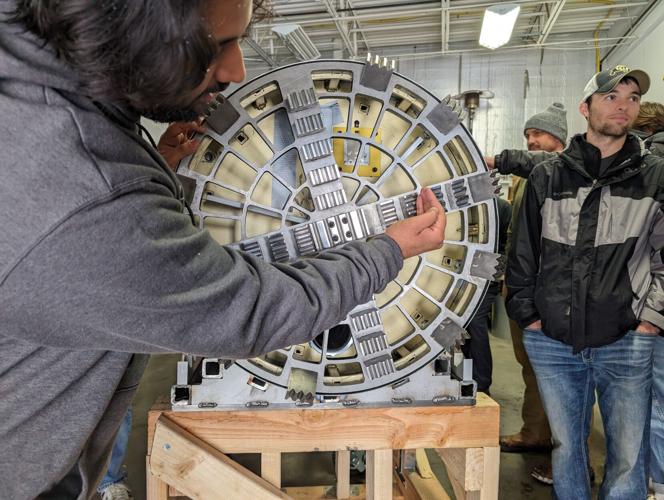
CU Boulder Engineering senior Ferin Von Reich shows off the boring end of the team's tunnel-boring robot in a workshop on Saturday. Despite heavy snow and ice, the 25 teammates met to explain their work for the upcoming competition.
Sage Kelley [email protected]
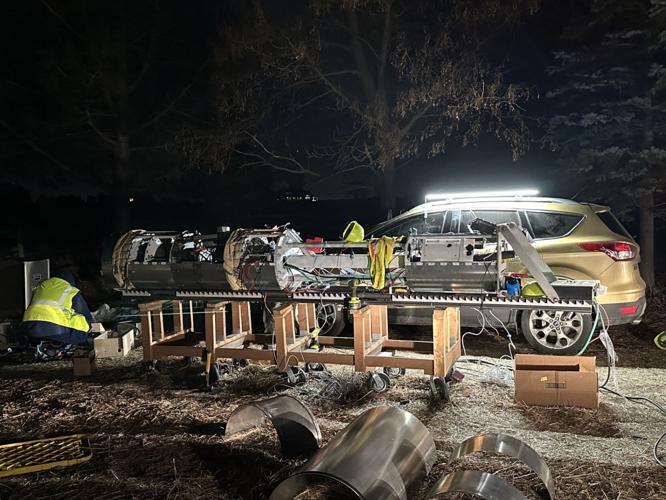
In a small unit outside of Lafayette, around 25 CU Boulder Engineering students tinkered Saturday with the potential future of transportation — along with their personal futures.
The CU Hyperloop team, made up of CU students of all ages and majors, are preparing their 2,000-some-odd-pound tunnel-boring robot for Elon Musk’s The Boring Company’s international “Not-a-Boring Competition” in Bastrop, Texas, in March. One of five finalists in the 2023 competition, the group is working feverishly to perfect this year’s machine.
The Boring Company, founded in 2016, sparked the idea of creating Hyperloop tunnels that would lead to high-speed transportation underground. Over seven years, the company has created only 2.4 miles of operational tunnels, according to Fortune. A less-than-impressive outcome.
The digging process is arduous and expensive — leading to the initial Hyperloop Pod Competition by Musk’s SpaceX from 2015 to 2019, and the now the Boring Competition that sees student-led groups pining for new solutions.
“The idea of tunneling has been around a long time,” Ferin Von Reich, project manager and senior at CU Boulder, said. “The goal of the competition is to make tunneling faster and cheaper. In the industry, with the state of tunneling right now, if you go as fast as a snail, you are at lightning speed… We’re all trying to get to snail speed. No one can get there, yet.”
The competition involves testing programming and software. Once the tunnel boring machine is approved for testing, it competes in two races. One race involves which can dig the farthest in the shortest amount of time, the other involves a race to 100 feet.
CU Hyperloop was started in 2017. This year marks their third year in the boring competition. In 2023, they placed third due to their programming ideas. Unfortunately, they were unable to compete in the tunnel races due to an electrical fire, driving the commitment for the team to one-up their machine in 2024.
“The buy-in has gotten stronger. When I started, we met maybe once a week. Now, someone is doing something seven days a week,” Von Reich said.
In 2023, the team was tinkering tech all the way to the competition. This year, they were ready to start digging in January.
“We optimize for iteration. We’re always trying to improve the machine and make it better,” he added. “We tested over winter break. We found a bunch of different stuff that we can make better, more efficient.”
More than boring
The CU Hyperloop group is made up of five student “teams,” focusing on structures, circuits, propulsion, software and business. They work together to create every part of the machine, from mechanical construction to circuit boards.
The students work for free while working to garner funding from sponsors.
“We’re up against teams with hundreds of thousands of dollars in funding. We’re just cold calling companies, trying to get funding and getting whatever outreach we can,” freshman Matis Uhl said.
But the dedication and work about more than just potentially winning the competition. To these students, it’s about building their own future.
“To think about what we’re doing, obviously for free, just to learn and be a part of it, is really cool,” Uhl said. “It’s great to see the people that are motivated. I was amazed by what people were willing to spend their time doing — how smart and committed people are for something that’s just for fun.”
“As a student club, this is entirely engineering experience. It’s probably the best experience you can get,” Von Reich added, noting that multiple students already have jobs lined up at startup engineering firms and other businesses.
They both pointed toward the learning and communal environment. Every student brings about new ideas and techniques, and they all learn from them, bolstering their abilities as engineers.
“For example, you can come in and learn how to weld, if you want. Everyone is helpful and willing to teach you,” Uhl said. “I think building your resume with the competition is a big factor, but if you took it away, people would still be here just to work on something that hasn’t been done before.”
And with a 2,000-pound hulking mass of student innovation marking the determination of CU’s youth in building a brighter, faster tomorrow, that hard work has already paid off — regardless of competition success.