







Moffat Tunnel wastewater spill highlights rail safety issues for state, local leaders
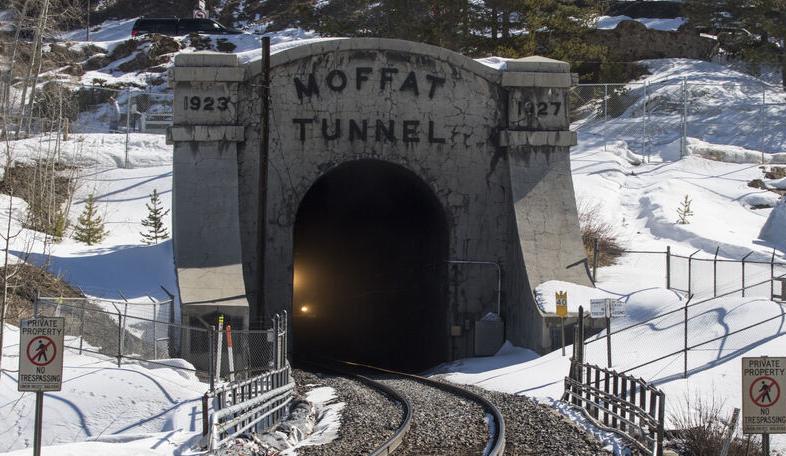
iStock. The train tracks leading to the historical Moffat Tunnel, which cuts through the Continental Divide. A train is inside the tunnel.
JuliScalzi via iStock
As Colorado lawmakers this month prepare to do something that Congress has been incapable of for more than a year — debate meaningful rail-safety legislation — Union Pacific, state regulators and officials in Grand County are debating tough questions about a massive wastewater spill last summer into the Fraser River near the state-owned Moffat Tunnel.
In December, the Colorado Department of Public Health and Environment’s Water Quality and Control Division issued a notice of violation and a cease-and-desist to railroad giant Union Pacific for allowing “400,000 gallons of untreated groundwater and industrial wastewater from the Moffat Tunnel to bypass treatment and discharge directly into the Fraser River.”
A spokesman for CDPHE said fines are still forthcoming for the railroad in the little-publicized July incident.
The spill was reportedly caused by a power surge and then failure at a Union Pacific Railroad wastewater treatment facility at the west end of the 6.2-mile tunnel near the town of Winter Park at 10:25 p.m. on July 28, 2023. It lasted until noon on July 30, dumping wastewater into the critical high-altitude tributary of the Colorado River.
The railroad, which is negotiating with the state to renew its lease to run trains through the Moffat Tunnel — a $12,000-a-year, 99-year deal that expires on Jan. 6, 2025 — has a history of wastewater violations connected to the state-owned tunnel. Union Pacific, which owns the Central Corridor rail line through the tunnel, was compelled to build wastewater treatment facilities in 2017 after the CDPHE cited and fined the company for numerous incidents dating back to 2012.
Katherine Morris, water quality manager for Grand County, where the spill occurred, said she was notified of the incident on July 31. She was asked if letting an entire weekend elapse before notifying local officials was adequate given the nature of what was discharged into the local water supply.
“Those are two separate questions. Is that an adequate amount of time? If this was really a big deal, no, it’s not,” Morris said in a phone interview. “That’s a huge disconnect always, but part of that is the railroad didn’t report that in time. So, there’s the railroad, but then there’s CDPHE, and both of them introduced lags, so it’s very imperfect. But given what was released, yes, it’s fine.”
Morris went on to explain that the wastewater treatment facilities were installed after annual or semiannual cleanings of the tunnel caused “accumulated soot and also probably drippings from all of the diesel fuels” to run in a black stream directly into the river back in the mid- to late 2010s.
What was discharged in July from the 24/7 treatment facility were “metals and little bits and pieces of minerals,” such as naturally occurring uranium deposits, that are shaken out of the tunnel walls when trains pass through and agitate the bedrock.
“So the water that’s coming from the tunnel, just regular groundwater discharge, just gets routed to the river, and I’m not going to make a big stink out of that,” Morris said when asked if she felt the public should have been notified in July. “I sure don’t feel that I would. All the metals and the TSS (total suspended solids), that’s all aquatic-life concern, and it’s chronic, not acute, so it’s not going cause a massive die-off.”
However, Rich Newton, board member of the Colorado River Headwaters Chapter of Trout Unlimited and a resident of the nearby, downriver town of Granby, was less sanguine, saying the incident perfectly underscores the need for better rail safety and local notification laws.
“This discharge in July highlights the critical need for stronger rail safety laws and immediate notification of spills, incidents and discharges,” Newton wrote in an email. “The Colorado, Fraser and other waterways are at risk as more trains move billions of gallons of oil along our rivers. Towns in Grand County get their drinking water from these rivers. Farmers and ranchers use river water for crops and livestock. We in Grand County depend on the health and vitality of our rivers, streams and aquatic life for our livelihoods. We must have stronger rail safety laws that include strong provisions for immediate notification of all incidents.”
Pressed on whether the state, currently debating rail regulations in House Bill 1030 (rail safety requirements), should insist on faster, more stringent notifications for accidents, spills and other safety issues, Morris said, “I sure would hope so. I would love it if the railroad would reach out to us directly, but they’ve got their protocols.”
Union Pacific spokesperson Robynn Tysver, in an email, wrote: “Union Pacific takes our environmental stewardship seriously, and we have taken steps to ensure a robust backup power source is in place in the event of future power outages, which contributed to last summer’s incident. We also will fully comply with the Colorado Department of Public Health and Environment’s order.”
The Arizona-based environmental group Center for Biological Diversity, which has an office in Denver, points to the Moffat Tunnel spill as yet another reason to oppose the proposed Uinta Basin Railway in Utah that would dramatically increase oil train traffic along the Colorado River, through the Moffat Tunnel and down into the Denver metropolitan area.
“The state of Utah and oil drillers are spending tens of millions to shove nearly 5 billion gallons of toxic crude oil a year on rails through Colorado and along the Colorado River,” an attorney for the group wrote in an email. “That’s why we need stronger rail safety laws, state and federal. Our communities, our streams, our safety are at risk.”
The Center for Biological Diversity was one of several environmental groups that joined Eagle County in successfully suing the U.S. Surface Transportation Board over its approval of the controversial Uinta Basin Railway, requiring the federal agency to send proponents back to the drawing board to much more extensively review the downline environmental impacts of the huge increase in oil trains, including the potential for toxic spills into the sensitive headwaters of the Colorado River.
After the U.S. Forest Service recently withdrew its approval for the Utah oil-train project, proponents are now seeking more public funding to move forward in the courts while also pursuing alternate rail loading expansions to increase trucking of the oil.
Colorado public health officials said of the discharge into the Fraser River that occurred in July:
“The division is evaluating Union Pacific’s responses and their plan to prevent future occurrences. Union Pacific submitted the information on Jan. 10, 2024,” CDPHE Water Quality Control Division spokesperson John Michael said in an email, adding fines are coming.
Colorado state Sen. Kevin Priola, an Adams County Democrat, a co-sponsor of the rail safety bill, said: “Being familiar with a lot of the news stories and public concerns about public safety, as well as growing up and living around a number of train crossings and seeing firsthand how over the years they’ve just grown exponentially longer and longer, that creates a lot of problems for people trying to commute.”
The Colorado Rail Safety Requirements bill, if passed as written, would “limit the maximum length of trains operating in the state, require the use of wayside detector systems, limit the amount of time a train can obstruct public travel at certain crossings, authorize a crew member’s designated union representative to investigate certain reported incidents, authorize the Public Utilities Commission to impose fines for certain violations, require fine revenue to be paid to the Front Range Passenger Rail district for the purposes of maintaining and improving the safety of [that] system, and require certain railroads to carry insurance coverage in minimum amounts.”
And Priola is a sponsor of Senate Bill 32, designed to incentivize increased use of public transportation around the state, including by train, and cleared the Senate Transportation and Energy Committee on Monday.