







Denver decides against replacing Columbus, Carson monuments
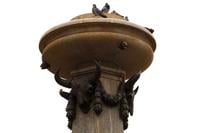
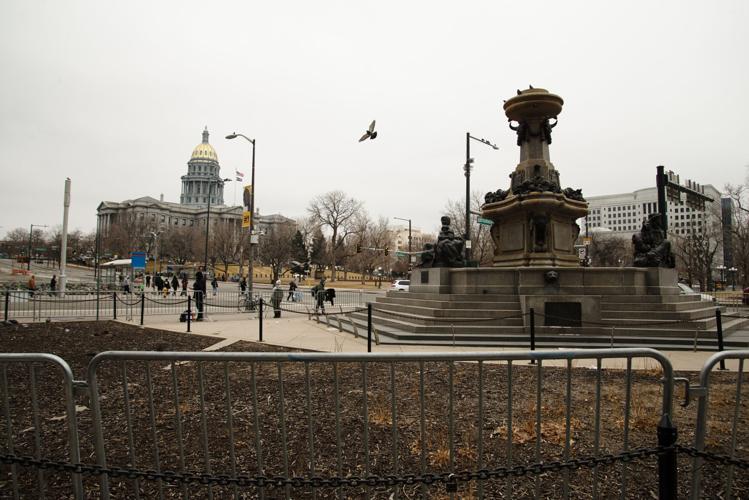
The immediate area surrounding Pioneer Monument remains sectioned off on Friday, Feb. 16, 2024.
Tom Hellauer/Denver Gazette
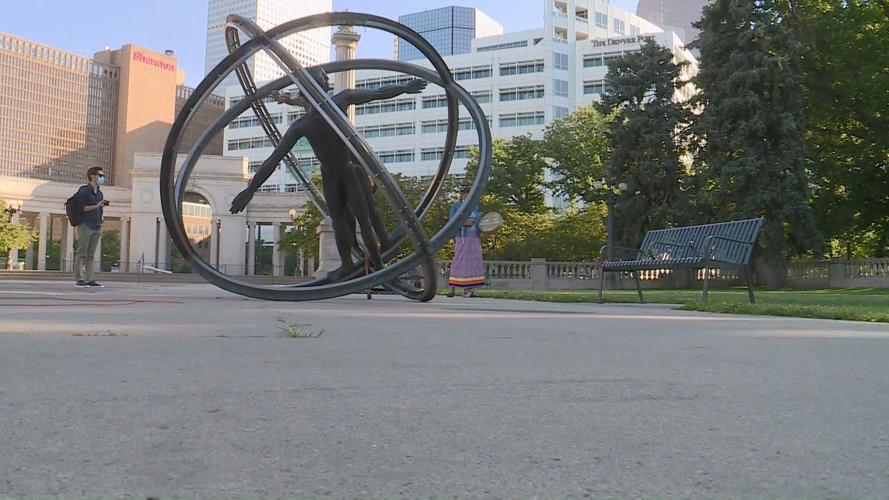
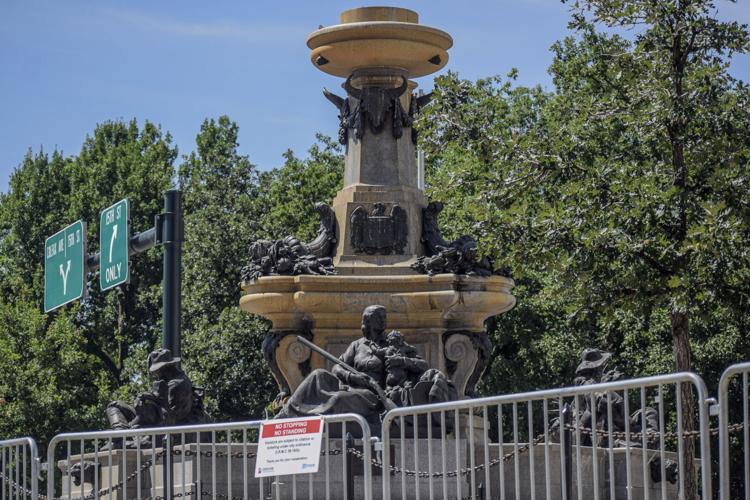
City of Denver officials have decided not to return to the Civic Center area a statue commemorating Christopher Columbus and another representing Kit Carson. The Columbus memorial was toppled and spray painted by protesters. The likeness of a buckskinned Carson, on a leaping horse, was removed shortly after that by the city to protect it — just in case it was next.
Both had a history of controversy throughout the years because “they are symbols of the colonizers and the destructive effects of colonization,” said Tarriana Navas-Nieves, the city’s director of cultural affairs for Denver Arts and Venues. She said that Denver’s past has a different story than cities in the South.
“We are not a city with Confederate statues,” but she noted that Colorado’s history of Western expansion has its own contentious stories.
“In our case, it’s tricky,” she said. “It’s not an easy road to navigate.”
The city sent out notices last week to various parties affected by the decision including the artists’ families, the Italian Commission and the American Indian Movement. Glenn Morris, who sits on AIM’s leadership counsel, said the decision is a “step in the right direction” and added that “the city has come to its senses about recognizing the destructive nature of those statues.”
The Kit Carson and Christopher Columbus statues are being kept in storage in an undisclosed location known only to a few people including Navas-Nieves, in order to keep them from potential damage.
Though the likeness of Carson is gone, the base of the dry fountain which surrounded it is still standing at the northwest corner of Colfax Avenue and Broadway. It is known as The Pioneer Monument.
The Columbus statue was not a likeness of Christopher Columbus, and instead was the modern sculpture of a four-sided human figure encircled in rings. But after it was donated, it honored the fact that Colorado was the first state to recognize Columbus Day as a holiday.
It was a gift to the city by Italian immigrant Alfred Adamo in 1970.
Today, there is only a grassy area where it once stood.
Navas-Nieves said that the Adamo family was disappointed about the decision not to reinstate the sculpture, but she acquiesced that Denver’s difficult choice was not going to make everyone happy.
“It’s important as a city to acknowledge the pain caused by memorializing these pieces,” she said.
Last year, The Andrew W. Mellon Foundation — a New York group which provides grants to support communities through the arts — chose 10 cities to receive $25 million. Denver received $2.3 million of that money, $500,000 of which will pay for an audit and a consultant to research each of at least 20 Civic Center monuments.
Besides the Kit Carson and Christopher Columbus statues, there are at least 20 monuments placed around Civic Center which Denver Arts and Venues will research including the Sea Lion Fountain at the north end of Civic Center Park, which was installed in 1922, a golden eagle, which is perched atop the Denver City and County building, and a bronze sculpture titled “On the War Trail,” also dedicated in 1922. It depicts a Native American riding bareback on a horse with a spear in his hand.
In the case of the Pioneer Monument, replacing old statues with new statues may not be the answer.
“Does the fountain remain? Do we find another sculpture for the top? Do people want to create an Native American sculpture or maybe the fountain needs to go,” Navas-Nieves said.
Morris wants to see the entire corner redeveloped because of its history.
“It was the end point of the Smoky Hill Trail,” he said.
The wagon road began in Leavenworth, Kan., and was used specifically for the gold rush to the Rocky Mountains, traveled by early settlers, and used to get supplies and the mail to Denver.
Before colonization, it was an ancient tribal trail which intersected favorite hunting grounds for the Plains Indians. There were many battles between Native Americans and pioneers along that east-west route.
To some, Carson was a brave frontiersman and trapper who floated between cultures — even marrying two Indigenous women, an Arapaho and a Cheyenne.
“Kit Carson was the most famous of the Indian Scouts and mountain men,” said University of Denver emeritus professor Tom Noel in an earlier interview. “He was a real service to the U.S. Government leading troops into battle.”
But to others, Carson was no hero.
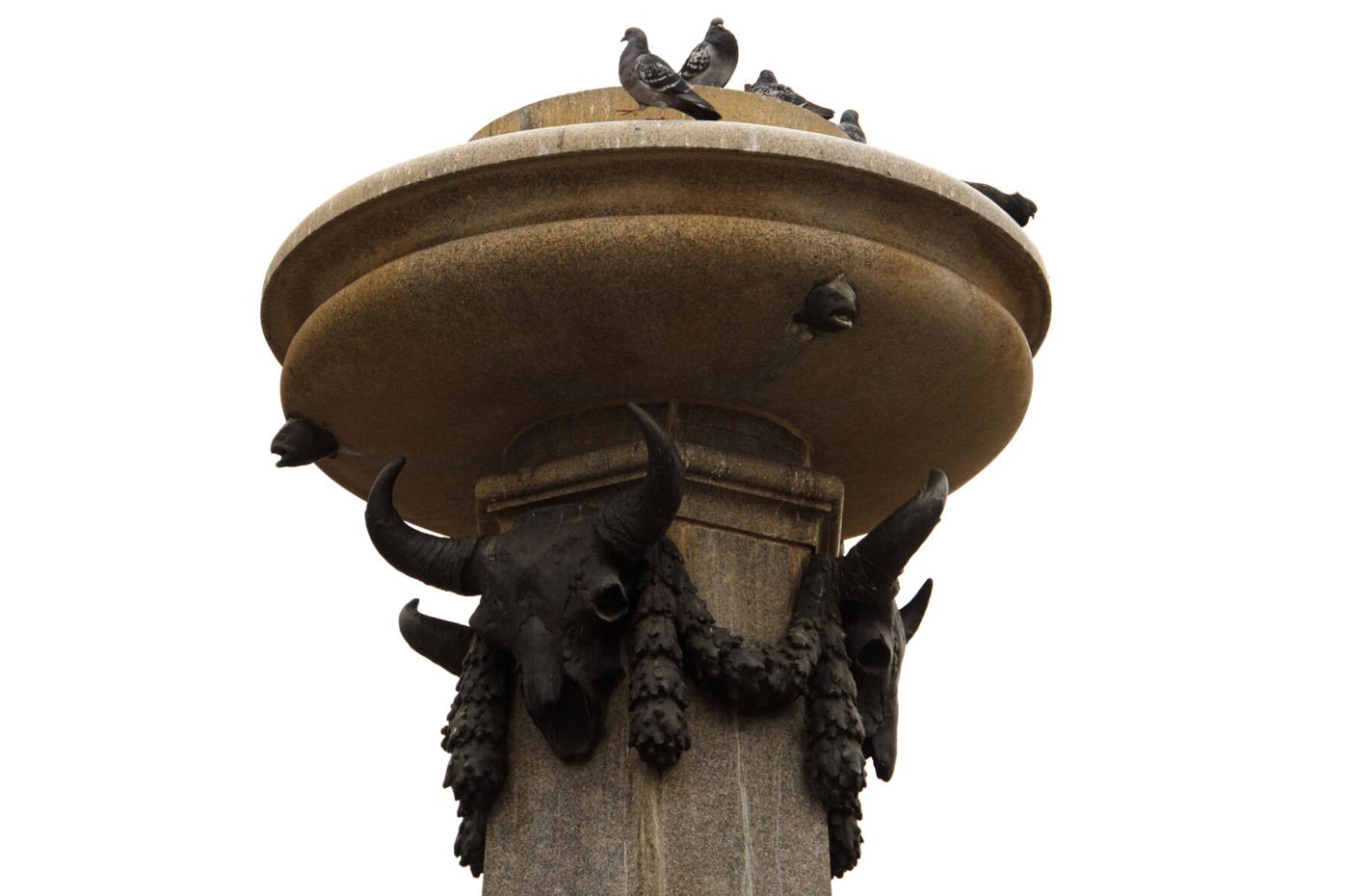
Pigeons perch atop the Pioneer Monument where a statue of frontiersman Kit Carson used to sit at the Northwest corner of Broadway and Colfax Avenue, Denver, and remains empty on Friday, Feb. 16, 2024 as officials still remain unsure of what to do with the fountain.
Tom Hellauer/Denver Gazette


Pigeons perch atop the Pioneer Monument where a statue of frontiersman Kit Carson used to sit at the Northwest corner of Broadway and Colfax Avenue, Denver, and remains empty on Friday, Feb. 16, 2024 as officials still remain unsure of what to do with the fountain.
In a letter to then-Mayor Michael Hancock in 2020 imploring him to take the Pioneer Monument down, AIM referred to Carson as an “Indian murderer.”
Morris and many tribal leaders said they feel pain when they see the base of the Pioneer Monument with its carvings of settlers armed with rifles.
“It depends on how you’re looking at the lens of history,” he said. “They’re either intrepid adventurers, but to another perspective they are invaders or colonizers.”
Jonathan Nelson, a Navajo (Dine’), an artist and member of the City of Denver’s American Indian Commission, said that the reassessment of monuments is a good start, but there’s a long way to go.
“I have to educate youth and other individuals that these memorials are not telling the whole truth,” he said. “Kit Carson was rounding up Navajos in 1864.”
Navas-Nievas knows the city must consider every voice in order to establish trust moving forward.
“How do we capture history in different ways other than a sculpture or memorial?,” she said. “What stories are we telling and whose voice hasn’t had a platform?”